





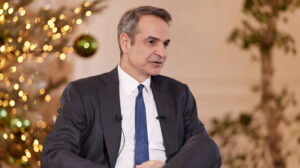
Prime Minister Kyriakos Mitsotakis spoke about the agricultural issue on Action24. The excerpt is from his interview with Athinaida Nega, broadcast on the channel’s news bulletin.
He said:
“There are some who want to talk with us, and there are others who, let me put it simply, are bullying them in a logic of keeping the front united. We want to find a solution to this issue, and the solution can only come through sincere dialogue and not through reactions whose supposed aim is to harm the government but ultimately just trouble society as a whole.
What I don’t understand, and I think most of society doesn’t either, is how, while protesting and taking fairly aggressive actions like blocking roads and troubling society, they don’t want to come and hear the government’s thoughts and proposals to address these critical issues in the primary sector.”
Translation into English:
29/12/2025 20:59
High prices and tax relief
At this point, he directly referred to high prices, noting that “the government cannot fail to see it” and that it is “the number one problem that citizens tell us they are facing,” adding that although it already existed in 2023, by now “the sense of accumulated high prices has taken hold.”
Mr. Mitsotakis linked tax relief policies to support for disposable income, saying that “citizens will begin to see increases in their real wages from January” and that “pensioners are already seeing this.” He also referred to measures for young people, using the phrase “you will not pay tax until you turn 25,” explaining that this is a response to concerns they express about starting out in life and the cost of living.
29/12/2025 20:53
We will be judged on consistency and on how we deal with high prices
Prime Minister Kyriakos Mitsotakis outlined two key criteria by which, as he said, citizens will evaluate the government, starting with consistency toward the commitments made in the last election.
As he noted, “the first thing that someone who trusted us 2.5 years ago should look at is whether we are consistent with what we said,” stressing that New Democracy was elected “with a specific agenda” and arguing that it is being implemented: “to improve wages—we are improving them,” “to invest heavily in the National Health System—significant changes are being made,” “to strengthen the Armed Forces—we are doing so.”
The prime minister posed as a central question whether the government is implementing the program on which it was elected and whether “we told the truth to citizens,” emphasizing: “I believe we are on a good path to delivering on our core commitments.” At the same time, he highlighted a second criterion: the ability to manage extraordinary situations, saying that citizens expect answers to the question “how do you handle emergencies?”
29/12/2025 20:52
Question about new parties and the Karystianou Party
Athinaida Nega raised the issue of the landscape of new political formations, saying that “we are waiting, we expect new parties,” and asked for a characterization of “those expected to be founded,” mentioning indicatively the “Karystianou Party.”
“It is strange for expectations to be measured without knowing the programmatic intentions of those concerned,” the prime minister said. He added that the discussion would make sense “when and if we have the realignments that some predict may occur in 2026.”
Asked by Athinaida Nega about a past remark that Alexis Tsipras could “burn out in the warm-up,” Mr. Mitsotakis replied that “I will not comment on that either,” adding that “these are festive days.” He stressed, however, that “the beauty of our democracy is that everyone has the opportunity to expose themselves to the judgment of citizens.”
The prime minister also pointed out that “saying you will form a party and actually forming one are very far apart,” noting that “at some point, someone will cross the Rubicon if they decide to make that choice.” He concluded by saying that he does not consider founding a party “a simple decision” and that he has learned “not to lose much sleep over issues that I can neither control nor influence, nor that ultimately concern me.”
29/12/2025 20:51
To enter politics, one must have held a real job
Referring to the hypothetical scenario of one of his children wanting to get involved in politics, Prime Minister Kyriakos Mitsotakis responded to a question by Athinaida Nega.
The prime minister stressed that “engaging in politics is not the only way to contribute,” noting that there are “many other ways to contribute to public life” without it being “mandatory for someone to enter politics.”
At the same time, he set prior work experience as a key criterion for anyone wishing to enter politics: “they must have done something before entering politics. They must have ‘paid social security contributions.’ They must have worked.” As he said, he does not consider it sufficient for someone to enter politics at the age of 25 “without understanding what it means to have a boss, what it means to clock in… to have deliverables, to make a living, to sweat it out,” describing this experience as “absolutely essential” for anyone who wants to engage in public affairs. He clarified that “the same obviously applies to my own children, if any of them ever choose to enter politics.”
29/12/2025 20:05
29/12/2025 19:57
“In elections, citizens decide whether to renew the government’s “contract””
Referring to the final judgment of governments, which in politics comes with elections, Prime Minister Mitsotakis emphasized that it is then that citizens decide “whether they want to renew our hiring contract or not.” He added: “They hired us for four years to do a job,” and in elections they judge “whether we should continue or someone else should do this job.”
He noted that at that moment, citizens “put things on a scale” and assess whether “the positives outweigh the negatives,” recognizing that negatives will always exist and that “the positives could be more.” The crucial question, as he posed it, is “which way the scale tips,” i.e., “whether the country is moving forward or backward.”
In the same context, he raised the issue of daily life, noting that despite “the undeniable problems of high prices,” citizens are called to judge if “their lives have ultimately improved” and if “they see a better future with one government or make another choice.”
29/12/2025 20:39
“Investment in defense is an investment in peace – No third party will guarantee our security”
Referring to 2026, he stated: “No, I am not worried, nor is there any reason for panic,” answering the possibility of war. He added that “we must not ignore the fact that our country has an obligation to be ready to handle any situation and any crisis.”
In this context, he linked government choices to strengthening deterrence, saying: “We are investing heavily in the combat readiness of our Armed Forces, in new defense systems, and in human resources.”
Mitsotakis emphasized: “We now live in different times,” and stated that “no one can guarantee our security; no third party will guarantee it,” stressing that “we ourselves must be strong enough to deter anyone who may threaten our sovereignty or sovereign rights.” He concluded: “Investment in defense is essentially an investment in peace, democracy, and prosperity” and is “a necessary prerequisite for citizens to sleep peacefully at night.” He also reminded: “And for citizens to sleep peacefully, some stay awake… the members of the Armed Forces and security services.”
29/12/2025 20:36
Reference to the war in Ukraine
Against the backdrop of the war in Ukraine, Prime Minister Mitsotakis emphasized: “We have a war in the European continent after 80 years,” and “the war in Ukraine has lasted four years, with hundreds of thousands of deaths,” noting that “we must not forget this.”
He described it as a conflict between “an aggressor and a defender,” where “one wants to change borders by force” and the other “tries to defend against these plans imposed by a stronger power.”
29/12/2025 20:35
“We do both” – Crisis management and reforms
Asked whether crisis management or reform dominated during the two government terms, Mitsotakis replied: “We do both,” adding that the outcome “will be judged by the citizens.”
He noted that the first four-year term “forced us to devote a lot of time to crisis management,” recalling that “five years ago at this time… the ‘Freedom’ operation began, the vaccination campaign,” and that the pandemic was “a huge economic, social, and psychological shock” that had to be addressed.
He also listed successive challenges over recent years: the refugee issue, issues with Turkey, the energy crisis, the war in Ukraine, and unrest in the Eastern Mediterranean. Entering 2026, he said: “We have every reason to see the glass half full,” but noted that the world is becoming more uncertain, making “rapid crisis response” crucial, as “unexpected events will constantly arise that must be managed.”
29/12/2025 20:34
Favorite book of 2025
In a lighter tone, Mitsotakis revealed his favorite book of 2025: “My favorite book of 2025 is the one I am reading now. It is very interesting. It won this year’s Booker Prize. It is called ‘Flesh.’ I am reading it in English; it has not yet been translated. It is extremely interesting.”
He also mentioned Alexis Patelis’ book, noting: “And I cannot help but praise it if I do not advertise Alexis Patelis’ book, ‘The Great Return,’ which describes, through the very insightful perspective of someone who has been by my side for the last five years, this great effort to restore Greece’s credibility and international image.”
Ask me anything
Explore related questions




