





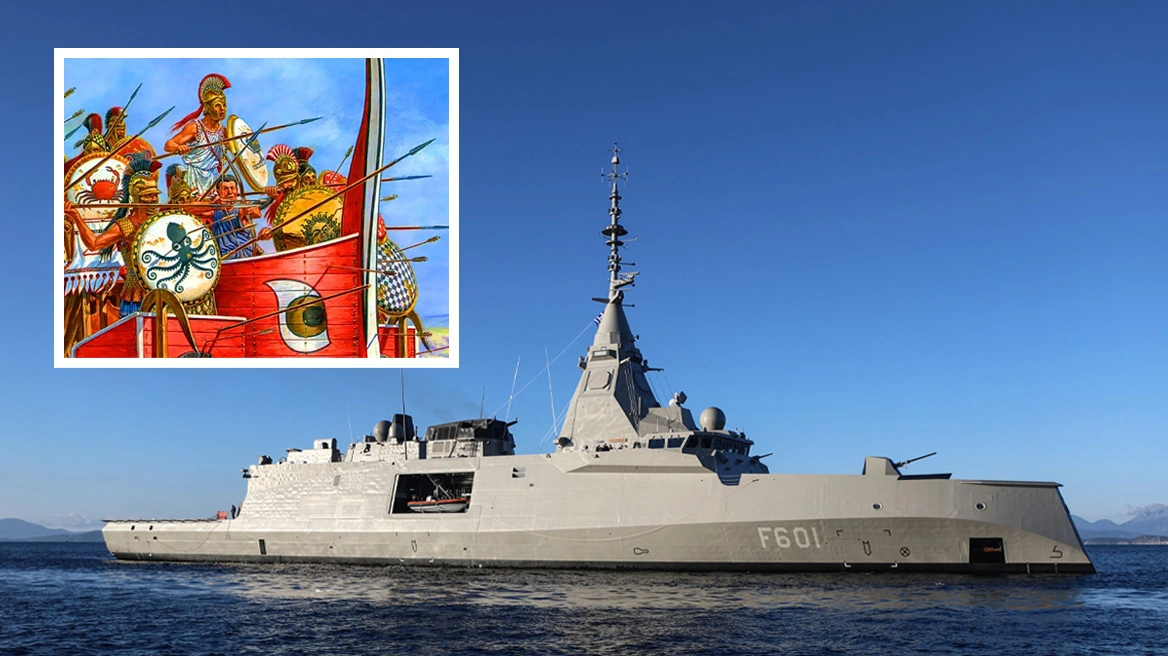
Almost 2,475 years after his death, Kimon (also spelled in English: “Cimon”) returns to Cyprus. This is, of course, the frigate that bears the name of the great ancient Athenian politician and military leader, who was the fear and terror of the Persians. The similarities end somewhere here, since Kimon lost his life in Cyprus fighting the Persians, whereas the newly built frigate sailing to the island is set to create an anti-missile and anti-drone defensive shield…
But how much do we really know about the underrated Kimon, one of the most important ancient Greeks? Kimon’s military abilities, born around 506 BC, became evident from the naval battle of Salamis (480 BC). When the Persians attacked Athens and Themistocles tried to persuade the people to abandon the city and countryside and board the ships to Salamis to fight at sea, many considered this endeavor reckless.
Then Kimon, first of all and followed by his friends, appeared at the Kerameikos, and together they went up to the Acropolis. There he dedicated a horse’s bridle to the goddess Athena, holding it in one hand, wishing to show that at that moment Athens did not need cavalrymen but sailors. And after dedicating the bridle, he took down and picked up a shield from the temple, and after praying to the goddess, he went down toward the sea, setting the example. Thus many others took courage as well. In the naval battle he proved “brilliant and brave” and soon won the affection of his fellow citizens, who gathered around him and urged him to think and act in a manner worthy of the battle at Marathon.
Within a short time (476 BC), Aristides, recognizing his abilities and wishing to sideline Themistocles, handed him the leadership of the aristocrats. Kimon was continuously elected general from 476 to 461 BC, and after the ostracism of Themistocles (471 BC), which was the result of Kimon’s own efforts, he dominated the political life of Athens.
Although a fervent patriot, Kimon sought the elevation of his city to a leading power, but not at the expense of Sparta, which he considered essential for the defense of Greek lands against Persian expansionist ambitions. The Spartans, for their part, also respected Kimon and did not hinder his efforts to make Athens a strong naval power. His action as commander-in-chief of the allied Greek forces began in 476 BC from Byzantium (on whose site, as is well known, Constantinople was later built). He liberated the Hellespont from the Persians and headed to the Thracian coasts where Persian garrisons were stationed. He besieged the city of Eion, on the Strymon River, which was held by Persians and troubled the Greeks of the surrounding areas. Initially, he defeated the Persians and confined them within the city. Then, after driving away the Thracians who lived above the Strymon and supplied the Persians of Eion with grain, he became master of the entire region and led the besieged into a dead end. The Persian general Boges set fire to Eion and burned together with the other Persians and their possessions. Although Kimon captured Eion, he did not benefit significantly, because most of its goods were burned along with the barbarians.
Nevertheless, the city was fertile and beautiful, and he handed it over to his fellow citizens to settle colonists there. It should be noted that Kimon was not only a great military leader but also an excellent politician. He gave the poor many opportunities for employment in public works, on warships, and in cleruchies, a measure he was the first to implement. The cleruchs, who retained all their rights as Athenian citizens, acquired fertile lands in various regions of Greece. Thus, they not only solved their livelihood problems but also served the interests of their city, Athens, by controlling the surrounding areas.
We return to Kimon’s triumph at Eion. This great success led the Demos to grant him permission to set up in the Agora of Athens the stone Herms with three epigrams (“…and the people allowed the stone Herms to be dedicated to him…”), as Plutarch writes. These epigrams, cited by the Boeotian historian, constituted the highest honor for Kimon, since neither Themistocles nor Miltiades were honored in a similar way. Indeed, when Kimon’s father requested an honorary olive wreath, Sophanes of Decelea spoke in the Assembly of the People and objected, expressing a view that showed ingratitude but found resonance among the citizens of Athens: “When, Miltiades, you fight alone and defeat the barbarians, then claim to be honored alone.” In 475 BC Kimon campaigned on Skyros. He expelled the Dolopes, who lived by piracy at sea, and settled Athenian cleruchs on the island to secure free navigation in the area.
Knowing that Theseus had been treacherously killed on Skyros, Kimon managed to discover his tomb. He placed the bones of the Athenian hero on his trireme and took care of all matters related to the transfer with reverence. Thus, the bones of Theseus were transported to Athens about 400 years after his death, as Plutarch writes, something that is probably inaccurate. The bones of Theseus were placed in the Theseion. In 474 BC Kimon campaigned against Karystos, which refused to join the Delian League, and in 472 BC forced it to capitulate and accept Athens’ terms. He had now become particularly popular in his city. In the ostracism of 471 BC he succeeded in having Themistocles ostracized. The democrats were completely weakened, and Kimon governed Athens unimpeded.
In 469 BC, after the secession of Naxos, Kimon sailed to the island, besieged it, and forced its inhabitants to return to the Delian League.
The Greek victory over the Persians at the Eurymedon
When Kimon learned that the Persians were anchored in Pamphylia, a coastal region of Asia Minor, he campaigned against them with 200 Athenian triremes and 100 allied ones (468 BC). The triremes had originally been built by Themistocles and were excellent in speed and maneuverability; however, Kimon modified them in width and enlarged their decks so that more hoplites could board and attack the enemy more effectively.
Ephorus mentions that the commander of the Persian fleet, consisting of 350 ships, was Tithraustes. Phanodemus raises the number of Persian ships to 600. The commander of the Persian infantry was Pherendates. Callisthenes reports that near the Eurymedon River, Ariomandes, son of Gobryas, the most important leader of the Persian force, was anchored with the fleet.
In the battle that took place at the mouth of the Eurymedon in 467 BC, the Greek forces crushed the Persians who threatened the Greek cities of Asia Minor and the islands of the Aegean Sea. Subsequently, in a fierce land battle with the Persian troops encamped nearby, the enemy infantry was routed, and the Persian camp, full of rich spoils, fell into Greek hands. Immediately afterward, Kimon surprised and destroyed 80 Phoenician ships that were coming to join the Persians.
By achieving two victories in one day, Kimon surpassed the victories at Salamis (480 BC) and Plataea (479 BC). Thucydides writes: “And after this there occurred both a land battle and a naval battle at the river Eurymedon between the Athenians and their allies against the Medes, and on the same day the Athenians under Kimon son of Miltiades won both, and they captured Phoenician triremes and destroyed them all, to the number of two hundred.”
After this impressive victory, the prestige of the League was strengthened, and many Greek cities of Caria, Lycia, and Ionia joined it. In the spring of 465 BC, Kimon sailed to the Thracian Chersonese and cleared out the remnants of Persian forces.
Athens now amassed great power and acquired the prestige of the protecting force of all Greece. Soon, however, some cities began to resent the high allied tribute and contemplated secession. In 465/4 BC Thasos seceded. Kimon campaigned against it and in 463/2 BC forced it to capitulate under very harsh terms.
Meanwhile, the Persians had signed a peace under which they were to stay away from the Greek sea (toward the interior of Asia) for as far as a horse could gallop in one day, and no Persian warship with a bronze ram was to sail west of the Cyanean Rocks and the Chelidonian Islands.
The exile of Kimon
Meanwhile in Athens the democrats became active and accused Kimon that after Thasos he avoided invading Macedon because he had been bribed by King Alexander I of Macedon. Among his accusers was the then-emerging Pericles. Kimon managed to be acquitted, but the democrats had become a formidable force.
In 464 BC a very strong earthquake struck Sparta, where Archidamus II, son of Zeuxidamus, was then king. As Vassilis Papazachos and Kostas Papazachos write in their book Earthquakes of Greece, the quake had a magnitude of 7 on the Richter scale. Only five houses in Sparta remained standing and 20,000 people were killed. Many fissures opened in the ground and landslides occurred on Mount Taygetus. The Helots seized the opportunity to revolt and, with the help of the Messenians, attacked the Spartans.
The Lacedaemonians sent Pericleidas to Athens requesting help. Indeed, Kimon succeeded in campaigning to Sparta with many hoplites. However, when in 462 BC the Spartans again summoned the Athenians against the Messenians at Ithome, they ultimately did not accept them and dismissed them. This was considered a huge insult to Athens and led to the dissolution of its alliance with Sparta, which had been signed in 481 BC.
This was also the reason why in 461 BC Kimon was exiled for ten years, accused of being “pro-Spartan and anti-people.”
Kimon returns to the forefront
In 457 BC, when the Lacedaemonians were returning from the operation to liberate Delphi from the Phocians and camped at Tanagra, the Athenians went out to confront them. Kimon came armed and enrolled in his tribe, the Oeneis, ready to fight. The Council of Five Hundred, however, did not allow him to do so, fearing that he would cause unrest in the army and lead the Lacedaemonians into the city. He then departed, asking Euthippus of Anaphlystus and his other friends to fight bravely against the enemy. They took Kimon’s armor and formed a unit of 100 men. All fought bravely and fell dead on the battlefield. The Athenians grieved their loss and regretted their behavior toward Kimon. In 453 BC, through the actions of Pericles, Kimon was recalled from exile on the condition that he would no longer engage in Athens’ internal affairs, which indeed occurred. In 451 BC he managed to sign a five-year truce with Sparta, and the following year (450 BC) he led yet another campaign against the Persians, this time in Cyprus, which unfortunately was also his last…
The campaign in Cyprus – The death of Kimon
With 200 Athenian triremes and probably another 100 allied ones, Kimon sailed to Cyprus in 450 BC. There the Persian admiral Artabazus was anchored with 300 triremes, while on the opposite coast of Cilicia Megabazus was encamped with 300,000 men.
While the fleet was ready to sail, Kimon had a dream. His seer friend Astyphilus of Posidonia, interpreting it, told Kimon that it “foretold” his death. Nevertheless, Kimon did not cancel the expedition. He sent 60 ships to Egypt, with the ultimate aim of dismantling the entire Persian state, and with the rest he defeated the Persian fleet, consisting of ships from Phoenicia and Cilicia. Thus, he became master of all the coastal regions opposite Cyprus. After capturing Marion, he besieged the strong Kition, but during the siege he fell ill or was wounded and shortly thereafter died (449 BC). Shortly before leaving this life, he ordered his officers to lift the siege and conceal his death from his men. This resulted in maintaining high morale among the soldiers, who a few days later defeated the Persians outside Salamis of Cyprus in both a naval and land battle, as Thucydides writes. From this double triumph came the phrase “even in death he was victorious.” His body was transported to Athens. His fellow citizens buried him with great honors in front of the Melitides Gates, near the tombs of his ancestors.
Kimon’s generosity and great works in Athens
From the spoils he gained from his victories over the Persians, Kimon built the southern wall of the Acropolis. He ensured that the Long Walls were securely founded, since their foundations were laid in marshy and swampy ground. With his own money, large quantities of gravel and boulders were placed in the marshes. He also cared for the beautification of the city by creating open spaces, planted many plane trees in the agora, and transformed the Academy of Athens from a dry and barren area into a grove full of water, adorned with clean paths and shady places for walking.
His generosity was astonishing. Let us see what Cornelius Nepos (100–31 BC) writes:
“For his kindness was so great that, although he owned farms and orchards in very many places, he never placed a guard over them to protect the crops, so that anyone who wished might freely take from his produce. Servants always accompanied him with money, so that if anyone was in need of his help, he would immediately have something to give, so as not to give the impression that by delay he would refuse. Often, when he saw someone struck by misfortune and poorly clothed, he would give him his own clothes. Every day he prepared his dinner in such a way that whoever he saw uninvited in the marketplace he would invite to join him, which he never failed to do daily. No one lacked his affection, no one his help, no one his property. He made many people rich; many poor people who had died without leaving burial expenses he buried at his own cost…”
We believe that Kimon is underrated by Greek history itself. He believed in the hegemony of Athens, but he wanted all Greeks to unite against the common enemy, the Persians. It is characteristic that he gave his three sons the names Lacedaemonius, Eleius, and Thessalus. He had become the fear and terror of the Persians, whom he crushed wherever he encountered them, even in offensive wars. Moreover, even when he was exiled he did not betray his homeland and did not side with the Persians. Certainly, Miltiades, Themistocles, Leonidas I, and Pausanias remained in history as legends, but we believe that next to them the name of Kimon also deserves to be written…
Sources: Plutarch, Parallel Lives, Kimon–Lucullus and Kimon in Cornelius Nepos, Zitros Editions. World Biographical Dictionary, vol. 4, Ekdotiki Athinon.
Ask me anything
Explore related questions




