





Military presence in the eastern Mediterranean is increasing following the strike at Akrotiri and amid fears of new drone attacks.
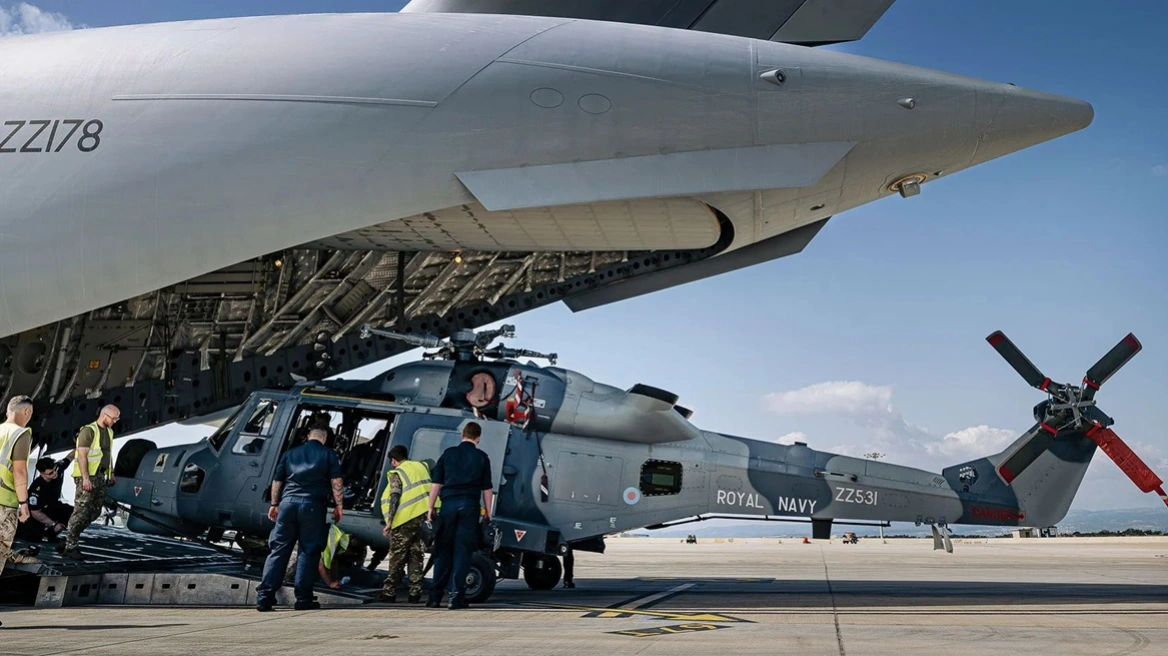
The situation around Cyprus is changing day by day, as European and British moves are now taking on a clearly operational character. As of this afternoon, two Wildcat helicopters are stationed at the British base in Akrotiri with the mission of countering unmanned aerial vehicles, while the expected arrival of the Italian frigate Federico Martinengo in the area has also been confirmed.
These two developments show that after what occurred at Akrotiri, the military fortification of the region is being strengthened in practice, not just in words. Cyprus may not be involved in offensive operations, but it now finds itself at the center of an expanded network of defense and surveillance.
At Akrotiri to counter drones
According to the information network of the British bases, the two Wildcats were deployed to Cyprus for missions aimed at neutralizing Iranian drones. This mission is considered unusual for these helicopters, but according to Commander Andrew Henderson, it falls fully within their operational capabilities.
As he explained, the Wildcat—considered one of the best maritime attack helicopters in the world—can carry up to 20 Martlet multi-purpose missiles. These missiles are laser-guided and can be directed from the cockpit, allowing them to be used to destroy unmanned aerial vehicles.
Their presence at Akrotiri is not simply a relocation of equipment. It represents an adaptation to the type of threat that has already appeared in the region. The British appear to be taking the possibility of new drone attacks seriously and are strengthening the base with assets capable of responding immediately.
The Federico Martinengo is also on its way
At the same time, a diplomatic source in Nicosia confirmed on Friday afternoon the expected arrival of the Italian frigate Federico Martinengo in Cyprus.
According to the same source, who spoke to the Cyprus News Agency, the frigate was southwest of Crete and was expected to reach Cyprus within the next 48 hours. An earlier announcement from the Italian side stated that the ship is being sent with at least 160 naval personnel, as part of a coordinated effort among Italy, Spain, France, and the Netherlands.
This mission shows that European mobilization around Cyprus is not limited to diplomatic assurances. It is now taking the form of a real naval presence aimed at strengthening security in the eastern Mediterranean.
A ship with real operational capability
The Federico Martinengo (F 596) is a Carlo Bergamini-class frigate of the Italian Navy and part of the FREMM multi-purpose frigate program. It is not a vessel sent merely for symbolic presence but a unit with clear operational capability.
Just last year it completed participation in the European mission EUNAVFOR Aspides in the Red Sea, which focused on protecting commercial ships from attacks by the Houthis. This means the frigate heading toward Cyprus has recent experience operating in a real threat environment.
Cyprus at the center of deterrence
The combined presence of British helicopters on anti-drone missions and the approach of the Italian frigate reflects the new reality. Cyprus is not part of offensive operations, but because of its geography, bases, and the international situation, it now sits on the map of regional deterrence.
This explains why the area is filling with military assets from European countries. The message is clear: there is growing concern about new attacks, there is a need for surveillance and protection, and for that reason the eastern Mediterranean is becoming increasingly militarized.
These are not theoretical assessments or symbolic gestures. They are operational decisions taken because the risks are considered real.
Ask me anything
Explore related questions




