





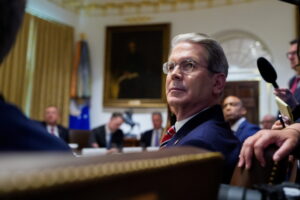
The U.S. government is allowing Iranian oil tankers to pass through the Strait of Hormuz, despite tensions in the Persian Gulf, in order to ensure sufficient supply to the global energy market, U.S. Treasury Secretary Scott Bessent said on Monday in an interview with CNBC.
Bessent stated that Iranian oil transport vessels have already begun departing from the region and that the United States is not intervening in their transit.
“Iranian ships are already leaving and we have allowed them to do so so that the rest of the global market continues to be supplied,” he said.
The movement of tankers through the Strait of Hormuz has dropped sharply in recent days, as Iran has been carrying out attacks against commercial vessels in the Persian Gulf. Despite the strong presence of the U.S. Navy in the region, Tehran continues to export millions of barrels of oil through this narrow maritime route.
According to Bessent, the Trump administration believes that ship traffic in the strait—which connects the Persian Gulf to international markets—will gradually begin to increase before U.S. and allied naval forces step in to escort commercial vessels.
“We believe there will be a natural opening left by the Iranians and for now that is acceptable. We want the global market to remain adequately supplied,” the U.S. Treasury Secretary noted.
Possible postponement of the Trump–Xi meeting
The U.S. Treasury Secretary also said that a meeting between U.S. President Donald Trump and Chinese leader Xi Jinping may be postponed for organizational reasons.
Trump had suggested on Sunday that the summit could be delayed, as the United States pressures China to help reopen the Strait of Hormuz. On Monday, Bessent attempted to soften that interpretation, arguing that any postponement would mainly be related to logistical issues.
“If there is a delay in the meeting, it will not be because the president demanded that China take responsibility for security in the Strait of Hormuz,” Bessent said.
Ask me anything
Explore related questions




