





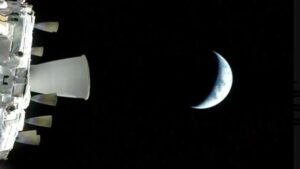
The Orion spacecraft and the crew of the Artemis II mission are now on their way to the Moon, following the successful completion of the critical trans-lunar injection burn, which placed them on a path beyond Earth’s orbit. NASA’s mission control center in Houston confirmed that the maneuver was carried out as planned, allowing the mission to proceed smoothly.
Confirmation from Houston of successful burn
Mission officials announced that the process was completed successfully, paving the way for the next phase of the journey to the Moon. The trans-lunar injection burn is the key step that allows Orion to leave Earth’s orbit and move onto a trajectory around the Moon.
The successful completion of the maneuver confirms that the mission is progressing according to NASA’s plan, with no technical issues reported.
Beyond any previous crewed journey
The mission crew is expected to reach the far side of the Moon on Monday, April 6. Although no landing is planned, the astronauts will have the opportunity to witness a view never seen by humans from such a distance.
The mission is a significant step in humanity’s return to the Moon and is part of a broader plan for future crewed missions.
The importance of communications in deep space
One of the key risks of the mission is the potential loss of communication with mission control and Earth.
“Reliable communications are the lifeline of crewed spaceflight,” said Kevin Coggins, deputy associate administrator of NASA’s communications and navigation program.
While Orion is in Earth orbit, it uses the Near Space Network, a system of around 40 satellites operated by governments and private organizations, covering the Atlantic, Pacific, and Indian Oceans.
As the spacecraft heads toward the Moon, the crew will use the Deep Space Network, a system of giant radio antennas located in California, Spain, and Australia.
The hatch is now closed.
— NASA (@NASA) April 1, 2026
The Artemis II astronauts are now strapped into their seats and ready for launch. pic.twitter.com/NWSjgklep9
Planned 41-minute communication blackout
During its passage behind the far side of the Moon, there will be a communication blackout lasting approximately 41 minutes, as radio signals will not be able to reach Earth.
This temporary “silence” is an expected phase of the mission, as the Moon blocks the line of communication between the spacecraft and Earth’s communication network.
Ask me anything
Explore related questions




