





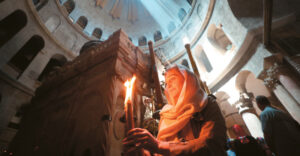
In Jerusalem, the holy crossroads city of three monotheistic religions and six Christian denominations, the atmosphere is once again tense as the US-Israeli war against Iran rages on for five weeks. Since the beginning of the clashes, more than 70 warnings of Iranian raids on Jerusalem’s Old City have been activated. On 20 March, an Iranian missile fragment injured one person. A few days earlier, rocket fragments caused minor damage as they fell near the Holy Sepulchre, as well as the Al-Aqsa Mosque, which Israeli authorities have closed since the start of the war.
Insecurity is particularly pervasive in the Old City area, where Jews, Muslims and Christians are crowded together in an area of less than a square kilometre. And with them, the emblematic symbols of their religions, their religious habits and customs, cultures and attitudes that have managed to coexist for centuries, but in a very delicate balance that only a spark is enough to upset. Let alone a deadly war.
The continuation of the Iranian strikes was almost preordained. On March 29, Palm Sunday for Catholics, the Israeli authorities banned Catholic Patriarch Pierbatista Pichabala from entering the Holy Sepulchre.
They cited the ban on gatherings at places of worship because of the war. International reactions followed, led by Macron, only to be followed by an apology from Netanyahu himself, accompanied by assurances that the Cardinal would be allowed access to the temple. Pichabala attributed the incident to a “misunderstanding”, but Holy Week services were held with one bishop per church and a strictly limited number of worshippers.
The same will happen with the Orthodox Church. The Patriarchate of Jerusalem has decided to completely restrict outdoor celebrations of Holy Week. The decision was dictated by the need to preserve the sanctity of the days, but also human life, with the Patriarchate making it clear that the historical status of the pilgrimages remains non-negotiable.
The Holy Light
In fact, the Holy Light ceremony, a highlight for Orthodoxy, where millions of believers from all over the world await with devotion the exit from the Holy Sepulchre of the Holy Sepulchre of the Patriarch of Jerusalem after 15 minutes of prayer, will again this year take place without the presence of people, but before just 15 Orthodox clergy, 10 Armenians and 5 Copts. The remaining Holy Friends will celebrate the services in the Chapel of Saints Constantine and Helen within the Patriarchate. Even the traditional ceremonies, such as the Niptera and the procession of the Epitaph, will take place in the Holy Courtyard under strict police supervision and with a limited number of people.
At the same time, in the diplomatic field, Athens, in contact with the competent authorities, will ensure the presence of a Greek delegation at the ceremony, in accordance with the etiquette in force at the Church of the Resurrection, even in a symbolic, strictly limited form. It is most likely that only the Deputy Foreign Minister and the Archbishop of the Holy Sepulchre will go to the city. The handing over of the Holy Light will take place at David’s Gate by a representative of the Patriarchate, accompanied by Israeli police.
The inextricable link between religions
Jerusalem for Jews, Al-Quds for Muslims, Jerusalem for Christians, Jerusalem for Christians, the capital of three religions, is not a pretty city. But it is unexpectedly charming. It creates emotion, awe, vibrates the visitor believer of any religion or creed. One cannot remain indifferent, moved, ecstatic.
The three leading cult monuments of the Jews, Muslims and Christians, but also the hundreds of others that adorn its cityscape, with domes of Christian churches, Muslim minarets and Jewish seven-light lamps, make you feel as if you are walking on 4,000 years of history itself, in which at one point the tectonic plates of these three monotheistic religions collide. Sometimes calming, sometimes causing earthquakes. The global symbolic weight of this city cannot be measured since it expresses in aggregate the strongest human emotion, the religious one, the belief in God.
These three religions and their respective cultures were born there and are inextricably linked. Christianity was born out of the Jewish tradition and Islam developed from both Christianity and Judaism. Woven into the mosaic of cultures is the continuous thread of belief in one God and reverence for Jerusalem as “the place where heaven and earth meet”. It is no coincidence that the city is considered the ultimate pilgrimage destination for followers of all three religions.
All of which have claimed it and continue to claim it. With often suicidal passion they clashed with each other for its conquest and control. They conquered it, tore it down and rebuilt it, projecting it in their national and religious mirror as the primary symbol of their identity. The British historian Simon Sebag Montefiore describes it as ‘a city that is at once the history of heaven and earth’. And he gives the explanation as to why all this is so: “Nothing makes a place more sacred than the antagonism of another religion.”
Jerusalem has been the capital of Israel since 1949, the seat of its government, with 966,000 inhabitants. It is located on a plateau between the Mediterranean and the Dead Sea. Its status is the subject of a dispute between Israel and the Palestinians. The eastern part of the city is considered by the international community as an occupied part of Palestine after the 1967 war, when Israeli forces occupied it from Jordan. Its population is 64% Jewish, 34% Muslim and only 2% Christian.
The population is 64% Jewish, 34% Muslim and only 2% Christian.
The Old City is its historic heart. Abraham, Israel’s General Head, Jesus Christ, son of the God of Christianity, and Muhammad, the Prophet of Islam, passed through its lands at great distances between them. Over 300 synagogues, churches, mosques and other religious monuments, packed into a square kilometre, reflect its importance to the three religions.
It is a World Heritage Site, but in reality it is a maze of narrow alleyways teeming with residents and visitors, surrounded by a fortified stone wall with nine gates – separating those of Damascus and the Lions – and divided into four districts: the Armenian, Christian, Muslim and Jewish. Most importantly, it is home to some of the holiest sites in the world. Its security has been in the hands of the Israeli authorities since 1967.
The holy symbols
This is exactly where the coexistence of the three religions is based. The sacred symbols of each religious tradition follow a common historical path through time, standing side by side. A typical example is the Temple Mount. A symbol of national identity for Jews and Muslims, it is the site where the First and Second Jewish Temples once stood and where the Al Aqsa Mosque and the Dome of the Rock stand today. As the holiest site in Judaism and third in Islam it remains a sensitive and religiously and politically charged location.
The Dome of the Rock is a Muslim shrine with a gilded top. However, Jews believe that at its center was the site of the foundation stone from which the world was created. The site has recently been violated more and more frequently, causing heated controversy, and the current rule is that it is open to all, but only Muslims have the right to pray.
The Wailing Wall, or Western Wall, is the holiest pilgrimage site for Jews. It is the only remnant of the Temple of Solomon, built in 960 BC and destroyed by the Babylonians in 587 BC. It was rebuilt in 520 AD by Zerubbabel, the political leader of the Jews, and in 20 AD King Herod built a much larger temple on its site. It was destroyed in 70 AD by the Roman Emperor Titus and in the 16th century the remaining part of it became a main place of pilgrimage for Jews who mourned the loss of their temple. A place of long hours of prayer. Jewish tradition claims that the third and final temple will be built on the same spot.
The Holy Sepulchre
The Holy Sepulchre or Church of the Resurrection is the most iconic monument of Christianity. It was erected by Saint Helen, the mother of Constantine the Great, in the 4th century AD on the foundations of a Roman temple, including the hill of Golgotha and the cave where Jesus was buried. The monument was restored by Gelepi Komnenos in 1810, encompassing all its previous historical phases: the time of Constantine the Great, the Byzantine era, the Crusades, the Renaissance and Bonifacio di Ragusa in 1550.
The 15th century, the Renaissance, the Renaissance, the Renaissance and the 1550s, the 15th century, the 15th century, the 15th century, the 15th century and the 1550s.
The latest restoration of the Holy Cube of the Holy Sepulchre was carried out in 2017 with the cooperation of the city’s three Christian communities: the Orthodox, Franciscan and Armenian. It makes sense, as the Greek Orthodox Patriarchate, the Franciscan Order of Monks and the Armenian Patriarchate have sovereign rights to the shrines, while the Egyptian Copts, Ethiopian Orthodox and Syrian Orthodox coexist.
During the delivery of the project, NTUA lead professor Antonia Moropoulou revealed a unique experience of her own: “When we opened the Cubicle, under the marble slab of Komnenos we found a slab probably of a crusader. And underneath it was revealed the bed of the Rock where it is believed that the body of Christ was deposited after the Deposition.”
To get to the temple, faithful Christian visitors follow the Via Dolorosa, bowing at its 14 stops, each associated with an important station on Christ’s journey to Golgotha; the last five are inside the Church of the Resurrection, a labyrinthine collection of temples built around the Holy Sepulchre.
Outside the Old City, there are also many hidden gems for Christians. In East Jerusalem there are revered sites mentioned in the New Testament. Such as the Place of Ascension, the Holy Father, the Mount of Olives, the Garden of Gethsemane and the Church of All Nations. The Temple Mount and in particular the Mosque of Al Aqsa is the third holiest place for Sunni Muslims after Mecca and Medina. It is the place where Muhammad travelled from Mecca to pray and made the “Night Journey” to the throne of God. It was built in the 7th century, when the Muslims conquered Jerusalem.
In the Crusades it was converted into a palace and later used as a Christian temple until Saladin took Jerusalem. In the last century, Turks and Jordanians have been carrying out the necessary repairs required by the building’s antiquity, giving it its present appearance, while the Palestinian Authority has taken over its administration. The Jordanian royal family has spent $2.1 billion since 1920 on its support and maintenance.
History
The historical journey of Jerusalem is incomprehensible. It was founded in 2107 BC by the Canaanites. In 1400 BC it fell into the hands of Egypt and in 1000 BC it was transformed by David into the capital of the Israelite nation. It then acquired the character of a religious centre when Solomon built his famous temple there. It was conquered by the Babylonians in 586 BC, when it was destroyed along with the temple. Along with it were lost the traces of its most important relic, the Ark of the Covenant with the Ten Commandments.
In 70 AD it was destroyed again by the Roman troops of Titus. It was rebuilt by Hadrian in 135 AD as Ailia Capitoline and adorned with many monuments. With the rise of Constantine the Great it regained its old name. The Emperor’s mother St. Helena was quick to discover the places associated with the Passion of Jesus. Thus, Constantine built the first temple at the site of Golgotha, centred on the Holy Sepulchre, as well as the Basilica at Bethlehem, the place where Christ was born.
Constantine built the first temple at the site of Golgotha, centred on the Holy Sepulchre.
Persians, Arabs, Turks
Jerusalem was captured by the Persians in 614 AD and by the Arabs in 638 AD. In 1099 the city fell into the hands of the Crusaders, who made it the seat of the Kingdom of the same name. In 1187 it was recaptured by the Arabs and later again by the Crusaders. The Turks conquered it in 1517 and in 1542 Suleiman the Magnificent erected the present wall.
In 1917 the area passed under British rule until 1948, when the state of Israel was established. At that time, West or New Jerusalem was occupied by Israel, while East or Old Jerusalem, within the walls, was occupied by Jordan. In the 1967 Six-Day War, Old Jerusalem, along with the west bank of the Jordan River, was occupied by Israel. Israel annexed them and declared that undivided Jerusalem is its eternal capital. The international community did not recognise this action and diplomatic missions remained in Tel Aviv. Jerusalem became contentious and one of the major thorns in the Israeli-Palestinian negotiations from the early 1990s until now. In 2017 Donald Trump recognized it as Israel’s capital.
Permanent threats
Prime Minister Benjamin Netanyahu’s official policy is to maintain the status quo on the Temple Mount. However, far-right politicians are pushing for Jewish prayer to be allowed in it. A visit to it in 2000 by former Prime Minister Ariel Sharon was seen as a challenge to Muslim control and sparked the Second Intifada uprising. When Hamas launched the horrific attacks of October 7, 2023, it called the invasion the “flood of Al Aqsa”, accusing Israel of trying to wrest control of the region. Similarly, in August 2024, Israeli National Security Minister Itamar Ben-Gvir’s visit to the Temple Mount in August 2024 reignited tensions, arguing for equal prayer rights for Jews.
In addition to this, the demographic shift in the composition of the population against Muslims has been evident in recent decades, and is now extending to the detriment of the Christian population. In the Christian quarter, strict administrative regulations are beginning to be imposed to force the inhabitants to leave. The most prominent measure is the prohibition of expansion or renovation of buildings with building permits.
The Greek Orthodox Patriarchate
In this environment full of imbalances, instability and social tensions, the Greek Orthodox Patriarchate of Jerusalem (“mother of all Churches”, as it was founded shortly after Jesus’ resurrection) plays a role that goes beyond the narrow boundaries of a religious institution. Being for the faithful of the local Orthodox communities a basic point of reference and essential support in their daily life, it functions as a stabilizing factor in maintaining the religious, social and cultural cohesion of the Roman Orthodox element.
Its educational work contributes to this in particular. The Patriarchate maintains schools within the State of Israel, such as the educational complex of St. Demetrios, but also in the areas of the Palestinian Authority and in Jordan, serving a large number of students from different social and cultural backgrounds. In addition, the historic Patriarchal School of Zion, recognized by the Greek state, contributes to the preservation of Greek Orthodox education and tradition.
The strategy of strengthening Education and the presence of Orthodoxy in the region will be supported by two more initiatives. According to information, from next September the first recognized university institution in the Hashemite Kingdom of Jordan will start operating under the patronage of the Patriarchate and with a special legislative framework. It will offer studies in theology and other scientific fields, linked also to the broader effort to strengthen the Christian witness in the region.
Meanwhile, in the heart of Jerusalem, the Patriarchate is launching the creation of a theological center at the Monastery of the Holy Cross. The aim is to re-establish the historical school which for decades has been a reference point for Orthodox theological education, research and training in the Orthodox world at large. This monastery is directly linked to the long presence of the Church in the Holy Land.
Ask me anything
Explore related questions




