





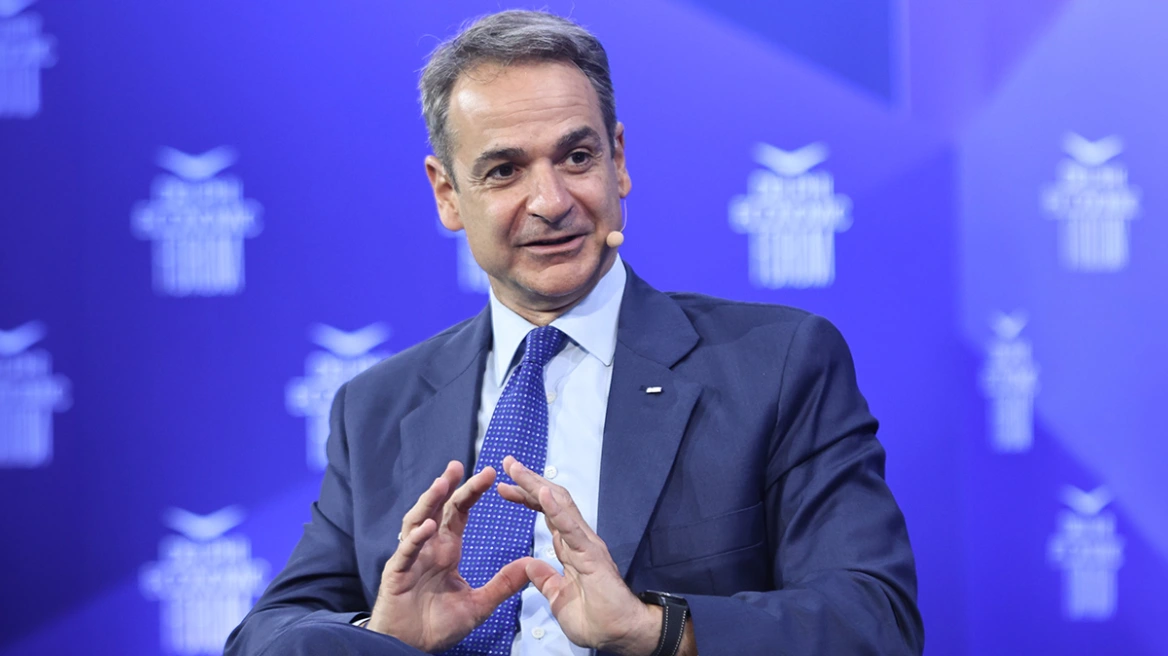
Prime Minister Kyriakos Mitsotakis highlighted the risk of broader economic and energy turmoil if the blockade in the Strait of Hormuz continues, in his discussion with António Costa. His intervention carried a clear message in favor of diplomatic de-escalation, as well as European preparedness in the event of a prolonged crisis. The discussion was moderated by CNN correspondent Fred Pleitgen.
The Prime Minister described the situation as extremely critical, noting that the international community may be facing a crisis of considerable magnitude, which could directly affect supply chains, energy prices, agricultural production, and the overall course of the economy.
As he stated:
“We are potentially facing a crisis of significant proportions. If the blockade in the Strait of Hormuz continues, it is only a matter of time before we see serious disruptions in the supply of oil and products, significant increases in energy prices, shortages in fertilizers, rising inflation, and reduced growth.”
Mitsotakis emphasized that Greece is in a better position compared to other European economies, but made it clear that no country can consider itself shielded from such a shock.
“Greece is doing better than other countries in Europe, but we will not remain unaffected by a crisis of this magnitude.”
Within the same context, the Prime Minister stressed the need for an immediate diplomatic solution and aligned himself with António Costa on the need for de-escalation.
“I agree with Mr. Costa — the first priority is a permanent ceasefire that will return us to the situation before the war. A major maritime route cannot be subject to fees, therefore we must support a diplomatic solution.”
At the same time, however, Mitsotakis underlined that Europe cannot limit itself to wishes or to the expectation of rapid normalization, but must organize its response even for the worst-case scenario.
“But we must prepare for the worst-case scenario — we saw this in Ukraine. This crisis is an opportunity to redefine our position regarding our strategic autonomy and our energy security.”
The Prime Minister also raised the issue of energy realism, noting that Europe cannot speak only in terms of green transition without simultaneously addressing the questions of adequacy and security of supply.
Mitsotakis sent a message in favor of a European emergency plan, warning that a prolonged crisis cannot be managed at the national level alone.
“I call on everyone to be realistic and to have a Plan B in case the crisis expands, as no state will be able to support its economy without European support.”
His intervention at the Delphi Economic Forum thus outlined two parallel directions: on the one hand, the need for immediate de-escalation and a return to stability, and on the other, Europe’s obligation to treat the crisis as a wake-up call for its energy security, strategic autonomy, and the resilience of its economies in the face of new geopolitical shocks.
Ask me anything
Explore related questions




