





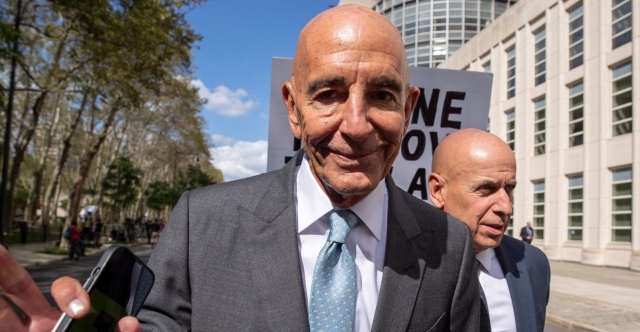
The US Ambassador to Turkey and Special Envoy for Syria, Tom Barrack, defended his recent remarks following the backlash they triggered, rejecting claims that he equates Israel with Hezbollah or that US policy in the Middle East is shifting. He also addressed Turkey, the F-35 program, and broader US regional strategy.
Responding in writing to questions from Fox News, Barrack insisted that his statements reflect “realism,” not a change in US policy. At the same time, he left open the possibility of Turkey rejoining the F-35 Lightning II program, despite its purchase of the Russian S-400 missile defense system. He argued that in the Middle East, only “strong leadership regimes” have proven effective.
He also stressed that Donald Trump’s approach of “peace through strength” requires a more pragmatic reading of the region’s realities.
Referring to his remarks at the Antalya Diplomacy Forum on April 17—where he described the Israel–Hezbollah ceasefire as a “pause” and said that “all sides have proven equally unreliable”—Barrack said he was simply describing the situation on the ground. He noted that the ceasefires of November 2024 and April 2026 have been fragile, as all parties involved—Israel, Hezbollah and their backers—have repeatedly tested limits, following longstanding patterns of violations, rearmament and proxy escalation.
He emphasized that mutual distrust is the main reason the US mediated the ceasefire, aiming to stop casualties, create space for de-escalation and establish a controlled framework that strengthens Lebanon’s sovereignty and Israel’s security. However, he made clear that the US position remains unchanged: “Hezbollah is a terrorist organization, responsible for the deaths of Americans and acts of destabilization.”
At the same time, he pointed out that within Lebanon there is a distinction between Hezbollah’s political wing (represented in parliament) and its armed organization, stressing that political trust “must be earned.”
Addressing his statement that the goal is not the “elimination of Hezbollah,” Barrack argued that fully eradicating such an organization cannot be achieved by military means alone—especially while Iran continues to fund and arm it. He said US strategy focuses on weakening Hezbollah’s terrorist capabilities so that diplomacy and a sovereign Lebanese state can ultimately prevail.
On Turkey, Barrack described the deadlock over the F-35 program as “irrational,” suggesting that the S-400 issue could be resolved within months through “targeted diplomacy” led by Secretary of State Marco Rubio, leveraging the personal relationship between Trump and Recep Tayyip Erdoğan. He clarified that any agreement would fully comply with US law, including the verifiable cessation of possession and operation of the S-400 systems.
He added that Turkey’s return to the program would strengthen NATO cohesion, benefit the US defense industry, and limit Russian influence.
Finally, responding to criticism over his remarks about “strong regimes,” Barrack said his views are based on decades of observation. He argued that countries that attempted to adopt Western-style democracy after the Arab Spring often descended into chaos or authoritarianism, while stable regimes—such as Gulf monarchies—achieved growth and stability.
He noted that Israel stands as a “significant exception” as a democracy in the region, while Turkey is presented as an example of strong centralized leadership with electoral processes. He concluded by saying that US policy is not moving away from supporting democracy and human rights, but is adapting to the need for stability and effective governance.
Ask me anything
Explore related questions




