





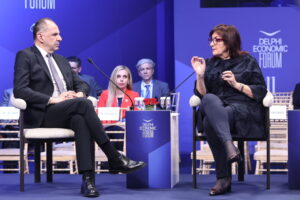
The mounting challenges facing the European Union’s Mediterranean member states—ranging from geopolitical instability to migration pressures and energy security—took center stage during a high-level discussion between Greece’s Foreign Minister Giorgos Gerapetritis and European Commissioner for the Mediterranean Dubravka Suica at the Delphi Economic Forum, held in Delphi from April 22 to 25.
Addressing the escalating crisis in the Middle East, Gerapetritis described the situation as “extremely dangerous and unstable,” warning of a new form of warfare with unpredictable consequences. He highlighted the weaponization of freedom of navigation and noted attacks targeting countries not directly involved in the conflict involving Iran.
“This is a new type of war with particularly dangerous characteristics,” he said.
The Greek minister also warned of potential spillover effects, including increased migration flows. He pointed to the displacement of approximately 1.2 million people in Lebanon as a major concern for Europe. At the same time, he underlined risks to global oil supply chains while acknowledging ongoing EU efforts to diversify energy sources.
Gerapetritis stressed the importance of safeguarding global maritime routes, opposing any restrictions or additional costs on navigation.
Highlighting Greece’s role in regional energy and infrastructure development, Gerapetritis referred to key projects such as GREGY, aimed at connecting Europe with Africa, as well as IMEC and GSI.
“We must go beyond energy interconnections and strengthen trade, mobility and communication between peoples,” he said, emphasizing the need for broader regional integration.
He also noted that while global attention remains focused on Ukraine and Iran, Greece is closely monitoring humanitarian crises in both the Middle East and sub-Saharan Africa.
Migration remains the dominant issue for Mediterranean countries, according to the Greek foreign minister. He outlined efforts to establish legal migration pathways and improve cooperation with countries of origin to better manage flows and facilitate returns of irregular migrants.
At the same time, he acknowledged the EU’s growing need for labor, describing migration management as a “complex balancing act” that requires enhanced interconnectivity.
Gerapetritis identified climate change as an “existential issue for Europe,” noting that the Mediterranean region is particularly vulnerable. He highlighted Greece’s initiatives to develop marine parks aimed at protecting biodiversity, alongside broader EU efforts to safeguard the marine environment.
“No country can tackle these challenges alone,” he said, calling for coordinated regional and international cooperation.
For her part, Commissioner Suica described the current geopolitical landscape as a “landmark moment” for both Europe and the wider world. She noted that the Iran conflict has triggered not only an energy crisis but also disruptions in global trade, while European citizens continue to face a cost-of-living crisis.
She expressed cautious optimism about diplomacy, saying a ceasefire in Iran could create an opportunity for dialogue. “That is the only way forward,” she said.
Suica also highlighted the broader regional impact of the crisis, including on Gulf countries, Lebanon, Syria, Gaza and Israel, stressing the importance of strong partnerships in the Mediterranean.
The Commissioner outlined the EU’s Mediterranean strategy, centered on three key pillars: resilience, interconnectivity and sustainable prosperity.
“We cannot act alone. Cooperation among the EU’s 27 member states and our southern partners is essential,” she said.
Suica emphasized the need to diversify energy sources to reduce costs for citizens and highlighted major regional initiatives involving Greece, including IMEC, GREGY and other cross-border projects.
She also stressed the importance of people-to-people connections, education—particularly for young people—and the development of legal migration pathways through talent partnerships with third countries.
Concluding her remarks, Suica underscored the strategic importance of maintaining freedom of navigation, particularly in sensitive areas such as the Strait of Hormuz.
“Our goal is to transform the Mediterranean into a bridge to the world—and Greece into a gateway to Europe,” she said.
Ask me anything
Explore related questions




