





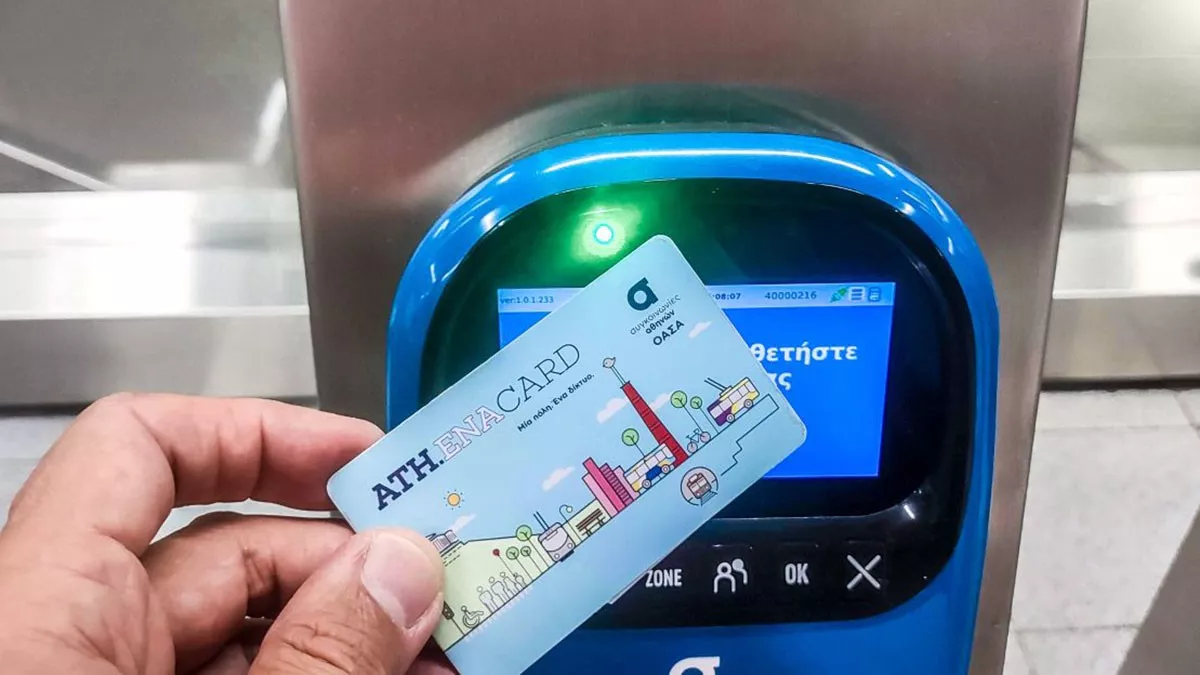
As of Saturday, May 30, 2026, passengers caught travelling without a valid ticket on the Metro, buses and trolleybuses will face a significantly higher fine.
The new fine has been set at 100€, up from the previous amount of around 72€, under Law 5290/2026 and the Government Gazette published on May 28. The increase amounts to roughly €28 and, although it may look modest on paper, the message is clear: fare evasion is no longer a cost-effective option.
Who it affects – What applies to reduced fares
The 100€ fine applies to passengers who are required to hold a full-price ticket or travel card. For those entitled to a reduced fare – including school pupils, students and people with disabilities – the fine is set at 50€.
In all cases, there is also a “lifeline” provision: if the offender purchases a personalised unlimited travel card valid for at least 30 days within 10 days, the fine is reduced by half – to 50€ instead of 100€. It is a way out that also acts as an incentive for regular use of public transport.
The figures show the policy is working
Behind the tougher penalties lies a policy that is already producing results. In the first four months of 2026, more than 3.48 million ticket inspections were carried out across the urban transport network – almost double the number recorded in the same period last year.
The impact was visible: ticket and travel card validations across the OASA network exceeded 113.5 million. Buses recorded a 25% increase, from 27.8 million to 34.7 million validations, while the Metro posted a 9.1% rise, from 72.3 million to 78.9 million.
Artificial intelligence at stations to catch fare dodgers
Alongside the increase in inspections, a camera system equipped with special artificial intelligence software is being developed to detect, in real time, passengers who slip through the gates behind others without validating a ticket, taking advantage of the open barrier.
The data are then used to identify stations with high rates of fare evasion, where the presence of inspectors is subsequently reinforced.
The broader picture: vandalism also in the crosshairs
The tougher penalties for passengers travelling without a ticket form part of a broader wave of interventions in public transport. The government has also recently introduced fines of up to €40,000 for vandalism and graffiti on public transport vehicles and infrastructure.
The message is unified: public transport is not a space of impunity.
Ask me anything
Explore related questions




