





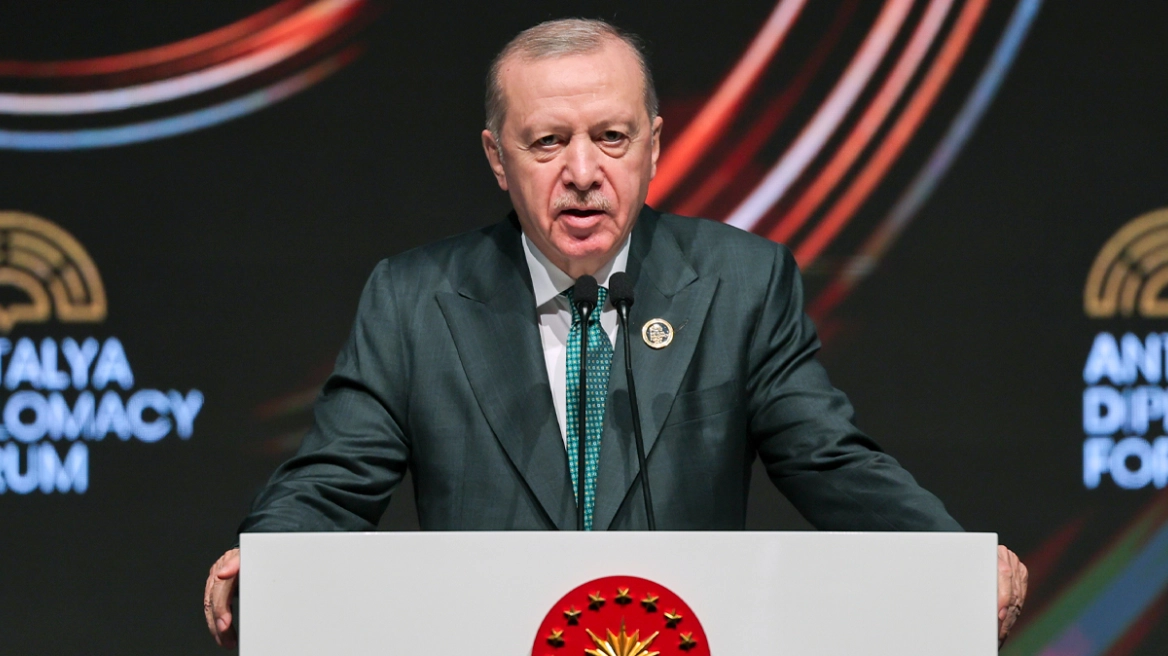
In recent months, Israel—and especially Prime Minister Benjamin Netanyahu—has become a near-daily topic on Recep Tayyip Erdogan‘s agenda. This is largely due to the multiple military operations and fronts opened by Tel Aviv across the Middle East against countries and organizations with which Ankara maintains close ties.
Having repeatedly described Israeli strikes in Iran, Palestine, and the West Bank as attacks against the entire Muslim world, Erdogan escalated his rhetoric again this week. He argued that Israeli actions in Syria and Lebanon constitute a direct threat to Turkey. His remarks come at a time when relations between Ankara and Tel Aviv continue to deteriorate, as the interests of the two countries increasingly clash across critical geopolitical arenas, from Syria to the Eastern Mediterranean.
Netanyahu did not remain silent. Responding in strong terms, he described the Turkish president as an “antisemitic dictator” who “should not preach morality to Israel.”
Caught between the two is Donald Trump, who maintains generally good—if occasionally strained—relations with both leaders. Asked at the White House whether he was concerned about a possible confrontation between Ankara and Tel Aviv, Trump largely sidestepped the question. He claimed he had not heard Erdogan’s latest remarks, called him “a very good friend” and “a great leader,” and added that “nothing is going to happen with Turkey because I respect him and he respects me.”
Relations at a Low Point
Relations between Turkey and Israel have been at their lowest level in years, and analysts view Erdogan’s latest comments as another step toward escalation.
Although the two countries are not engaged in a military confrontation, their conflict of interests has become increasingly apparent.
“We are in a state of continuous conflict. Turkey is a very significant challenge for Israel,” an Israeli source told the television network N12, adding that Turkish rhetoric has gone beyond the boundaries of ordinary diplomatic disputes.
“It has become unbearable,” the source said.
The same source argued that Ankara does not seek a direct military clash with Israel, especially as a NATO member, but it possesses other means of pressure.
“Erdogan’s statements are not entirely new—they are old and repetitive,” the source noted. Turkey has little interest in becoming involved in a regional conflict with Israel, but it can still act against Jerusalem in other ways.
“Erdogan has ways of confronting Israel. Economically, he halted trade. Internationally, wherever the Turks can hurt us, they do.”
Syria at the Center of the Dispute
In a speech before the Turkish parliament, Erdogan argued that Israeli operations in Syria and Lebanon have reached a point where they directly affect Turkey’s security.
Syria is of strategic importance to Ankara, which seeks to maintain a decisive role in shaping developments following the fall of the Assad regime and the emergence of new political forces in the country.
Nimrod Goren, president and founder of Israel’s Mitvim Institute for Regional Foreign Policies, explained that Turkey views Syria as part of its sphere of influence and wants to preserve a strong dependency relationship with Damascus.
“Turkey sees Syria as its sphere of influence and would like it to be a kind of ‘little sister,’ almost a protectorate—something Syrians do not necessarily want,” he said.
According to Goren, Israel and Turkey had previously managed to coordinate their “red lines” in Syria to avoid clashes, but tensions have risen significantly in recent months.
Lebanon is a different matter. Goren notes that Lebanon is not traditionally part of Turkey’s sphere of influence, and Hezbollah does not maintain close ties with Erdogan.
In his view, the Turkish president is “taking advantage” of the situation in Lebanon, where Israel has limited some of its activities due to pressure from the United States while simultaneously facing substantial international criticism.
The Eastern Mediterranean as an Arena of Competition
Beyond Syria and Lebanon, Erdogan also directed criticism toward Israeli activities in the Eastern Mediterranean.
“We see initiatives led by Israel in the Eastern Mediterranean. No one should seek adventures in this region. Our response will be clear and strong if the rights of Turks and Turkish Cypriots are violated,” he declared.
“The Eastern Mediterranean is a much more challenging arena for both us and the Turks,” the Israeli source told N12.
According to the source, Turkey remains locked in a dispute with Greece over sovereignty issues involving islands and maritime zones, while also possessing considerable naval capabilities. Cyprus, too, remains a matter of vital importance for Ankara.
These developments are closely linked to the strengthening relationship between Israel, Greece, and Cyprus.
At the end of 2025, the leaders of the three countries met in Israel and announced further deepening of their political and defense cooperation—a development Ankara has watched with particular concern.
“Turkey sees the post-war architecture emerging in the Eastern Mediterranean as a mechanism being used against it. It therefore seeks to demonstrate its power in the region,” the expert said, describing the trilateral partnership as a “strategic problem” for Turkey.
The Israeli source stressed, however, that none of these disputes is expected to escalate into military conflict. Yet, “if one examines the range of risks and possibilities, the risk is greater in the Eastern Mediterranean than in Syria or Lebanon.”
According to the source, the likelihood of a miscalculation that could trigger escalation is higher in that arena.
Erdogan’s Ambitions and the Trump Factor
In recent years, Erdogan has sought to establish Turkey as the dominant regional power.
Within that framework, Israel is viewed by Ankara both as a rival and as a useful reference point for strengthening Turkey’s own geopolitical standing.
“It is part of Turkey’s policy to distinguish itself from other Arab countries and to be the most determined and proactive country in confronting Israel,” Goren said.
This approach, he explained, is intended to enhance Turkey’s position across the broader region. At the same time, Erdogan’s statements are also directed toward his domestic audience, which is largely hostile toward Israel.
Relations with Washington also play an important role.
According to Israeli assessments, Erdogan’s strength is reinforced by his good relationship with U.S. President Donald Trump.
“Erdogan depends heavily on the Americans. The source of his strength is the trust Trump places in him,” the Israeli source said.
The source expects Erdogan’s rhetorical escalation to continue but does not necessarily foresee a corresponding shift in actual policy:
“The Americans can easily limit the intensity of Turkish rhetoric. But as long as they do not establish red lines, the unbearable rhetoric will remain and will intensify.”
Ask me anything
Explore related questions




