





The memorandum of understanding between the United States and Iran is not—and could not be—a simple ceasefire document. It is the first outline of a new, fragile balance in the Middle East, as well as a 14-point roadmap for the day after, not only in Tehran–Washington relations but for the entire Middle East.
On paper, it ends hostilities, reopens the Strait of Hormuz, and brings Washington and Tehran back to the nuclear negotiating table. In practice, however, it does something more structural: it shifts the weight from the realm of military pressure to the realm of political bargaining.
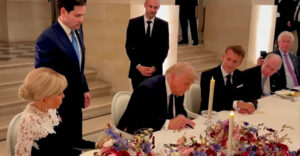
The moment Donald Trump signed the agreement
🚨 President Donald J. Trump has SIGNED the Iran Memorandum of Understanding at Versailles in France. 🇺🇸 pic.twitter.com/JQ6qlbvFAF
— The White House (@WhiteHouse) June 17, 2026
The first and most politically charged provision concerns Lebanon. The text does not merely speak of ending operations between the United States and Iran. It provides for the immediate and permanent cessation of military operations “on all fronts,” including Lebanon, and commits to respecting the country’s territorial integrity and sovereignty. This is the clause viewed in Israel as a red alert. Lebanon is not treated as a side issue. It is placed at the core of a U.S.–Iranian document. Tehran thus gains a diplomatic tool for any future Israeli strike against Hezbollah or for any discussion regarding the southern security zone.
For Israel, this may be the most dangerous precedent. Netanyahu’s government does not want the Iranian issue linked to Lebanon under any circumstances. It does not want Hezbollah to fall indirectly under the umbrella of a U.S.–Iranian understanding, nor does it want the Israeli military’s freedom of action constrained by an agreement it did not sign.
The second pillar of the memorandum is the mutual commitment to non-interference. Both sides undertake to respect each other’s sovereignty and territorial integrity and not interfere in each other’s internal affairs. The phrase may seem standard. It is not. It comes after years of open hostility, accusations of influence operations, destabilization efforts, targeted actions, and regime-change rhetoric. For Tehran, this wording functions as political security. For Trump, it represents a retreat from the language of total overthrow toward the language of management.
The President of Iran holding the signed agreement
The timetable set out is extremely tight: a final agreement within 60 days, with the possibility of extension. In reality, it is difficult to believe that within two months the nuclear program, sanctions, frozen assets, the status of Hormuz, the role of regional powers, and the presence of U.S. forces near Iran can all be resolved. The 60-day period is more political than technical. Trump needs an immediate image of success. Iran needs immediate economic relief. Both need time without war.
Where the agreement becomes immediately tangible is at sea. The United States commits to immediately begin lifting the naval blockade and to terminate it completely within 30 days. At the same time, following a final agreement, the removal of U.S. forces from Iran’s vicinity is envisaged. This is a clear victory for Tehran. Iran regains the ability to export, import, and function economically. For Washington, however, there is a cost: it loses one of its main levers of pressure before the most difficult part of the negotiations is concluded.
Even more sensitive is the provision concerning the Strait of Hormuz. Iran commits to ensuring the safe passage of commercial vessels without charge—but only for 60 days. This detail may prove strategic. If, after that two-month period, Tehran gains the ability to impose fees or acquire a new role in managing transit, global energy trade will not return exactly to its pre-war normality. Instead, it enters a new framework in which control over one of the world’s most important maritime corridors will pass through political coordination with Iran and Oman, as well as the other coastal states of the Persian Gulf.
The economic component is equally significant. The memorandum provides for a plan worth at least $300 billion for Iran’s reconstruction and economic development, with the participation of regional partners. Trump insists that the United States itself will not provide the money. However, he leaves the door open for financing by Gulf states. For Tehran, this amounts to a prospect of reintegration. For the Gulf monarchies, it may be the price of a difficult stability. For Trump, it is a political risk, as it recalls—on a much larger scale—the criticisms he himself directed at the 2015 agreement.
At the heart of the bargain lie the sanctions. The United States undertakes, according to an agreed timetable, to end UN sanctions, decisions related to the International Atomic Energy Agency, and U.S. primary and secondary sanctions. This is the real reward Iran seeks. Without sanctions relief, no Iranian leadership would accept meaningful nuclear concessions. The critical question is sequencing: what is lifted first, what remains as a guarantee, and who certifies that Tehran is honoring its commitments.
The nuclear issue, despite its importance, remains the vaguest part of the text. Iran “reaffirms” that it will not acquire nuclear weapons. The word carries weight, but no new substance. Tehran has already made a similar commitment under the Nuclear Non-Proliferation Treaty. The new element is the provision for downgrading enriched material under the supervision of the International Atomic Energy Agency. However, the material is not expected to leave the country. This leaves open the major question: whether Iran will truly lose its nuclear capability or merely freeze it at a lower level of intensity.
Until a final agreement is reached, both sides agree to maintain the current status quo. Iran will not advance its nuclear program. The United States will not impose new sanctions or deploy additional forces to the region. This creates a baseline for negotiations. It also limits the United States’ ability to escalate. In essence, the program is not resolved. It is frozen in its current state after the strikes, with facilities destroyed or only partially operational and enriched material remaining the major sticking point.
The immediate economic relief for Tehran does not stop there. The U.S. Treasury Department will issue exemptions for exports of Iranian crude oil, petroleum products, and related services—from banking transactions to insurance and transportation. In addition, frozen or restricted Iranian assets will become available upon implementation of the memorandum. The wording is broad: the funds may be used for payments to any final beneficiary designated by the Central Bank of Iran. This may be one of the points that provokes the strongest reactions in Washington, as it can be interpreted as excessive economic easing before a final nuclear agreement is reached.
To ensure that the memorandum is more than a political declaration, it provides for an executive mechanism to monitor its implementation and future compliance. Much of its credibility will be determined there. The U.S. will seek verifiable commitments. Iran will try to avoid a regime of permanent supervision. The same applies to the sequence of future steps: first come the cessation of operations, the lifting of the blockade, the reopening of Hormuz, the oil-related exemptions, and the release of funds—and only afterward the substantive negotiations on a final agreement. This is the most vulnerable point for Washington and the most useful for Tehran. Iran receives the immediate benefits first. The U.S. gets the end of the war and the reopening of Hormuz. The nuclear issue, however, is postponed to the second phase.
The final agreement, if one is reached, will be approved through a binding resolution of the UN Security Council. That would give it institutional weight and international backing. But the “if” is enormous. The gap over the nuclear issue remains. Israel has little reason to feel secure. Trump’s critics will speak of premature concessions. Tehran will seek to turn economic relief into negotiating time.
This agreement, by all accounts, does not solve the Iranian Gordian knot. It freezes it. It does not dismantle the nuclear program. It moves it into a new round of negotiations. It does not fully restore the old order in the Persian Gulf. It creates a new, more complex balance in which Iran emerges wounded but not defeated, the United States appears as the power that stopped the war but lost part of its leverage, and Israel is left with the most difficult question of all: how far it can accept an agreement that limits the war but does not eliminate the threat.
Ask me anything
Explore related questions




