





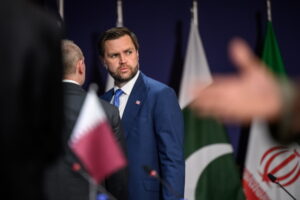
Iranian and US delegations have agreed to set up mechanisms aimed at halting hostilities in Lebanon and securing safe passage through the Strait of Hormuz, according to a statement issued today by Pakistan and Qatar, the two mediating countries, after the first round of negotiations intended to bring a definitive end to the war in the Middle East.
Meeting at a luxury hotel in Bürgenstock, in the Swiss Alps, the two delegations made “encouraging progress”, according to a joint statement from Islamabad and Doha.
The two sides agreed on a “roadmap aimed at reaching a final agreement within 60 days”, opening the way for a new round of technical talks later this week.
Iranian Foreign Minister Abbas Araghchi, who is part of Tehran’s delegation, said on X that “tireless Pakistani and Qatari mediation” had produced significant progress towards ending the war in Lebanon.
“Oil and petrochemical exports are exempted, the blockade has been lifted, some frozen assets have been released, and a major reconstruction and development plan has been launched for Iran,” he added, listing elements of the memorandum of understanding signed on June 17 by US President Donald Trump and Iranian President Masoud Pezeshkian.
The US did not immediately respond.
According to the joint statement from Pakistan and Qatar, the two sides also agreed to establish an immediate “conflict management centre” aimed at ending hostilities in Lebanon between the Israeli military and Hezbollah, the Iran-backed Shia movement, after clashes had threatened to undermine the ceasefire.
Communication channel for the Strait of Hormuz
Fighting between Israel and Hezbollah continued on Friday and Saturday in Lebanon, despite the memorandum of understanding explicitly calling for hostilities to stop on all fronts. In response, Tehran announced on Saturday that it was closing the Strait of Hormuz, the strategically vital waterway through which, before the war, about 20% of the world’s hydrocarbons passed.
On that issue, the Washington and Tehran delegations agreed to establish “a communication channel” to “avoid incidents and misunderstandings, with the aim of ensuring the safe passage of commercial vessels through the Strait of Hormuz”, Pakistan and Qatar said.
The announcements pushed oil prices lower. At around 6:25am Greek time, WTI, the US benchmark, was down 0.20% at $75.70, while North Sea Brent, the international benchmark, had fallen 1.41% to $79.43.
The Lebanon prevention task force will be “the first real test” of the other side’s intentions, according to Iranian Foreign Minister Abbas Araghchi.
In a possible sign of de-escalation, Israeli authorities said restrictions on gatherings imposed because of the war in the north of the country, near the Lebanese border, had been lifted as of this morning.
Israeli Prime Minister Benjamin Netanyahu, however, repeated that the Israeli army would remain in southern Lebanon “for as long as necessary”.
Hezbollah Secretary-General Naim Qassem rejected any possibility of a continued Israeli “security” zone in southern Lebanon.
Israeli military operations in Lebanon since early March have killed at least 4,106 people, according to Lebanon’s Health Ministry. The Israeli army has reported 36 casualties.
Iranian delegation walks out, but talks continue
According to Iran’s state news agency IRNA, the Iranian delegation walked out of the talks in Switzerland after one hour and 20 minutes yesterday in response to the “publication of an offensive message by the US president”. The process later continued thanks to the mediators.
The walkout followed a post by President Donald Trump on Truth Social in which he demanded that Tehran “stop” Hezbollah from causing “problems”, warning that otherwise the US would strike Iran “harder”, followed by three exclamation marks.
“They would do better to weigh their words. Otherwise, our armed forces are ready to respond,” Mohammad Baqer Ghalibaf, the speaker of Iran’s parliament and head of the Iranian delegation, said on X.
Under the “Islamabad Memorandum of Understanding” signed on June 17, the parties committed to refraining “from threatening each other with the use of force” during the talks.
The latest negotiations are expected to lead, within a renewable 60-day deadline, to a final agreement to end the Middle East war, which broke out on February 28 with intense US and Israeli aerial bombardments against Iran and has killed thousands of people, most of them in Iran and Lebanon.
Major differences also remain over Tehran’s nuclear energy programme, which the US, Israel and other Western governments have regarded with suspicion for decades.
According to Iranian state television, the nuclear issue was not discussed during the first session.
The same source, the IRIB network, said the Iranian delegation refused to pose for photographs alongside the US delegation, which included US Vice President JD Vance, US presidential special envoy Steve Witkoff and President Trump’s son-in-law, Jared Kushner.
“We held in-depth discussions on all aspects of the agreement” concerning Iran’s nuclear programme, a senior US diplomat told reporters in Bürgenstock.
Ask me anything
Explore related questions




