





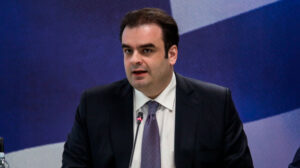
The inauguration of the International Organization for Migration’s new Supply Chain Centre in Thessaloniki marks a major step in strengthening the city’s role as a regional hub for humanitarian logistics, Minister of National Economy and Finance Kyriakos Pierrakakis said on Monday.
According to the minister, the investment also carries a clear economic dimension, as the International Organization for Migration (IOM), a United Nations-related agency, manages humanitarian aid supplies worth more than $1 billion every year, while in some cases the annual volume reaches $1.7 billion.
“This creates significant opportunities for the Greek economy, businesses, suppliers, supply chain companies, as well as research institutions and universities that can contribute innovation, know-how and specialised knowledge,” Pierrakakis said.
He added that the Centre could act as a catalyst for Greek entrepreneurship, opening the way for greater participation in international procurement and global value chains.
“Most importantly, we are not talking about an infrastructure project that may bear fruit at some point in the future. We are talking about a structure that is already producing tangible results. Within its first few months of operation, the Centre supported 21 international missions, managed more than 20,000 cubic metres of humanitarian aid and helped respond to emergencies in crises ranging from Afghanistan and Myanmar to Mozambique and Sudan,” he said.
Pierrakakis also announced that the IOM’s new Supply Chain Centre will be housed in a modern facility in Kalochori, which is already being adapted for this purpose.
“In this context,” he added, “I have already instructed the National Development Fund to proceed with the preparation of your Organization’s new permanent Logistics Centre, a project with a total budget of €5 million.”
Deputy Foreign Minister Yannis Loverdos said, for his part, that the IOM Supply Chain Centre is already operational and is supporting humanitarian aid missions around the world.
“By strengthening the IOM’s capacity to respond quickly and effectively to crises, it directly contributes to the Organization’s humanitarian mission and, at the same time, strengthens Thessaloniki’s role as a strategic hub for logistics and humanitarian action,” he said.
Loverdos also stressed that the IOM Supply Chain Centre, operating within the framework of the United Nations system, reflects Greece’s long-standing commitment to multilateralism.
“As a founding member of the UN and a current member of the Security Council, Greece firmly believes that the complex challenges of our time can only be addressed through international cooperation and effective partnerships. The IOM is at the forefront of these efforts, and Greece is proud to support its mission,” he noted.
Thessaloniki Mayor Stelios Angeloudis said the IOM’s strategically important decision to choose Thessaloniki as the headquarters of its Supply Chain Centre highlights the city’s geographical advantages and modern infrastructure.
He underlined that, beyond logistics, the Centre’s purpose is to help deliver humanitarian aid to people who need it most.
“We want a city that attracts international organisations and investment and connects economic development with social responsibility,” Angeloudis said, adding that the IOM Supply Chain Centre is an important step toward realising that vision.
SungAh Lee, Deputy Director General for Management and Reform at the IOM, said she was confident that this strong logistics infrastructure would mark the beginning of a long-term partnership between the Organization, Greece and Thessaloniki. Lee had signed the agreement with Pierrakakis for the establishment of the Centre.
She stressed that what matters most is not the offices or the warehouse space, but “the family that will receive help during the most difficult moment of their lives.”
“Behind every pallet that leaves the Centre is someone who has lost their home, someone uprooted by conflict or natural disaster, someone waiting for help to arrive. In our work at the IOM, speed means dignity, reliability means protection, and readiness often means the difference between life and death,” she said.
Lee also referred to the growth opportunities that will arise for local businesses in Thessaloniki and expressed the IOM’s willingness to pursue partnerships with universities and the private sector.
The director of the Thessaloniki Supply Chain Centre, Lado Gvilava, said the ambition is clear.
“Our ambition is to build a centre in Thessaloniki that will excel in logistics for the humanitarian aid sector — one that is effective, sustainable and ready for the future. We want the Centre to be a place of knowledge, innovation, collaboration and opportunity,” he said.
Ask me anything
Explore related questions




