





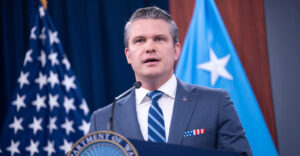
According to individuals familiar with the matter, cited by Wall Street Journal, Secretary of Defence Pete Hegseth intended to announce that Washington was preparing further cuts to its military forces in Europe, beyond the cancellation of the deployment of an armoured brigade in Poland and the earlier withdrawal of an infantry brigade from Romania.
However, his proposal was blocked when it was presented to Marco Rubio — the Secretary of State and national security adviser to President Donald Trump — and other senior officials, according to the same sources.
He ultimately traveled to Brussels, but instead of immediate announcements of cuts, Hegseth stated that the US would carry out a review of its military presence in Europe, a process that could last up to six months.
This disclosure indicates that the US administration has not yet decided on the scale of potential reductions in the number of American troops in Europe or the pace at which they would be implemented.
Although Trump has spoken about “punishing” NATO countries that, in his view, do not spend enough on defence or did not support the US war with Iran, Hegseth’s proposals and strong positions have caused concern among allies and US lawmakers — including leading Republicans — who fear it could cause lasting damage to the Alliance and encourage Russia.
A spokesperson for the Pentagon, Sean Parnell, when asked, stated: “Secretary Hegseth ensured that his message was aligned with the President’s goals and agenda and did not want to limit the President’s decision-making space.”
At the NATO summit, discussion of US military presence in Europe
The level of US troop deployments and allied defence spending is expected to be at the center of President Trump’s meeting with NATO leaders in Turkey next week.
Alliance officials hope the summit in Ankara will highlight unity with the United States and support for Ukraine in the war with Russia, but they fear tensions with Trump could overshadow the meeting.
According to officials, NATO is even considering canceling plans for a new summit next year in Albania.
“The United States spends more money on NATO than any other country, by a vast margin, to protect them, without getting any benefit from it,” Trump said in a social media post on Thursday.
The Pentagon’s defence strategy issued in January had already signaled that the US would reduce its military presence in Europe as it shifts its focus more towards the Western Pacific and the Western Hemisphere.
The aim of the strategy is for European countries to take primary responsibility for the conventional defence of the continent.
Cancellation of armoured brigade deployment in Poland and Trump’s surprise
In May, Hegseth abruptly canceled the nine-month rotational deployment of an armoured brigade in Poland from Fort Hood, Texas.
The decision triggered strong reactions from both Republican and Democratic lawmakers, and also alarmed Polish officials, who said they had not been informed in advance.
The move also surprised Trump himself, who later called Hegseth asking why he was treating a key ally so poorly.
The US president subsequently announced that he would send 5,000 troops to Poland, although according to US officials, no additional forces have yet been deployed.
However, the possibility of further reductions in US troops in Europe remains. Hegseth and his chief policy adviser, Elbridge Colby, are said to be particularly determined to reduce US forces committed to Europe.
Colby has long been considered an advocate of a strategy prioritising Asia, seeking to limit US commitments in other regions in order to free up resources to counter China.
The war with Iran gave Hegseth and Colby new justification to reassess US military commitments, as although the United Kingdom provided a base for long-range US bombers used in strikes against Iran, Spain refused to provide facilities for the attacks.
After criticism from the German Chancellor of the Trump administration’s strategy towards Iran, the US president continued his criticism of Europe and threatened to withdraw troops from Germany.
Pressure from the Pentagon for cuts has caused concern in Congress, with Republican and Democratic lawmakers advancing provisions that would prevent the Defence Department from reducing forces below 76,000 troops without a prior risk assessment.
Concerns intensified last month when Hegseth’s office scheduled a briefing call with lawmakers ahead of the NATO defence ministers’ meeting in June. However, during the call, Hegseth only stated that he planned a comprehensive review.
Announcing this process, he sent a clear message to Europe. “Make no mistake — this will be a real review,” he said at the opening of the semi-annual NATO defence ministers’ summit. “It will aim to ensure that NATO moves quickly and irreversibly towards Europe taking primary responsibility for Europe’s defence,” he added.
Ask me anything
Explore related questions




