





If the experts at Morgan Stanley are anywhere close to being correct, ordinary table salt could soon find itself at the center of a global economic, technological, and environmental revolution.
Within the next decade, sodium chloride—better known as salt—could become a highly valuable commodity, marking a major turning point in its long history.
The latest milestone in that journey is linked to batteries for electric and hybrid vehicles, which have largely driven the rediscovery of salt as a modern industrial treasure—and as a strategic asset in the undeclared economic and technological rivalry between the West and China.
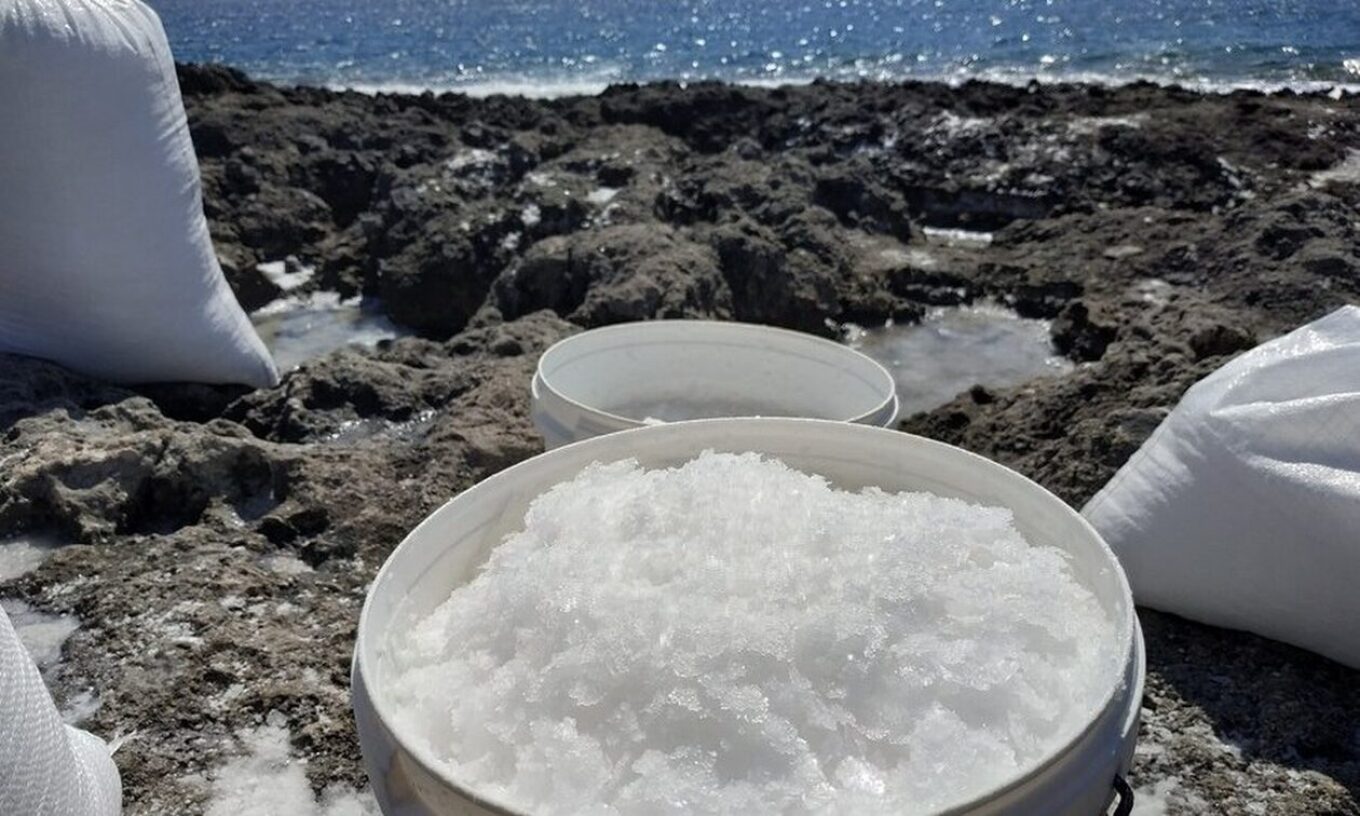
In the Beginning… There Was Salt
The story of salt begins thousands of years ago, at the dawn of organized human civilization. According to the ancient Greeks, salt was born directly from the sea—a connection reflected in its etymology. The Greek word als referred to the sea, while halas eventually came to mean salt itself.
The Latin word sal evolved from the Greek term and became the root for the word “salt” in many European languages: salt in English, sel in French, sal in Spanish, sale in Italian, and Salz in German.
One of the world’s earliest known salt mines operated in China around 6000 BC. Meanwhile, Austria’s city of Salzburg—literally “Salt Castle”—received its name in the Middle Ages because of its strategic location on the Salzach River, which transported salt from nearby mines.
Likewise, numerous European cities ending in “-ich” (such as Norwich), places like Halle and Saal, and even Alimos in Greece derive their names from salt.
Dozens of words and expressions in many languages also originate from salt, including the biblical phrase, “You are the salt of the earth.”
The importance of salt extended far beyond cooking. During Roman times, soldiers were sometimes paid in salt, known as salarium—the origin of the modern English word salary.
Ironically, today’s salaries often struggle to keep up with today’s “salty” prices—but that’s another discussion altogether.
Entering the Commodities Markets
Salt is once again attracting global attention, primarily because of the rapid expansion of electric vehicles and the urgent need for cheaper, more efficient batteries.
Demand for better battery technology continues to rise, and salt has recently emerged as a key ingredient in developing next-generation sodium-ion batteries.
From a commercial perspective, this could elevate salt into the ranks of globally traded commodities, where its value would fluctuate according to supply and demand, much like oil, gold, timber, metals, wheat, rice, coffee, or cocoa.
So why not salt?
Until now, salt has remained absent from major commodity exchanges in the United States, Europe, and Asia because it is heavy, inexpensive to transport only over relatively short distances, and widely available almost everywhere.
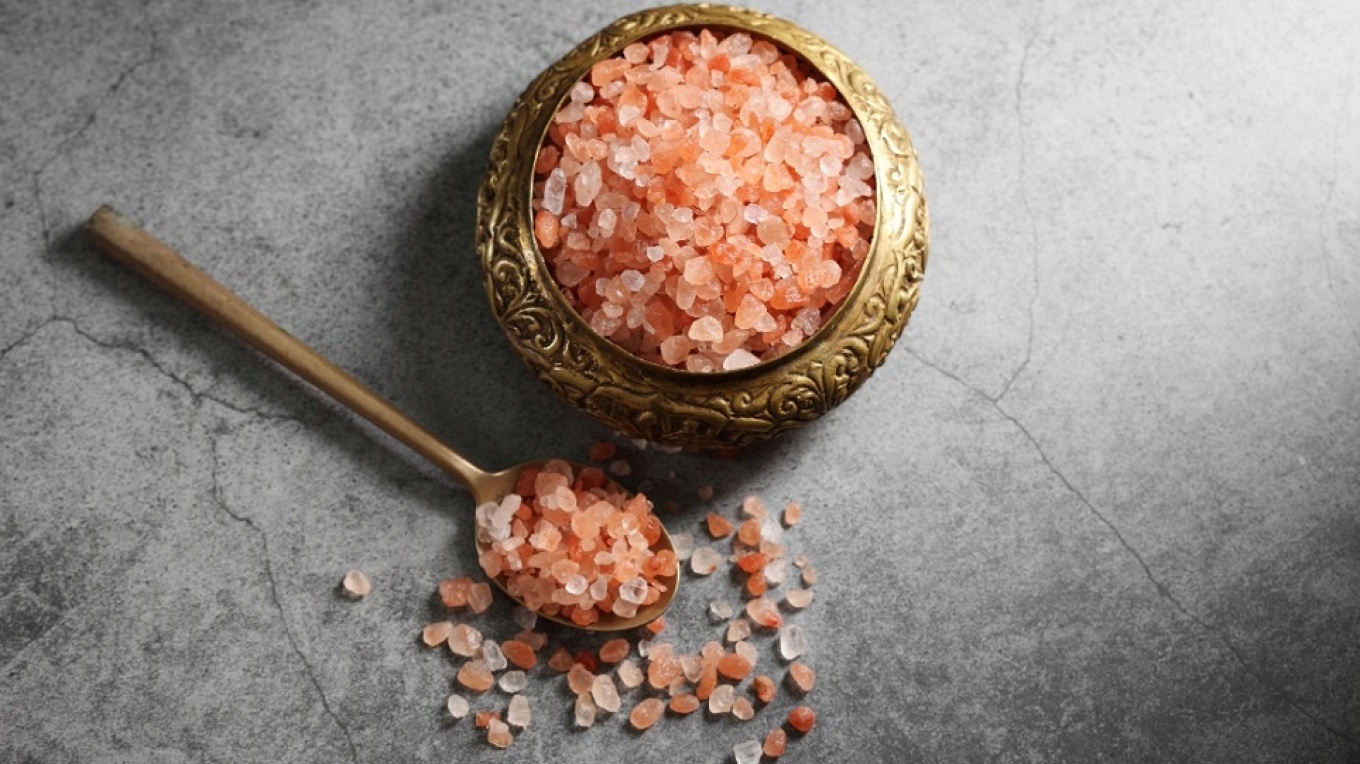
Premium products such as Himalayan salt or gourmet sea salts are traded in relatively small volumes and have never required centralized global price discovery.
Furthermore, salt reserves are considered virtually inexhaustible, especially when the world’s oceans are taken into account. As a result, the risk of shortages—and the dramatic price spikes that accompany them—has historically been extremely low.
According to the Observatory of Economic Complexity (OEC), salt ranks only 575th among the world’s 1,222 most traded products. Nevertheless, global trade in salt grew by approximately 4.25% annually between 2020 and 2024.
Greece’s Interest
For Greece, salt is more than just part of its linguistic heritage.
In 1898, during the country’s financial crisis, Greece surrendered control of its state salt monopoly to the International Financial Control Commission, along with several other monopolies, in an effort to repay foreign creditors.
Today, under entirely different economic circumstances, that former state monopoly has become the object of intense investor interest.
The tender process for selling at least a 51% stake in Hellenic Saltworks S.A. (Ellinikes Alykes S.A.) has entered its second phase.
Seven investment groups remain in contention, including companies active in food production and distribution, infrastructure, retail, and international salt production.
Among them are:
- A consortium led by M.P. Theodorou (Cyprus’ largest salt producer) together with Salinity Group AB.
- Kalas S.A., Greece’s largest salt producer and packager.
- Pitsias S.A.
- Konstantopoulos S.A.
- A consortium including Unisel SAS and Chion S.A.
- Mantis Trading.
- Meccanica Group together with Italy’s SOSALT, which produces around 120,000 tonnes of sea salt annually and exports to 32 countries.
Hellenic Saltworks
Hellenic Saltworks S.A. was established in 1988, three years after Greece officially abolished the state monopoly on salt.
Its main objective was to achieve national self-sufficiency in salt production while modernizing and mechanizing Greece’s viable saltworks.
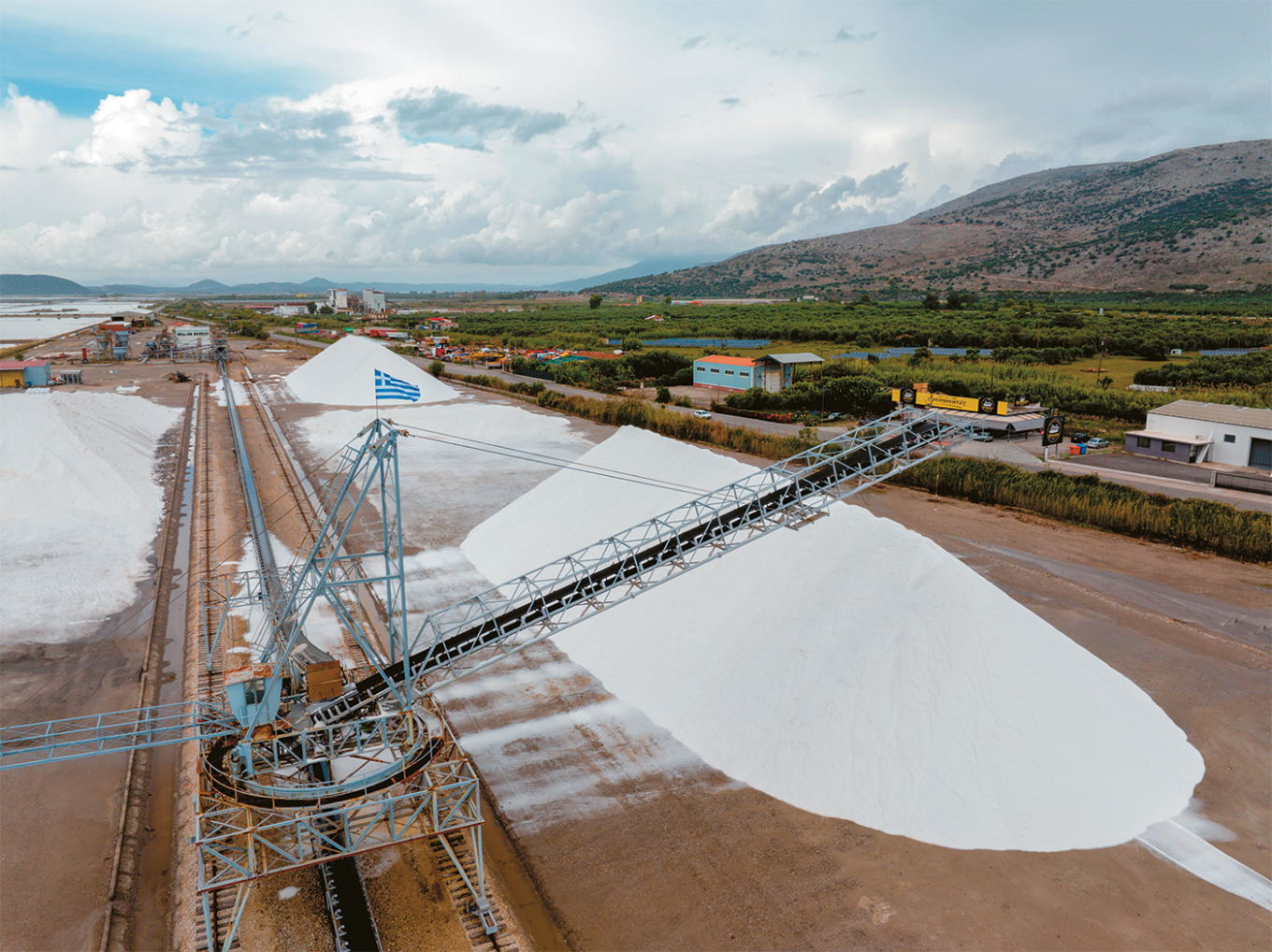
The company succeeded the historic Alykai Messolongiou S.A. and manages saltworks in:
- Messolonghi
- Kalloni (Lesbos)
- Polichnitos (Lesbos)
- Aggelochori (Thessaloniki)
- Kitros (Pieria)
- Mesi (Komotini)
- Nea Kessani (Xanthi)
In 2018, the Greek state’s 55.19% stake was transferred to the Hellenic Corporation of Assets and Participations (HCAP). In 2023, HCAP increased its ownership to 80%.
The Municipality of Messolonghi owns 10.19%, while the remaining shares belong to several municipalities with holdings below 5%.
The company is not part of Greece’s General Government sector and receives no state budget funding.
Prospective investors will soon gain access to a Virtual Data Room to evaluate the company’s finances, future prospects, and investment requirements before submitting binding offers.
Despite Greece’s extensive coastline and centuries-old relationship with salt, annual domestic production amounts to only 200,000–210,000 tonnes, with Messolonghi accounting for the largest share.
By comparison, China produces more than 50 million tonnes annually, making it clear that Greece is unlikely to become a dominant global supplier, even if salt becomes a strategic industrial material.
A New Industrial Role
Technology is redefining salt’s purpose.
For centuries it has been used as:
- a seasoning,
- a natural food preservative,
- a de-icing agent for roads,
- and a raw material for the chemical industry.
Now, as a key ingredient in sodium-ion batteries, salt may be entering another golden age.
Historically, salt was once known as “white gold.” During the Middle Ages, empires—including the British Empire—built trade routes and expanded their influence around access to salt.
Even around 1800, salt was so valuable that one kilogram reportedly cost about four times as much as the same quantity of beef, largely because food preservation without salt was nearly impossible.
Waiting for the Boom
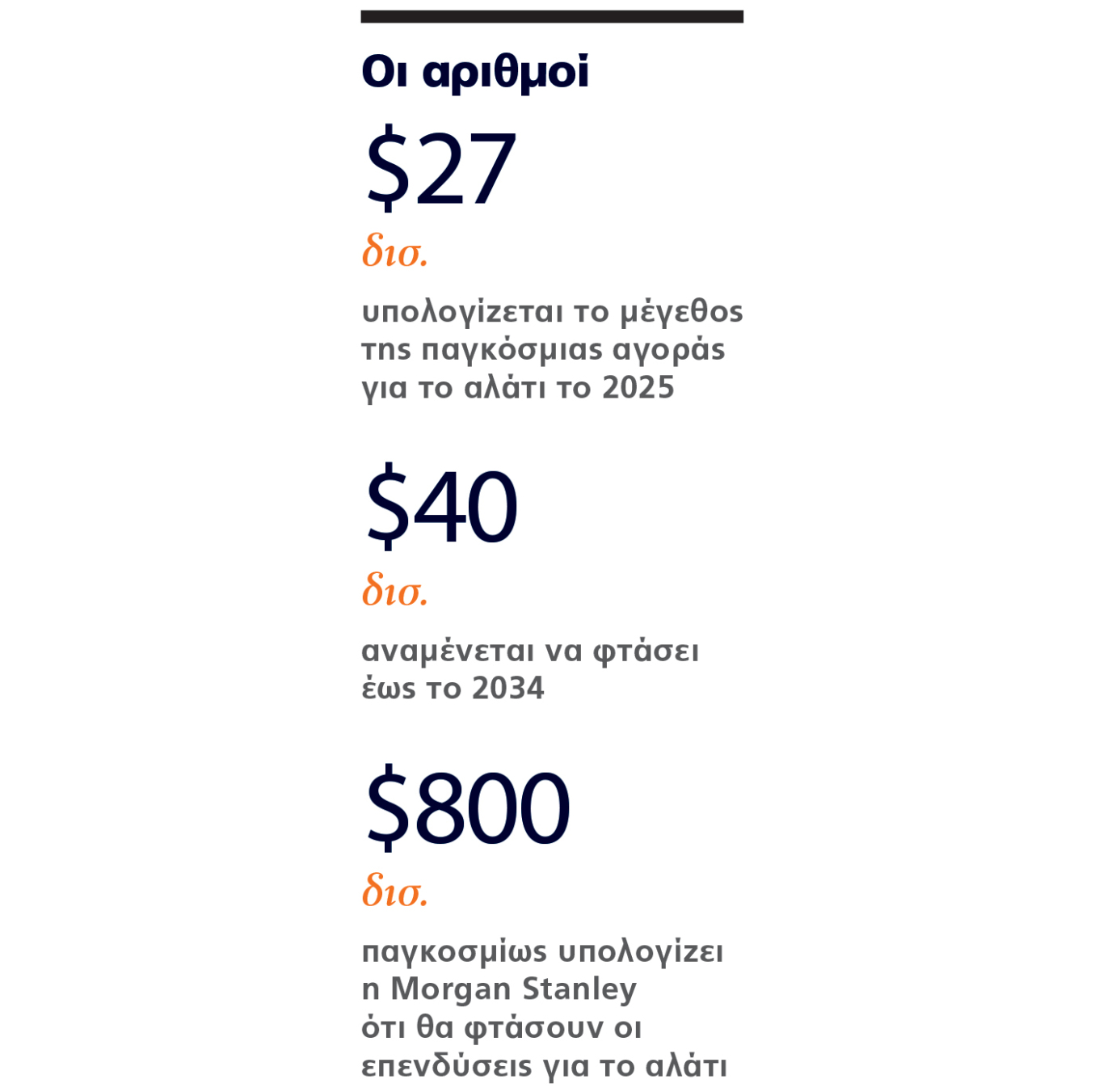
The global salt market is estimated to be worth around $27 billion in 2025 and is projected to grow to approximately $40 billion by 2034.
This outlook has fueled renewed discussion about making salt a fully traded commodity on financial markets.
The debate intensified after Jack Lu, Morgan Stanley’s Head of Asia Research for chemicals, oil, and gas, told clients that:
“Salt will become the next oil.”
According to Lu, as much as $800 billion could be invested worldwide in the infrastructure needed to support this growing industry.
He predicts that salt’s importance in the global raw materials market could increase dramatically—from roughly 2% today to around 20% by 2030 and approximately 37% by 2035, representing an increase of roughly 1,750%.
Why Sodium Batteries Matter
Lu’s forecast is based primarily on the growing importance of sodium-ion batteries, which offer several major advantages over today’s lithium-ion technology.
Unlike lithium, sodium is:
- abundant almost everywhere on Earth,
- inexpensive,
- easy to obtain,
- and already widely used across numerous industries.
Lithium and other rare-earth materials, by contrast, are exactly what their name suggests—rare, expensive, and difficult to extract.
Current lithium iron phosphate (LFP) batteries cost approximately 30–40% more to produce than sodium-ion batteries.
That cost advantage explains why Morgan Stanley believes sodium-based technology could attract enormous investment.
The Bigger Picture
In a letter to investors, Jack Lu and his colleagues at Morgan Stanley’s Hong Kong office argue that:
“In a world increasingly driven by artificial intelligence, and at a time when energy security has become critically important, sodium-ion batteries provide a solution precisely where energy security intersects with AI.”
The combination of chemistry, economics, artificial intelligence, and energy security is transforming salt into a strategic resource.
However, there is one major geopolitical complication.
China is not only the world’s third-largest producer of lithium—it is also the largest producer of salt, with annual output of roughly 53 million tonnes.
That is nearly twice the production of India, the world’s third-largest salt producer, and more than three times Germany’s output.
As a result, while sodium-ion batteries may transform the energy industry, they are unlikely to weaken China’s strategic position. If anything, the growing importance of salt could further strengthen it.
Ask me anything
Explore related questions




