





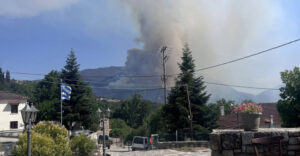
The Hellenic Thoracic Society (the professional body representing Greece’s respiratory medicine specialists) has issued guidance for residents and workers near active wildfire fronts, as well as anyone exposed to smoke and airborne particles, covering the likely health effects and how to stay safe.
Core guidance for periods of smoke pollution
- Move away from the fire front immediately.
- People with serious underlying conditions, the elderly, children and pregnant women should avoid travel altogether.
- Stay indoors as much as possible with windows and doors shut. Air conditioning, which recirculates the air already in the room, is encouraged in high outdoor temperatures provided the room is and can remain sealed from outside air. Otherwise, residents are advised to set up one protected, air conditioned room within the home.
- Avoid activities that further degrade indoor air quality, above all smoking.
- Candles for lighting, cooking over an open flame, aerosol products and vacuum cleaners are all discouraged for the same reason.
- Avoid exercise and physical exertion.
- If travel is unavoidable, wear a well fitted, high filtration mask (FFP2 or FFP3). Surgical or cloth masks do not protect against inhaling smoke or ash. Travel should be timed for cooler hours, such as the evening.
Patients with chronic respiratory or cardiovascular conditions should not travel at all, especially where a high filtration mask cannot be worn. Those with asthma or chronic obstructive pulmonary disease (COPD), conditions that are particularly worsened by this kind of environmental strain, must strictly maintain their prescribed medication and contact their treating pulmonologist immediately if symptoms worsen, so treatment can be adjusted.
The public, especially on days of heavy atmospheric pollution from wildfires, are advised to follow official air quality announcements rather than relying on smell or sight alone. Real time air pollution data, particularly for PM2.5 particulates, is available through online dynamic maps, including those run by the Greek environment and energy ministry and the European air quality monitoring platform PurpleAir.
Possible symptoms and effects of short term smoke exposure
The most common symptoms linked to short term smoke exposure, regardless of cause, affect the upper respiratory tract: nasal congestion, a runny nose and a dry, scratchy throat. A dry, irritating cough may also develop, and breathlessness can occur even in people with no underlying condition.
Systemic symptoms such as dizziness, nausea, fatigue and headache may point to carbon monoxide poisoning, which should be investigated immediately and reported to a doctor.
These symptoms can appear in otherwise healthy individuals, but they occur more frequently and more severely in people with underlying conditions, particularly of the respiratory and cardiovascular systems.
Inhaling combustion products is known to cause thermal or chemical damage to the respiratory system. Direct thermal injury, caused by breathing in hot vapour close to the fire front, affects the upper airways.
Chemical injury is caused by inhaling organic microparticles of varying composition and size, or chemical irritants, and can affect both the airways and the lung tissue itself.
The leading immediate cause of death in a fire is asphyxiation, caused by the depletion of oxygen near the fire front combined with inhaling large volumes of smoke. A degree of chemical asphyxiation, with systemic symptoms caused by the body’s inability to use oxygen at cellular level, is also frequently present.
Chemical asphyxiation results from inhaling products of incomplete combustion, such as carbon monoxide or hydrogen cyanide, released when materials like plastics or other nitrogen containing substances burn.
Further from the fire front, inhaling microparticles and chemical irritants can still cause harm to a significant number of people, affecting both the respiratory and cardiovascular systems. The severity and extent of this harm from inhaling particles and/or toxic gases depends on several factors, including the size and diameter of the particles, the duration of exposure, the solubility of the toxic gases, and whether the person has an underlying condition. As noted, the resulting respiratory toxicity can affect the upper airway, the tracheobronchial tree and the lung tissue itself.
Ask me anything
Explore related questions




