





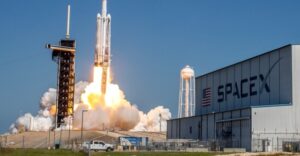
The upper stage of a SpaceX Falcon 9 rocket is expected to crash into the Moon on August 5, according to NASA, after an uncontrolled trajectory placed it on a collision course with Earth’s natural satellite. The object is traveling at approximately 2.43 kilometers per second—nearly 8,750 km/h—the BBC reports.
NASA’s Center for Near-Earth Object Studies (CNEOS) has confirmed that the rocket stage will impact the Moon after independent astronomers, using publicly available tracking data, determined that the component from a January 2025 launch was on an unavoidable collision course.
“There is absolutely no danger to Earth,” NASA spokesperson Jimmy Russell said, adding that the agency will continue monitoring the object both for educational purposes and to study the impact site afterward.
A Rocket Stage the Size of a Five-Story Building
The Falcon 9 was launched as part of a U.S.-Japanese mission carrying two lunar landers and scientific equipment to the Moon.
While much of the Falcon 9 is reusable and returns to Earth, its upper stage remains in space after separation. The section expected to strike the Moon is roughly the size of a five-story building and weighs at least four metric tons.
Astronomer Bill Gray, who first calculated the object’s trajectory, estimates that the impact will occur near Einstein Crater, on the sunlit side of the Moon visible from Earth. The collision is expected to create a new crater more than 17 meters (56 feet) in diameter.
A Unique Scientific Opportunity
The impact is expected at approximately 06:35 GMT on Wednesday and has already attracted the attention of both professional and amateur astronomers.
Dr. Matt Bothwell, public astronomer at the University of Cambridge, described the event as a remarkable natural experiment.
He explained that the collision will eject a massive cloud of lunar dust that could rise more than 50 kilometers (31 miles) above the surface before spreading across the Moon.
Because the Moon has virtually no atmosphere and much weaker gravity than Earth, nothing will slow the rocket stage before impact. Millions of kilograms of debris are expected to be blasted into space without atmospheric resistance.
What Will Be Visible From Earth?
The impact itself will not be visible to the naked eye. However, observers with powerful telescopes may be able to detect a brief flash on the Moon’s surface at the moment of impact.
For scientists, however, the visual spectacle is secondary to the data it will provide. Large telescopes in the Americas, NASA’s Lunar Reconnaissance Orbiter, and South Korea’s Danuri lunar spacecraft will monitor the flash, dust cloud, and newly formed crater in real time. A citizen science project is also encouraging amateur astronomers to record the event.
Researchers hope that analyzing the dust plume will reveal how much material is ejected, how high it rises, and how it settles back onto the surface. These findings are expected to improve models of lunar impacts and provide valuable insights into the layers just beneath the Moon’s surface.
A Reminder About Space Debris
Beyond its scientific value, the collision also highlights the growing problem of space debris.
“More people should be concerned about space junk,” Dr. Bothwell said, warning that more objects are being launched into orbit every year, while collisions between defunct satellites continue to generate new fragments, increasing the risk of an uncontrolled chain reaction.
According to the European Space Agency (ESA), more than 54,000 objects larger than 10 centimeters are currently orbiting Earth. Since the beginning of the Space Age in 1957, humanity has launched approximately 17,000 tons of material into space.
The last time a discarded rocket stage struck the Moon was in 2022, when the upper stage of a Chinese Long March 3C rocket impacted the Moon’s far side. Decades earlier, NASA intentionally crashed spacecraft into the Moon as part of the Apollo program to collect scientific data.
Ask me anything
Explore related questions




