





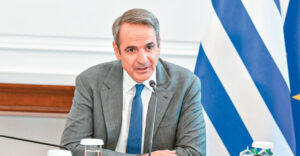
Until the devastating wildfires broke out in western Attica, a more relaxed, summer rhythm had settled over Maximos Mansion, the prime minister’s official offices, with Kyriakos Mitsotakis and his closest aides working through the government’s last outstanding business before a brief summer break. The ordeal of recent days, however, has upended those plans, putting the government’s core team back on high operational alert, with back-to-back meetings focused on managing the fallout from the fire.
Mitsotakis is in his office again this week, as are his closest aides. Despite the fresh ordeal of the major fire in western Attica, one thing has not changed: the political timetable for the next general election. Those close to the prime minister insist the decision to go to the polls in spring 2027 was taken long ago and is not affected by recent events, with Mitsotakis repeating at every opportunity that the government intends to serve out its full four-year term.
“I said from the outset that I would go to elections at the end of the four-year term. I have listened to other proposals, but I am sticking to my decision that this government will serve its full term,” Mitsotakis has told those around him, Proto Thema understands. Admittedly, for a time Mitsotakis, who usually brushes off such suggestions, did listen to them. He heard out the arguments put to him without ever agreeing or coming round to their view. He clearly weighed things up privately, but chose not to call an early election, for a series of reasons he has explained to both ministers and those close to him.
“We can, and I believe we will, do even better, much better than the polls currently suggest. We are the only ones with a plan. At the Thessaloniki International Fair [TIF, the annual trade fair where the government traditionally previews its economic policy for the year ahead], and this matters a great deal, we will set out the first pillars of what we want to achieve by 2030. Time is working in our favour, it is exposing how threadbare our political rivals are, and it lets us unveil our plan. Do not be afraid of political time,” Mitsotakis said on Thursday, at the end of the Cabinet meeting.
He is not saying this by chance. Mere rumours that he was weighing an early election for the end of September were enough to push Alexis Tsipras, the former prime minister, and Maria Karystianou, the paediatrician and campaigner who founded her party after losing her daughter in the 2023 Tempi rail disaster, to bring forward their own plans and announce their new parties. Tsipras offers Mitsotakis a first-class strategic rival for comparison, while Karystianou’s case is more of a headache for Maximos Mansion, though her party has run into dangerous territory with a string of officials quitting its ranks.
As for Antonis Samaras, himself a former prime minister, that is a different case altogether. Either way, Mitsotakis is banking on stretching out the political timeline, both to rally his own forces and in the hope of wearing down his rivals.
Three reasons why Prime Minister Kyriakos Mitsotakis is eyeing a May election
New Democracy, the governing party, will unveil a comprehensive plan for Greece 2030 on the road to elections due in spring 2027
Busy months ahead
For Mitsotakis, the period after the summer break is an opportunity for the government to put its foot down on the accelerator. He has already asked his ministers to go on the media and defend the government’s overall record, not just champion the achievements within their own portfolios.
Admittedly, those willing to put their heads above the parapet remain a minority within the Cabinet, and Mitsotakis knows it, even though he has no plans to reshuffle the government before the end of its term. “Unless one of you gives me an unpleasant surprise,” he warned during the closed-door session of Thursday’s Cabinet meeting.
Politically, Mitsotakis has two central arguments: political stability, and the ability to produce a vision and strategic priorities. “In this geopolitical climate, where you don’t know what tomorrow will bring, especially with the Strait of Hormuz, it matters that there is a steady hand on the wheel,” he tells everyone he speaks to.
TIF is a key milestone in Maximos Mansion’s planning. At Nikis Street, home of the finance ministry, Kyriakos Pierrakakis, the Minister of National Economy and Finance, and Deputy Minister Thanos Petralias are already working hard on the package, which Proto Thema understands will be sizeable and will include favourable measures for every social group: the self-employed, pensioners, salaried workers, civil servants and farmers.
“We will speak to every social group. That is the guiding principle behind the TIF package too, there will be something for everyone,” Mitsotakis tells those he speaks with, without going into much detail. The discussion, after all, is confined to a tight inner circle involving officials from the economic team, Maximos Mansion and the communications team tasked with framing the message.
Polling data make clear that New Democracy needs to win back key social groups. For the self-employed, officials are working on a formula to reduce or even scrap the presumptive minimum income tax rule, tying any relief to a good tax-compliance record, although a final decision has not yet been made. As for farmers, alarm bells keep ringing at Maximos Mansion, since correctly timed payments this winter will be crucial.
“We need time to rebuild our relationship with farmers too, and that means correctly timed payments, like the ones made in June,” Mitsotakis has acknowledged to those around him. Recent hailstorms on the Thessalian plain caused unrest, prompting the minister responsible, Margaritis Schinas, Minister of Rural Development and Food, to move quickly to table an amendment providing immediate, full compensation that will be tax-free and protected from seizure. The government cannot risk further cracks in a farming constituency it has traditionally relied on, since several smaller parties have begun making inroads there. It is no coincidence that farming union figures once loyal to New Democracy, such as Kostas Mitrodimos in Larissa, recently staged a rally in support of Karystianou, with Mitrodimos even sending out mobilisation texts in the style of election candidates.
More broadly, Mitsotakis believes economic measures take time to show results. Last year’s TIF proved the point: the economic measures only fed through from winter onwards, at which point New Democracy picked up two to three points in the polls. Voters, it seems, are not easily won over by promises, but attitudes shift once they see the relief in their own pockets. That is what happened last year with the rent subsidy, the top-up for pensioners and, above all, the tax cuts for salaried workers, particularly those with children.
Three reasons why Prime Minister Kyriakos Mitsotakis is eyeing a May election
Maximos Mansion is banking on the party’s new secretary general, Konstantinos Kyranakis, to rally right-leaning voters back to the fold

What is at stake
People come and go through the offices of Maximos Mansion, while Mitsotakis runs through the long-term planning on paper. He has always been politically meticulous, and when he has the luxury of time, he likes to draw up longer-term plans.
That meticulousness has won him crucial points before, such as in 2019, when he swept into Maximos Mansion with a ready-made team and clear political priorities already in place. A great deal has changed since then, however: the natural wear of time and the cumulative toll of politics have both taken effect.
That is why a sharper dilemma is needed, beyond Tsipras’s role as the bogeyman opponent. After all, the former prime minister still unsettles centrist voters, some of whom now sit with PASOK, the main opposition party, but not to the extent he once did. For Mitsotakis, stretching out the political calendar and serving the full four-year term dovetails with the prospect of Greece taking over the rotating presidency of the Council of the European Union on 1 January 2027.
Mitsotakis has already begun linking that prospect to the possibility that the complex negotiations over the EU’s new Multiannual Financial Framework for 2028 to 2034 could be concluded during Greece’s presidency, as he mentioned recently while in Vienna. The question this raises, indirectly but unmistakably, is clear: who should be negotiating that package? “It is obvious there will be stakes tied to the Greek presidency, since the negotiations on the 2028 to 2034 MFF will most likely be wrapped up during it. The country will need to have a government in place at that point,” Mitsotakis tells those who ask him about it.
For Mitsotakis, this is not about exploiting a significant national moment for the first time since 2014, but political realism. “Even I, if I were Mitsotakis, would call an election very close to the Greek presidency,” one minor opposition party leader admits to Proto Thema. Nikos Androulakis, leader of PASOK and of the official opposition, believes on the other hand that Mitsotakis should go a little earlier, since European partners would otherwise have reservations, although the Spanish Prime Minister, Pedro Sánchez, did something similar years ago.
Either way, several dates are being whispered about within New Democracy, with 23 May mentioned most often. Mitsotakis, however, is keeping his cards close to his chest on the exact date, though ultimately it matters little whether the vote falls in April or May. It is worth noting that Easter next year falls on 2 May, which effectively frames the available election window.
The new voters
At Maximos Mansion, officials are also poring over polling data and the focus groups held towards the end of July, which capture the mood of the electorate. The picture that emerges is of New Democracy hovering around 30%, with further reserves among undecided voters who are, in reality, its own former supporters.
The government’s strengths are seen to include foreign policy and defence, digitisation, economic management and improvements to the National Health System (ESY). There are also signs of the New Democracy base pulling together, and the ruling party has always performed well among older voters. It is widely accepted that New Democracy is “bleeding” support among working-age citizens, particularly those between 30 and 40, who still do not earn especially high salaries and are also grappling with the high cost of housing.
The cost of living emerges as the number one problem in the qualitative findings too, with voters appearing unmoved by constant government messaging on achievements unrelated to income, and instead demanding better pay, above the rate of inflation. In any case, what the focus groups point to as a strategic necessity is for New Democracy to appeal consistently to centrist and centre-right voters rather than reaching further to its right, while offering a vision for the next four years. According to those close to the party’s internal team, that horizon towards a Greece of 2030 must obviously be tied to measures that boost incomes, to reforms and institutional change, and to structural shifts in the primary sector.
Corruption scandals, meanwhile, are being counted by voters among the government’s negatives and are affecting Mitsotakis’s own standing too, which is now converging with the ruling party’s own poll numbers. Even so, Mitsotakis remains the political leader trusted most to handle the country’s critical issues, and there is a critical mass of voters in the electorate who have no appetite for upheaval.
At the same time, Mitsotakis has his eye on young, first-time voters too. “I attach huge importance to young people who will be voting for the first time. By the time the election is held, anyone born in 2010 will have the right to vote,” he tells those around him.
Around 400,000 voters will be added to the pool for the 2027 election, and New Democracy performs better among this age group than among people in their thirties, having already scored well with its tax-free allowance for under-25s. Along the same lines, Mitsotakis announced on Friday that tips will become effectively tax-free too, raising the threshold to €6,000 a year and applying it retroactively for the whole of 2026. It is something he has heard about on every one of his tours around the country, from workers and employers alike.
The Samaras factor
Naturally, one major topic of discussion within New Democracy concerns what will happen with Antonis Samaras’s prospective new party. The former prime minister did not take the bait over the early-election scenarios and did not rush to announce anything, unlike Tsipras and Karystianou.
Samaras will wait a while longer, judging that his interventions at this stage carry more weight with an air of biding his time, as with his recent broadside against Domna Michailidou, the Minister of Social Cohesion and Family, over her comments on the nuclear family. In the meantime, he is preparing the ground, talking to people, holding meetings at his office on Dimokritou Street, and working towards eventually forming a new political grouping.
Mitsotakis, for his part, does not want to say much about Samaras. He believes New Democracy is moving at a far better pace than in the past, crediting some of that to the energetic approach of Kyranakis, the party’s new secretary general, who took over after the party congress. “Let’s see if it even happens first,” he says cryptically about a possible Samaras party to anyone who asks him, although Maximos Mansion is well aware of the former prime minister’s moves.
The prime minister is an experienced campaigner with a good feel for his party’s grassroots, as do those around him who take its pulse on a daily basis. “There will be very strong reactions within the New Democracy base, and he needs to weigh that up,” Mitsotakis tells those he speaks with. There is no channel of communication with Samaras, and should he go ahead and form a party, he will be treated as a political opponent.
Ask me anything
Explore related questions




