





Whenever Aristotle returned to nature, he was seeking not so much confirmation of what he already knew as the things he had yet to discover. It is no coincidence that, in the Metaphysics, he wrote that people began to philosophise because they first marvelled at the world, knowing that wonder comes before knowledge.
It is a moment in which the gaze slows, the self-evident ceases to be self-evident, and a simple olive leaf becomes the starting point for another way of understanding the world.
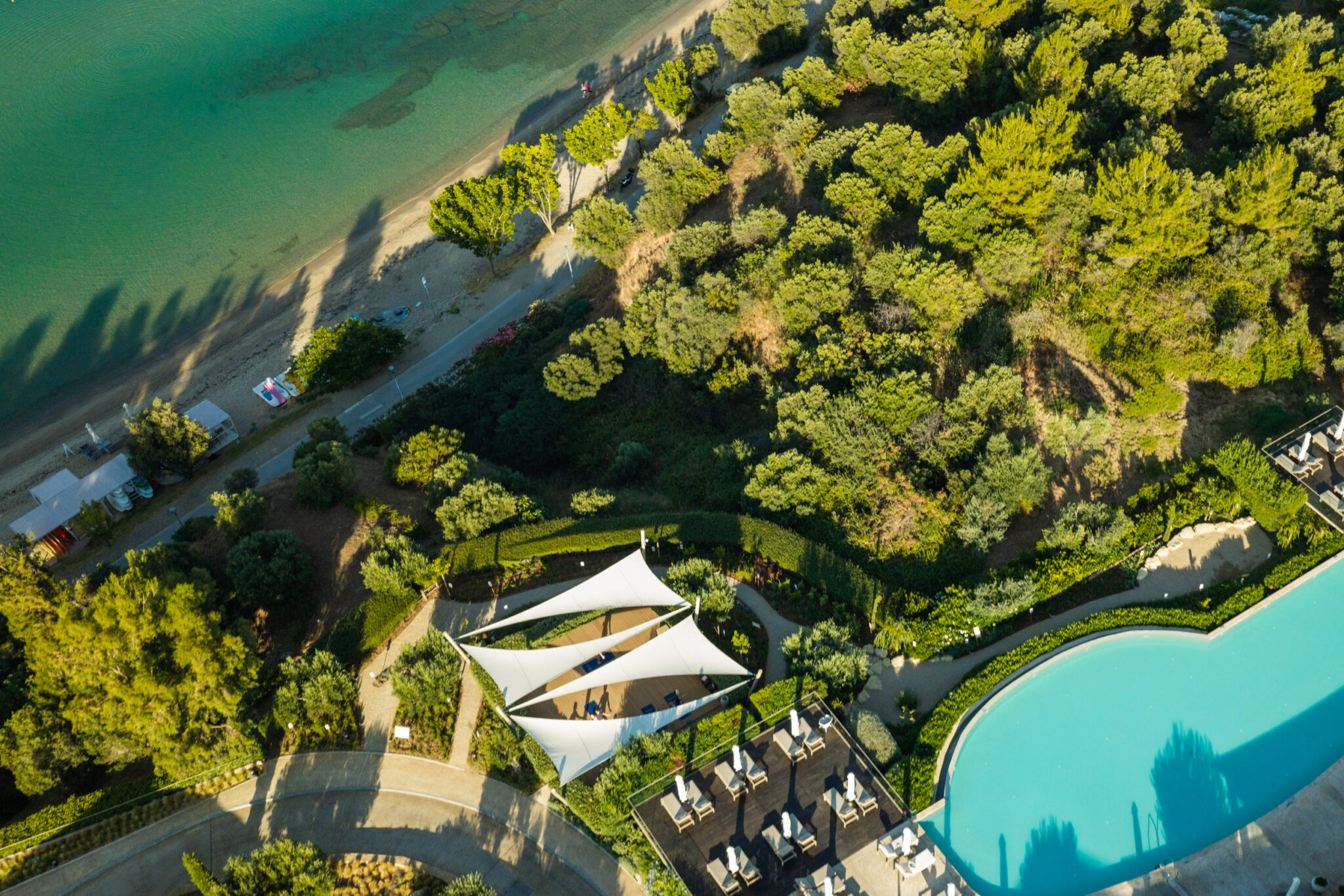
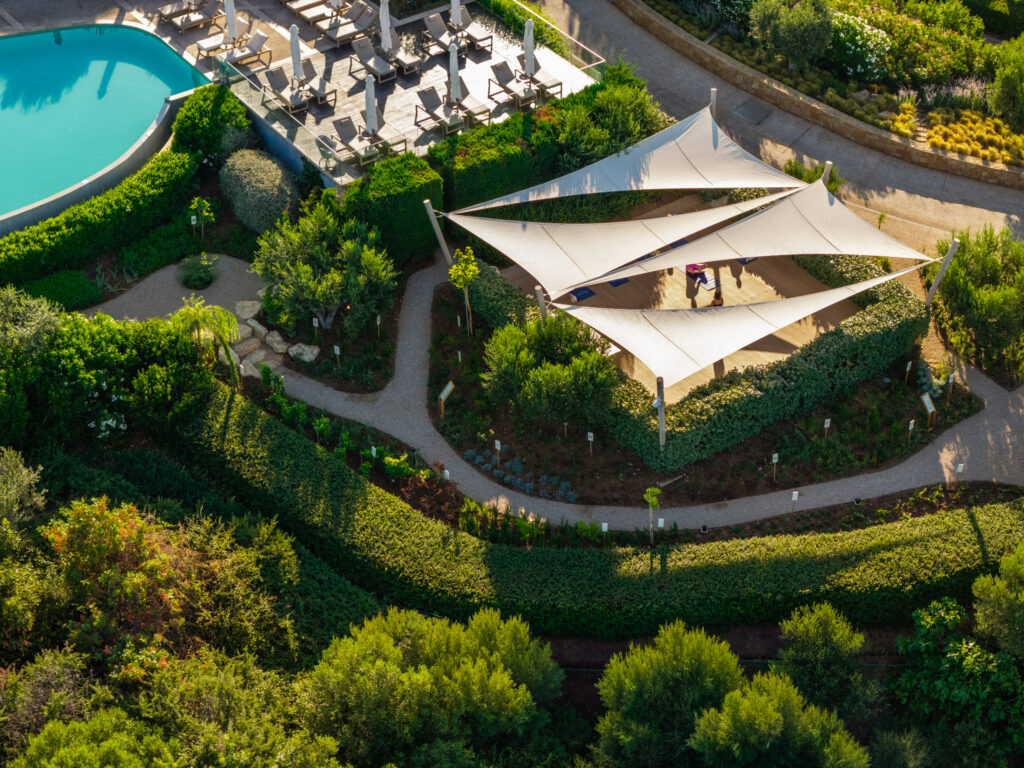
Perhaps that is why the Garden of Wisdom, created at Ikos Oceania in Halkidiki, feels less like a botanical garden than an open invitation to walk, if only in the imagination, for a while beside the philosopher who changed the way the West thinks.
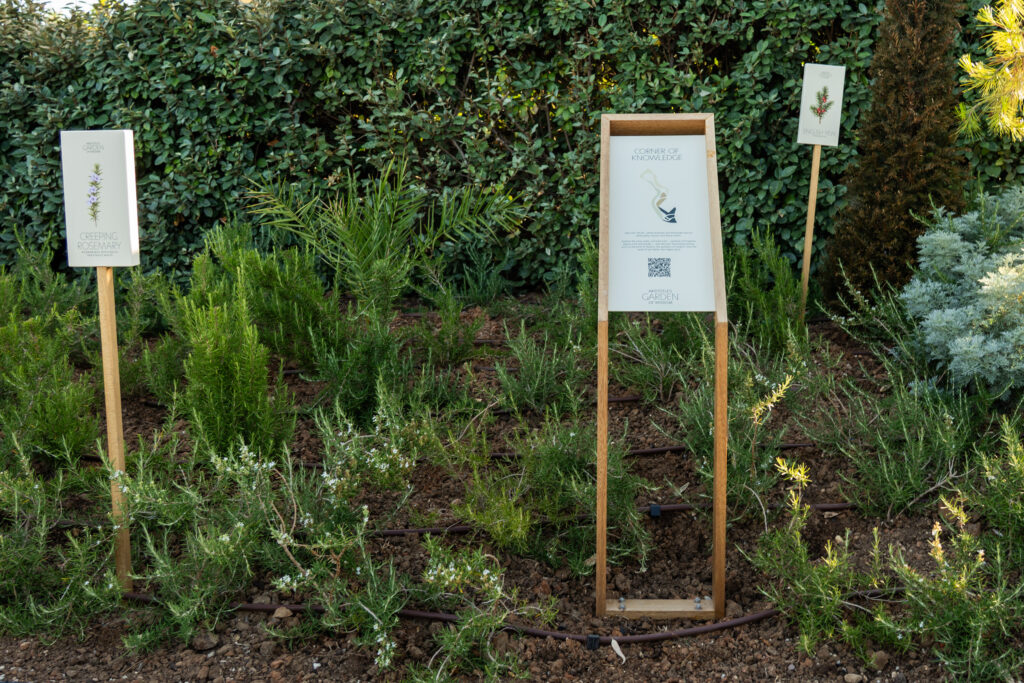
As we visited the garden, listened to the stories associated with the rare plants Aristotle documented, and discovered varieties we had not even known existed, we realised that the experience in its entirety was closely connected to the way philosophy was understood in antiquity.
What is the Garden of Wisdom?
Aristotle was, after all, not only one of the greatest philosophers in human history, but also a tireless observer of everything around us.
One of his central ideas was that knowledge does not begin with grand theories, but at the moment when someone stops before a tree and decides to look at it closely; when they bend over a plant not simply to admire its beauty, but to ask why it flowers in this season rather than another, and why it resembles yet differs from all the rest.
“Nature does nothing in vain,” he wrote, encapsulating in a few words an entire worldview in which even the humblest leaf has a reason for being and a story worth telling.
It is not difficult to imagine that this way of seeing was born long before Plato’s Academy or the Lyceum of Athens, in Stagira in Halkidiki, where Aristotle spent the first years of his life among forests, coastlines and aromatic plants, in a landscape where sea meets mountain and the horizon leads, almost inevitably, to the imposing presence of Mount Olympus.
That same geography, which shaped one of the most important thinkers of all time, now provides the natural setting for the Garden of Wisdom at Ikos Oceania in Halkidiki, transforming a visit from yet another chapter in cultural tourism into an experience that returns the visitor to philosophy’s most essential act: observation.
Perhaps this is the project’s most compelling feature: the Garden of Wisdom does not attempt to recreate antiquity as a scene frozen in time, nor does it turn Aristotle into yet another monumental symbol. Its ambition is more complex: to revive the way in which the philosopher of Stagira understood the world.
Visitors are invited not merely to learn which plants grow in the garden, but to ask why those plants became associated with particular ideas, gods, virtues and myths. In doing so, the garden reveals that, for the ancient Greeks, nature was never a neutral landscape, but a language rich in symbols, almost invariably imbued with the divine.
If the narrative of the “Garden of Life”, created by the Ikos Group on Kos in honour of Hippocrates, revolved around healing, herbs and medical knowledge, here the focus shifts to the very process of thought.
As Eleni Andreadis, ESG Senior Director at Sani/Ikos Group, has aptly observed, these gardens aspire to “connect the wisdom of the past with the experience of the present”, creating spaces that go beyond aesthetic pleasure to inspire, educate and engage the visitor.
The same philosophy runs through the Garden of Wisdom, which treats cultural heritage not as a precious object to be viewed, but as a living experience that continues to speak to people today. As she added: “With climate change, biodiversity loss and plastic pollution threatening tourism development across the Mediterranean – and beyond – sustainability is the only way forward.
“A strategic approach to sustainability must be holistic. On the critical issue of climate change, it means contributing to mitigation while simultaneously implementing adaptation measures and, as a result, increasing preparedness for its impacts. This comprehensive framework of action will help us safeguard Greece’s future as a tourism destination, while enabling us to advance and establish our country as a world-leading sustainable destination.”
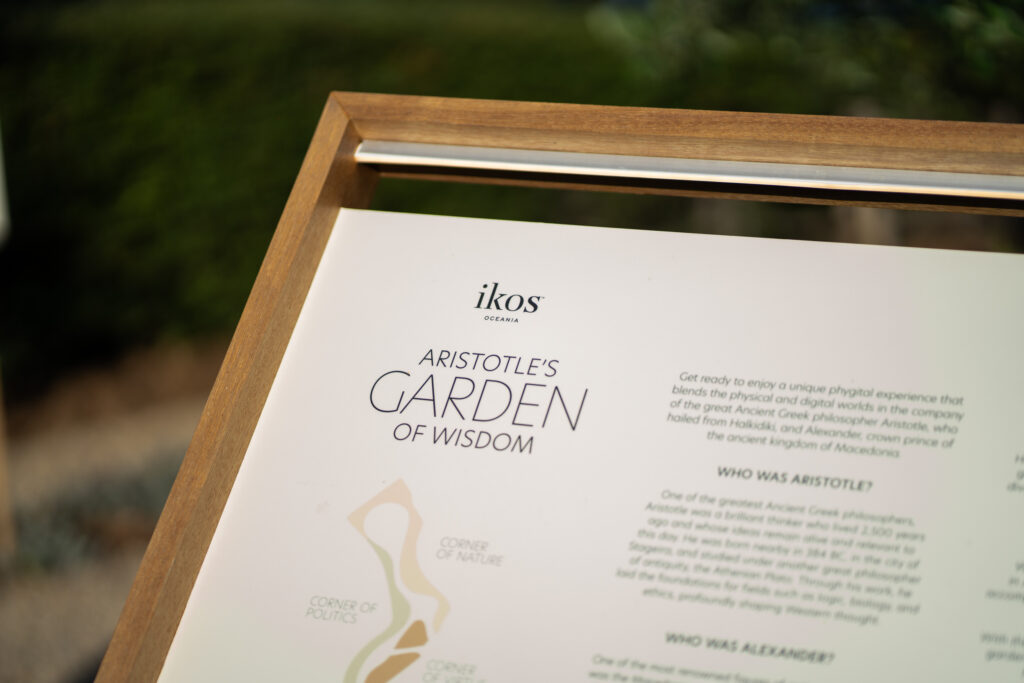
There is, however, another dimension to the Garden of Wisdom, one that reveals itself only when visitors lift their gaze from the plants for a moment and allow the horizon to complete the story.
Across the way, rising almost like a stage set requiring no directorial intervention, stands Mount Olympus, the mountain of the gods. Beyond Halkidiki’s tranquil present-day horizon, one can still discern, if only in the mind’s eye, the land where Aristotle was born, the realm of Philip II and Alexander – a place where history, mythology and philosophy are not successive chapters but layers in a narrative palimpsest.
The presence of Alexander, so vivid and immediate in the digital experience accompanying the garden visit, is integral to this idea. He is not presented as another historical exhibit, nor as an attempt to capitalise on the great commander’s fame. The young pupil conversing with his teacher beneath the shade of the trees reminds us that one of antiquity’s most important relationships was forged not in the imposing halls of a palace, but through conversation, curiosity and walking.
Before Alexander had ventured into the far reaches of the East, he had already been taught to observe, to question and to doubt. It is perhaps this educational dimension of Aristotelian thought that the Garden of Wisdom revives most convincingly.
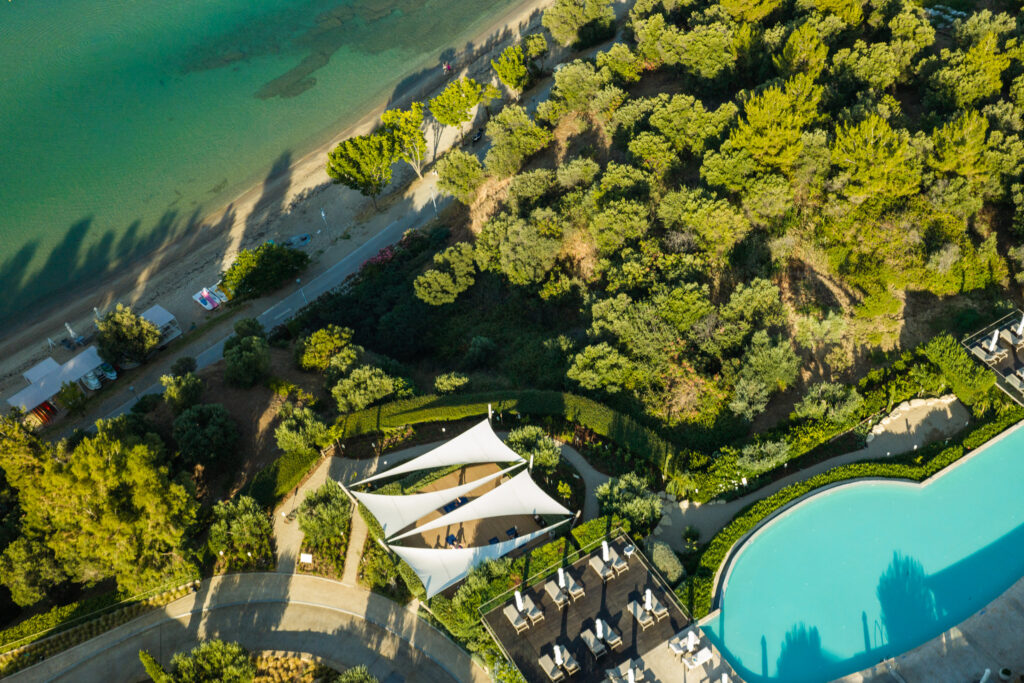
Rigorous scientific research and distinguished contributors
It is no coincidence that the project’s creators did not confine themselves to designing a beautiful landscape. Giving the undertaking its historical and scientific depth required the collaboration of people from entirely different fields.
The cultural and mythological research was carried out with contributions from the DIAZOMA Association and Vassilis Lambrinoudakis, Professor Emeritus of Classical Archaeology at the National and Kapodistrian University of Athens and one of the leading scholars of ancient Greek thought and landscape. The ethnobotanical curation was entrusted to Dr Eirini Vallianatou, who approached the plants not merely as biological species, but as bearers of memory, culture and local tradition.
Equally compelling is the project’s contemporary dimension. Archaeologist and author Katerina Servi conceived the idea and wrote the script for the digital experience, while its implementation was undertaken by the Narralive team at the Athena Research Center and the Department of Informatics and Telecommunications of the National and Kapodistrian University of Athens, under the scientific direction of Professor Yannis Ioannidis. The result is one of the most comprehensive digital storytelling applications designed for a garden of this kind in Greece.
Architect and Hellenic Open University professor Dr Stelios Zerefos served as the Garden’s design adviser. It is worth noting that the application does not compete with the physical setting. On the contrary, it acts as an invisible bridge between archaeology, philosophy, botany and the visitor’s contemporary experience.
And when the voices of Christos Loulis, who plays Aristotle, and Yannis Niarros, who portrays the young Alexander, begin to accompany the walk, visitors realise that technology need not distance people from nature. Used with restraint and imagination, it can bring them back to it with even greater immediacy.
That is why visitors do not feel that they are listening to a recorded tour, but that they are witnessing a conversation. Perhaps this is the most Aristotelian element of the entire undertaking: knowledge is not transmitted as a ready-made answer, but is born through dialogue, just as Aristotle would have wished.
Even the choice of plants follows this same narrative logic. The laurel is here not only because it is a characteristic Mediterranean species, but because it connects visitors with Apollo and the pursuit of knowledge. The oak evokes the sanctuaries of Zeus and the Macedonian royal dynasty’s deep bond with a tree that symbolised strength and endurance. The olive reminds us that, in the Greek tradition, wisdom was never separated from peace and a life lived in moderation. As for the pomegranate, when it opens to reveal dozens of small, crimson seeds, it seems to distil into a single image the ideas of abundance, continuity and ceaseless renewal.
This is where the Garden of Wisdom’s greatest achievement is perhaps most clearly expressed. It does not seek a nostalgic return to antiquity, nor does it turn Aristotle into a static thinker to be studied from a distance. Instead, it quietly suggests that great ideas remain alive only for as long as they continue to converse with life.
Aristotle’s thought, which began 23 centuries ago in this very place, seems to be returning to its natural setting. It escapes the display case of a museum and moves into a garden where light, wind, herbs and stories continue to compose what he himself would have recognised as the raw material of all genuine knowledge.
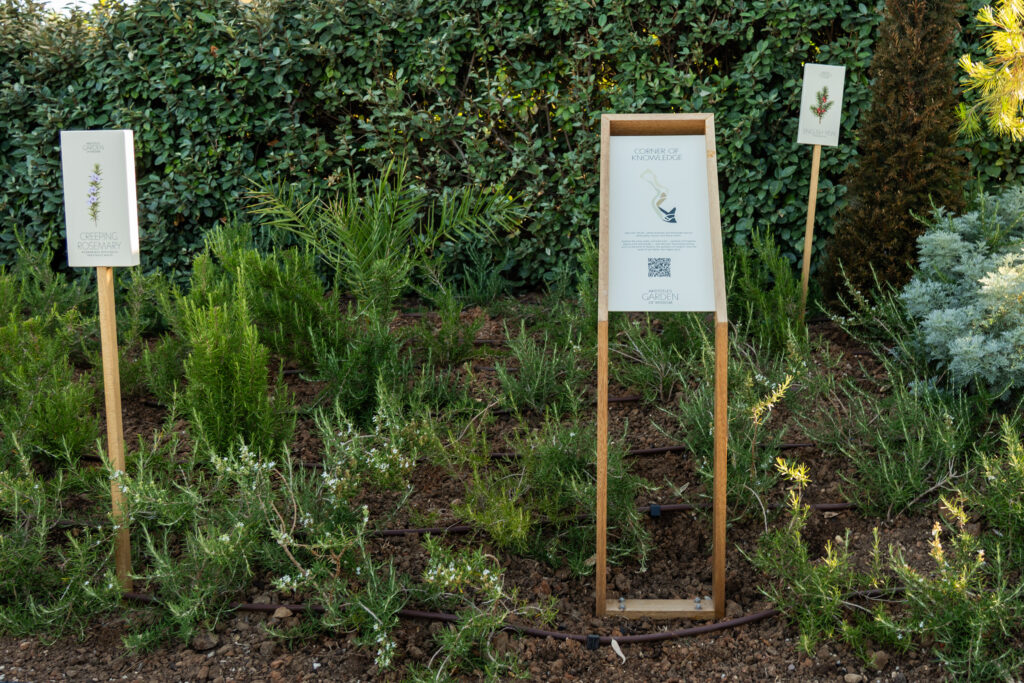
The contemporary relevance of the Garden of Wisdom
There is also a curious injustice in the way Aristotle is remembered. His name is immediately associated with logic, ethics and political philosophy, while it is sometimes forgotten that he was also one of antiquity’s most important naturalists: a man who devoted decades not only to thought, but to the persistent observation of the living world.
Long before the advent of modern science, the philosopher from Stagira had described hundreds of animal species, compared morphological characteristics, sought to understand the cycles of life and formulated an idea that was almost revolutionary for his time: nature is revealed not through conjecture, but through experience, observation and systematic recording.
This way of thinking would endure even more powerfully thanks to his beloved pupil and successor, Theophrastus. If Aristotle laid the foundations for a new relationship between humanity and nature, Theophrastus was the one who bent even closer to the plants, observing their roots, trunks and leaves, their flowering seasons, and the ways in which each species adapts to its environment. It is no coincidence that historians of science still call him the “father of botany”. Yet behind those first systematic descriptions lay no desire to dominate nature, but a profound conviction that human beings can become wiser only once they have first learnt to listen to it.
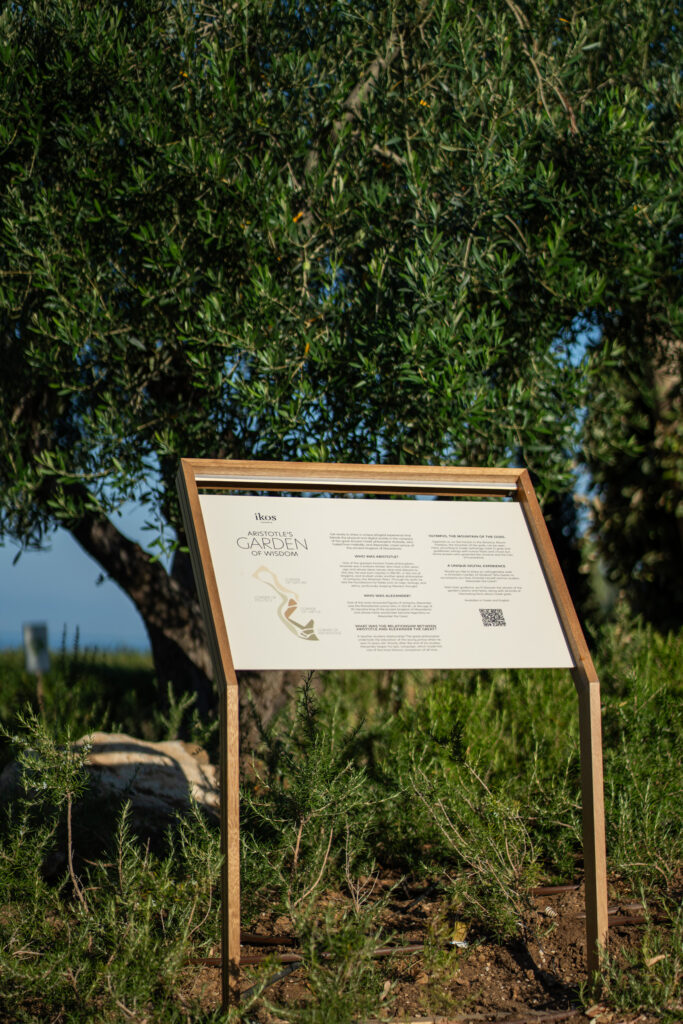
Perhaps this is where the Garden of Wisdom is most relevant today. At a time when the ecological crisis compels us to redefine our relationship with the natural environment, and disasters have become almost a daily reality – as the recent wildfires remind us – the garden does not propose an easy return to an idealised past. Instead, it reminds us of something far more essential: care for nature always begins with close observation and a deep understanding of it. We do not protect what we do not know; ultimately, we cannot truly know what we have not observed with care.
It is precisely there, in this almost imperceptible shift in our gaze, that the Garden of Wisdom ceases to be solely about Aristotle and comes to be about our own lives and identity.
Without didacticism or facile parallels, it reminds us that our relationship with the natural environment is built not only through momentous decisions or spectacular initiatives, but at the very moment when someone stands before a tree and chooses to see it not as part of the scenery, but as a living organism with its own history, its own lifespan and its own place in the world.
The Garden’s different sections
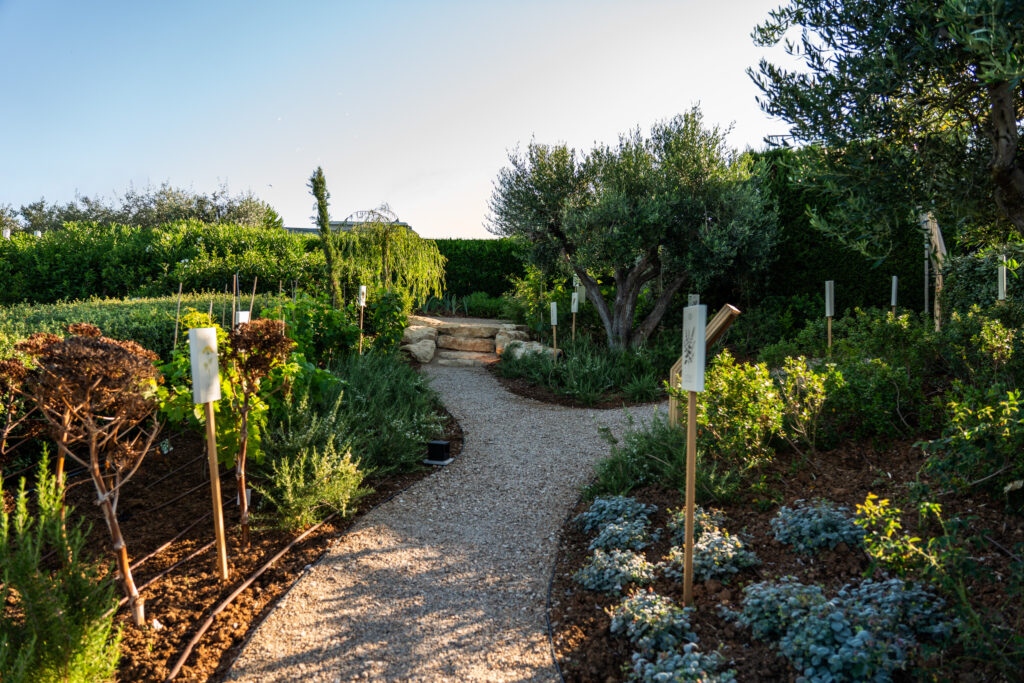
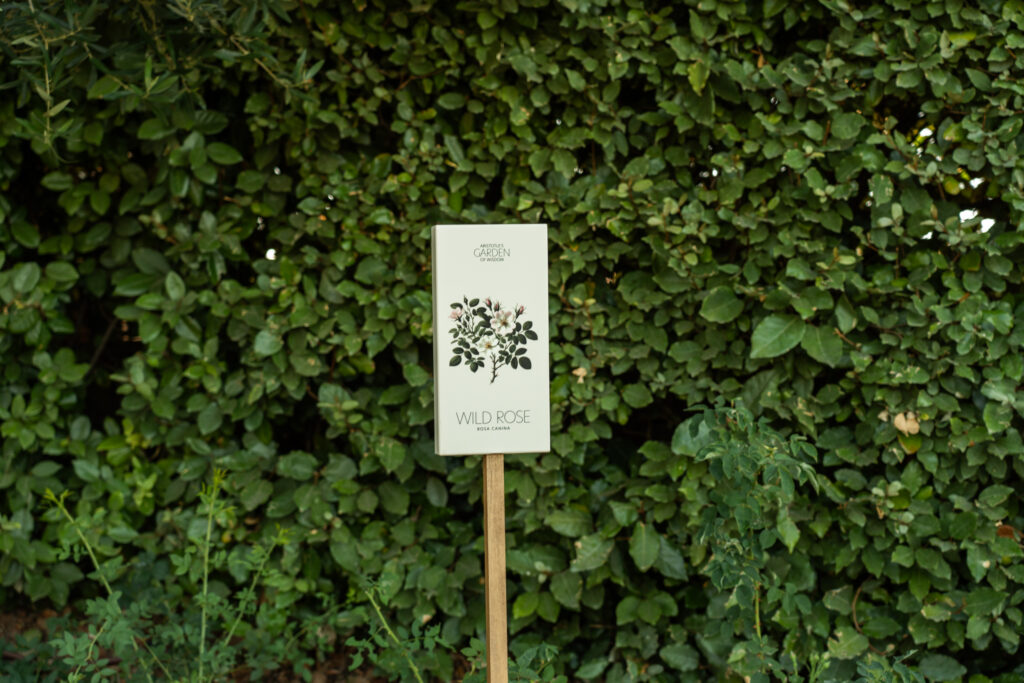
Perhaps this is why, as visitors wander among the garden’s four principal sections – Nature, Virtue, Politics and Knowledge – they realise that these are not four independent themes, but four chapters in the same worldview. In Aristotle’s world, nature gives rise to knowledge, knowledge shapes character, and virtue becomes the foundation of the city.
None of these ideas can exist in isolation, just as no ecosystem can survive when severed from the other elements that sustain it. As anyone strolling through this beautiful garden soon discovers, the information is there, as are the scientific references, but they are never imposed on the visitor.
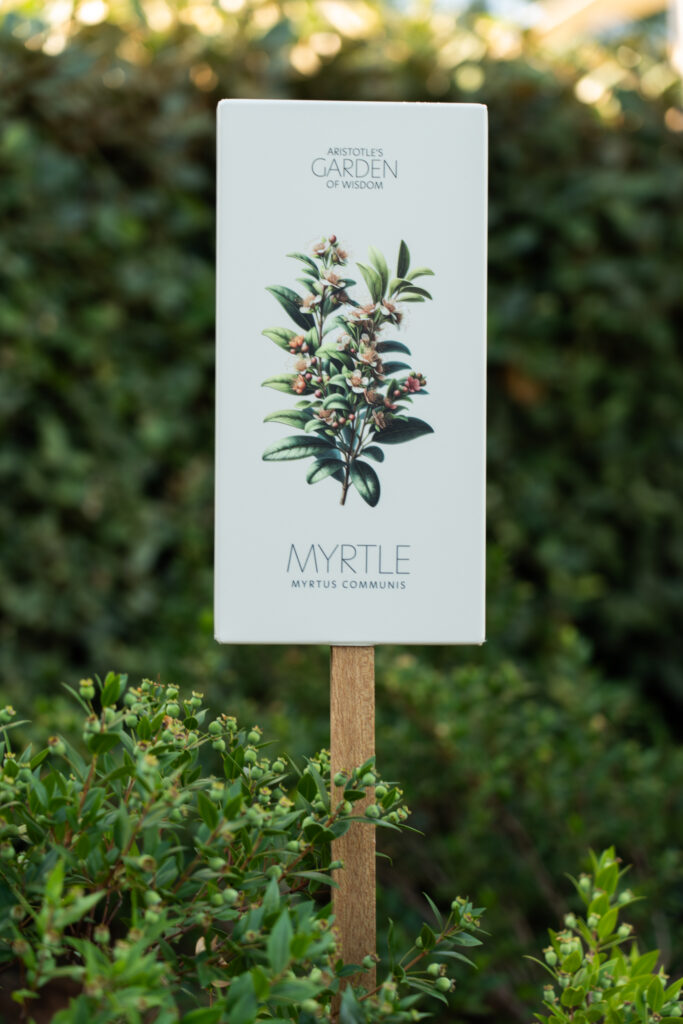
Visitors are given time to discover them for themselves: to pause before the myrtle without yet knowing that it was associated with Aphrodite; to touch, almost unconsciously, the trunk of an olive tree before reading why it became an enduring symbol of wisdom, resilience and peace; to follow with their eyes the shadow of a cypress moving slowly through the day, as though measuring a different kind of time from that kept by clocks. It is perhaps no coincidence that the path returns once more to the olive tree.
For if there is one tree that embodies the Greek experience of time, it is this one. It outlives those who plant it, withstands drought, regenerates even when its trunk appears dead, and carries from one generation to the next an almost unbroken memory of place.
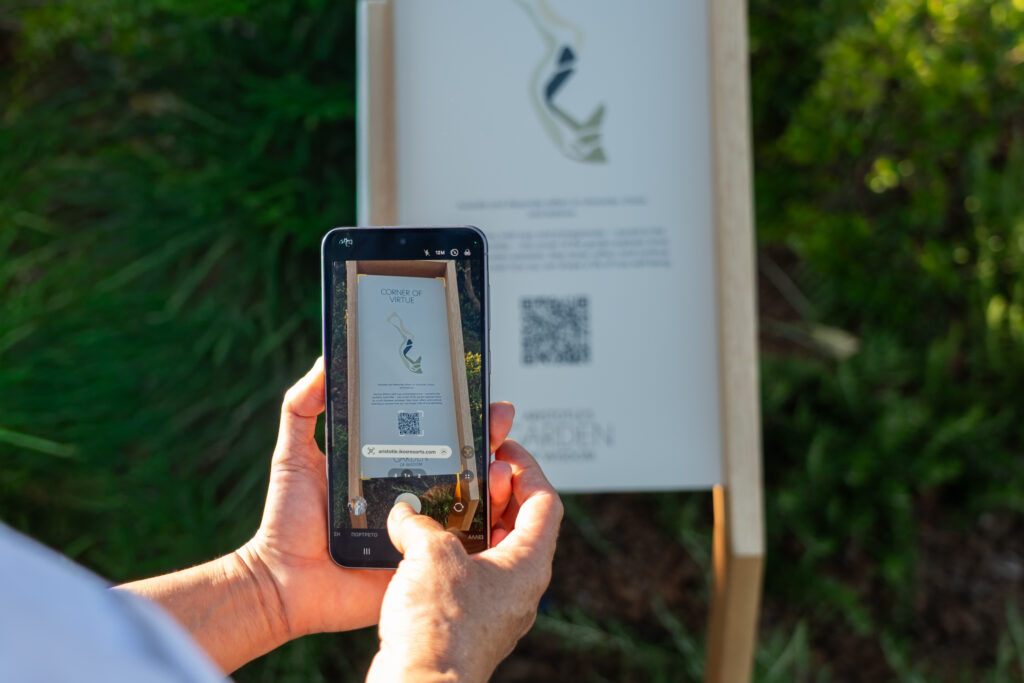
One might say that the olive is to the Greek landscape what Aristotle was to European thought: a presence so deeply rooted that we often forget how decisively it shaped the history of the place, symbolising its freedom and wisdom. Accordingly, the Garden of Wisdom does not ask visitors to follow a predetermined route. They may linger in Nature, return to Virtue, pass by Politics or begin with Knowledge. As in Aristotle’s own thought, there is no single point of entry, only the will to observe.
This freedom may be the undertaking’s greatest success. For the garden does not seek to recreate antiquity or to idealise it. It approaches it as a living conversation that continues to unfold. Everyone takes part in this conversation: the archaeologist who illuminates the layers of memory; the ethnobotanist who reads the history of plants; the narrator who gives voice to Aristotle and Alexander; the actor who lends them his tone; and the visitor who pauses before a pomegranate or a laurel and, if only for a moment, chooses not to hurry.
As the walk draws to a close, the gaze returns almost instinctively to where it began: to the olive trees changing colour as the light fades; to the cypresses that seem to converse with the sky; to the scent of myrtle and rosemary lingering in the air; and to the blue outline of Mount Olympus, steady on the horizon opposite.
What matters is not how much information one has retained, nor whether one remembers every plant or every historical reference. What matters is having grasped a profound worldview and allowed oneself a pause – one that may remain forever. Aristotle, after all, wrote: “For it is through wonder that people both now begin, and first began, to philosophise.”
Two and a half millennia later, in a garden in Halkidiki, in the land where the philosopher who transformed the way the West learnt to think was born, these words seem to recover their original meaning as a lived experience. They invite us to observe, to marvel and to listen closely to the world around us, turning experience into knowledge.
And so the garden ceases to be merely a landmark within the environmentally sensitive ecosystem of Ikos Oceania. It becomes a vivid means of rediscovering our relationship with a world we had forgotten we belong to – and which continually exceeds us.
Ask me anything
Explore related questions




