





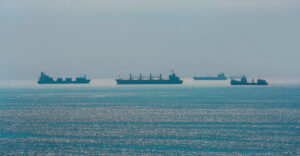
In the cabins of many ships that remain stranded in the Persian Gulf, sleep has long ceased to be a form of genuine rest. Seafarers sleep wearing their clothes so that they can leave their cabins immediately in the event of an alarm. Communication with home is often limited to a few minutes every several days, fresh food supplies are dwindling, and watches continue even when a ship has remained stationary for weeks.
Engines must be maintained, cargoes must be monitored, and all systems must remain constantly ready. For the approximately 6,000 crew members estimated to still be stranded in the wider region, the crisis is measured not only in missed passages, higher freight rates and millions of dollars in additional costs. It is measured in nights of anguish, delayed crew changes, limited supplies and the constant uncertainty over when they will return to their families.
At the beginning of the conflicts, approximately 20,000 seafarers, aboard nearly 1,500 commercial vessels, had been trapped in the Persian Gulf and surrounding maritime zones. Many gradually managed to leave, but thousands remain at sea under conditions that resemble prolonged wartime alert more than normal commercial activity.
The human toll shows that the threat is not theoretical. The International Maritime Organization (IMO) had recorded, as of August 4, 64 confirmed incidents against commercial vessels in the Middle East and 17 confirmed seafarer deaths. Every explosion, warning or report of an attack on a vessel in the region affects the crews’ watches, sleep and psychological state.
And returning to shore is not always easy, even when the shore is only a few miles away. Approvals from local authorities, coordination between governments, safe ports, and available air or land connections are required. Even when a seafarer is entitled to repatriation, putting that entitlement into practice can prove extremely difficult. Behind this human dimension, one of the most serious simultaneous disruptions to maritime trade routes in recent decades is unfolding.
The Strait of Hormuz, Bab el-Mandeb in the Red Sea and, by extension, the Suez Canal now constitute three successive “chokepoints” for global shipping. At the same time, the Black Sea has become a fourth, different in nature but equally dangerous, war front.
This is not simply a matter of three geographical points of tension. A new operational environment has taken shape, in which the decision to undertake a voyage now depends on military movements, sanctions, insurance exclusions, fuel prices and a shipping company’s ability to change its plans within a matter of hours. “Pressure on shipping is now being used as a tool of economic attrition, political influence and strategic control,” notes Alketa-Nikolaos Drosos, representative of EOS Risk in Greece and Cyprus.
Hormuz
The most critical point remains Hormuz. And the latest developments show that even reaching a political agreement does not necessarily mean a return to the free-navigation regime that existed before the war. On Wednesday, August 5, only two commercial-vessel transits were recorded, compared with approximately 130 to 140 per day before the war began. On Thursday, traffic recovered marginally, with four vessels passing through the Strait. In total, from Monday through Thursday, there were only 33 transits, compared with 50 during the corresponding four-day period of the previous week. The reality at sea, therefore, is far removed from the optimistic diplomatic statements.
Even more telling is the fact that only six crude-oil tankers exited Hormuz during the same week, while 21 vessels entered, most of them via the Iranian route. Chinese and Indian refineries appeared willing to take advantage of the steep discounts being offered for Iraqi Basra crude, but shipowners’ reluctance in the face of the risk remains strong.
“The greatest concern today is centered on Hormuz,” stresses Mr. Dimitris Roumeliotis, an analyst at Xclusiv Shipbrokers, pointing out that approximately one-fifth of global oil flows, as well as significant volumes of LNG, were transported through this passage. Iran is now seeking to link a possible reopening of Hormuz to a new system of navigation control. An Iranian parliamentary committee is examining a preliminary draft law that could prohibit the passage of American, Israeli and other vessels that Tehran characterizes as “hostile.” Fines for violations of the restrictions under consideration could reach as much as 20% of the value of the cargo being transported. The development is particularly significant for the shipping market, as it remains unclear exactly how a vessel would be defined as American, Israeli or “hostile.”
In commercial shipping, the flag is only one factor. A vessel may be registered in one state, owned by a company from another country, managed from a third jurisdiction, financed by international banks and chartered by a different commercial group. A broad Iranian interpretation could therefore affect many more vessels than the few flying an American or Israeli flag. At the same time, discussions between Iran and Oman are continuing over a new model for managing the passage. The proposal so far envisions a greater role for Tehran in inbound traffic toward the Persian Gulf, while for outbound vessels a route between Iranian and Omani waters is being discussed, with departure procedures being carried out through Oman following notification to Iran.
Central Corridor
Iranian sources also refer to a “central corridor” in which traffic could gradually be concentrated. This substantially changes the problem. The question is no longer simply whether Hormuz will open, but who will control entry, under what conditions vessels will pass, and whether access will remain free and without financial charges.
Before the war, the internationally recognized Traffic Separation Scheme divided traffic into designated lanes within Iranian and Omani waters. Today Iran is seeking a leading role in the future administration of the passage and is, in practice, challenging the previous model. And here perhaps the biggest obstacle for shipping emerges: money.
As part of the talks, Tehran is reportedly seeking charges amounting to 5% to 7% of the value of cargoes transported through the Strait. Oman is discussing a lower percentage, approximately 3%, while the U.S. position is that no mandatory charge should be imposed. For a shipowner, however, the issue is not merely the size of the payment.
The sanctions imposed by the United States on the Persian Gulf Strait Authority, the body created by Iran to manage the passage, create a serious regulatory-compliance issue. A payment to an Iranian entity could create problems for the shipowner, the charterer, the bank financing the vessel, or the commercial group controlling the cargo.
The situation is further complicated by the terms of the insurance market. A clause introduced for war-risk coverage provides that protection may terminate if a vessel pays a fee, toll or other mandatory charge for passage through Hormuz.
This creates a genuine deadlock. A vessel may need to pay in order to pass under Tehran’s requirements, but by making that same payment it could jeopardize its insurance coverage or create exposure to U.S. sanctions.
This is one of the main reasons why executives in the international shipping and insurance markets estimate that the agreement currently under discussion, in its present form, would be difficult to implement in practice.
Insurance Premiums
The global shipping community has already taken a position regarding the prospect of mandatory charges. The industry’s largest international associations have warned that a compulsory transit fee would essentially amount to a toll and would create a precedent for the international straits used for global navigation.
For the market, therefore, Hormuz is not simply a passage that has “opened” or “closed.” It is an area in which the shipping industry’s actual transport capacity has been reduced. Some vessels are waiting outside the Gulf, others are inside it without certainty as to when they will be able to leave, and companies are seeking each time a window during which they believe the risk is lower.
Every day of waiting increases the period for which a vessel is employed. The same fleet can complete fewer voyages during the year, reducing the capacity actually available in the market. At the same time, route changes increase ton-miles — that is, the product of the cargo carried multiplied by the distance that must be covered — thereby increasing demand for ships even when the overall volume of cargoes does not rise.
“When a route becomes dangerous, the market finds alternatives, even if these entail longer distances and higher costs,” says Dimitris Roumeliotis. The adjustment, however, comes at a price. War-risk insurance premiums are one of the most significant additional costs. During the crisis, charges ranging from 3% to as much as 10% of the insured value of a vessel have been reported, depending on the vessel type, cargo and route. For a large tanker, even a few percentage points can translate into costs of millions of dollars for a single voyage. This cost does not remain on the insurer’s or shipowner’s balance sheet. It is passed on to the charterer, incorporated into the freight rate, and ultimately increases the transportation cost of the cargo itself. At the end of the day, it reaches the consumer.
Fuel
Uncertainty surrounding energy flows is also affecting marine fuels. Particular pressure may be felt by marine gas oil, which is widely used by vessels operating in areas with stricter environmental regulations, such as the Mediterranean. Companies are thus simultaneously facing longer voyages, higher insurance premiums and fuel expenditure that is becoming more difficult to forecast.
The Gulf countries are attempting to reduce their dependence on Hormuz. Saudi Arabia is increasing its use of the East-West Pipeline to Yanbu on the Red Sea, while the United Arab Emirates has the Abu Dhabi Crude Oil Pipeline to Fujairah, outside the Strait. These diversions reduce some of the pressure, but they cannot fully replace the enormous quantities of oil that normally pass through Hormuz. And, most importantly, they no longer lead to safe waters.
6,000 Seafarers Stranded in the Persian Gulf
The Bab el-Mandeb Chokepoint and Suez
Here the second “chokepoint” appears: Bab el-Mandeb. Unlike the picture of near-paralysis in Hormuz, traffic through Bab el-Mandeb showed signs of recovery on Thursday. Monitoring systems recorded approximately 26 to 28 transits, compared with 19 the previous day. This improvement, however, remains fragile. The renewed hostilities in Yemen and attacks against forces linked to Saudi Arabia are a reminder that the Red Sea remains a zone of heightened risk.
The situation creates a particularly complex paradox: while Gulf producers are attempting to bypass Hormuz by moving larger quantities toward the Red Sea, the alternative route itself is also under military threat.
The third chokepoint is the Suez Canal. Technically, it remains open. Operationally, however, it continues to function at levels far below those before the crisis because access from the Red Sea has not been fully restored. Many vessels continue to choose to sail around Africa via the Cape of Good Hope. The detour can add approximately 10 to 14 days to a voyage, depending on the route, increasing fuel consumption, days of employment and the need for available tonnage. For containerships, tankers and bulk carriers, this change disrupts delivery dates, port schedules and turnaround cycles. The effects of the three chokepoints are now also reflected on the global map of crude-oil trade.
According to an analysis by Xclusiv Shipbrokers, based on data from Signal Ocean, from February through July 2026, the quantities of crude oil loaded for maritime transport amounted to approximately 1.05 billion metric tons, compared with 1.13 billion tons during the corresponding period of 2025. The decline reached 7.4%.
The most important point, however, is not only that the quantities have fallen. It is that the geography of supply is changing. The decline in cargoes from major Middle Eastern producers is being partly offset by increased volumes from Russia, the United States, Brazil, Venezuela and the United Arab Emirates.
The decline was particularly pronounced in shipments from Iraq, Kuwait and Iran. Iraq’s seaborne exports fell by 70.1% year-on-year, Kuwait’s by 79.3% and Iran’s by 47%. At the same time, U.S. exports increased by 19.6%, those of Brazil by 12.3%, while Venezuela more than doubled its volumes compared with 2025.
The Black Sea
And while Hormuz, Bab el-Mandeb and Suez function as geographical chokepoints, the Black Sea presents a different kind of risk. There is no single passage there restricting the flow; instead, there is an expanding war zone in which vessels, ports, storage facilities and energy infrastructure acquire strategic significance. Russia is intensifying attacks on Ukrainian ports and infrastructure, while Ukraine is expanding its operations against tankers, port facilities and energy targets linked to Russian exports. For certain categories of vessels, EOS Risk places the threat at the level of Extreme, meaning 5 out of 5.
“We are no longer seeing only attacks against military targets,” says Mr. Drosos. “We are seeing the systematic use of drones, missiles and unmanned surface vessels against commercial and energy targets.” The most worrying aspect for commercial shipping is that a vessel does not need to be the direct target of an attack to be affected. Shrapnel, mistaken identification, drifting mines, unmanned craft that have lost control and unexploded ordnance create an environment in which a commercial vessel can find itself in danger simply because it happens to be in the wrong place at the wrong time.
The threat increases particularly in and around ports, where many vessels are concentrated in a limited area and have little ability to maneuver immediately. The economic consequences are twofold. On the one hand, oil and refined-product flows are affected. On the other, any disruption to exports from the region can affect the global grain market and, ultimately, food prices thousands of kilometers away.
For Greek shipping, the pressure is immediate. Greek-owned vessels continue to transport energy, raw materials and essential goods through high-risk zones. The decisions made every day in the offices of Piraeus and Athens are no longer concerned only with the level of a freight rate and the duration of a voyage. They include sanctions checks, negotiation of insurance terms, assessment of ports and anchorages, emergency plans, crew changes and alternative routes. The decision over whether a vessel should enter a port, wait or change course may have to be made within a matter of hours. “Geopolitics has become a daily operational factor for every shipping company,” Mr. Drosos emphasizes. And this may be the most important element of the current crisis. The market is no longer simply waiting for an announcement that “Hormuz has opened.”
It is waiting to see vessels pass for a series of days without incidents, war-risk insurance premiums to fall, the licensing system to become clear, and the conflict between Iranian demands, sanctions and insurance terms to be resolved. The recent Iran-Oman proposal shows that there is diplomatic activity. The new Iranian terms, however, also indicate that a possible agreement may lead not to a full restoration of the previous freedom of navigation, but to a controlled maritime corridor operating under conditions. The reaction of the oil market to the latest information reflects precisely this uncertainty.
Uncertainty
Even if the political sides reach an agreement, time will be needed to test the new mechanism in practice, restore insurers’ confidence and bring shipowners back. There is, in addition, the risk of sea mines. EOS Risk has assessed that the existing traffic system should be avoided in areas where the lanes and adjacent waters are affected by active risk zones, while the presence of a mine has been recorded approximately three nautical miles northwest of Salib. Clearing such an area is not a process that can be completed overnight.
The signing of an agreement, therefore, will not automatically mean a return to normality. The actual reopening of Hormuz will be decided at sea: by whether a commercial vessel can pass without political discrimination, without unpredictable charges, with full insurance coverage and without the fear that a passage considered legal by one side may be regarded as a violation by the other. Until that happens, the three shipping chokepoints and the Black Sea war front will continue to rearrange the planet’s trade flows — and the thousands of seafarers on the front line will continue to pay the most immediate price.
Ask me anything
Explore related questions




