





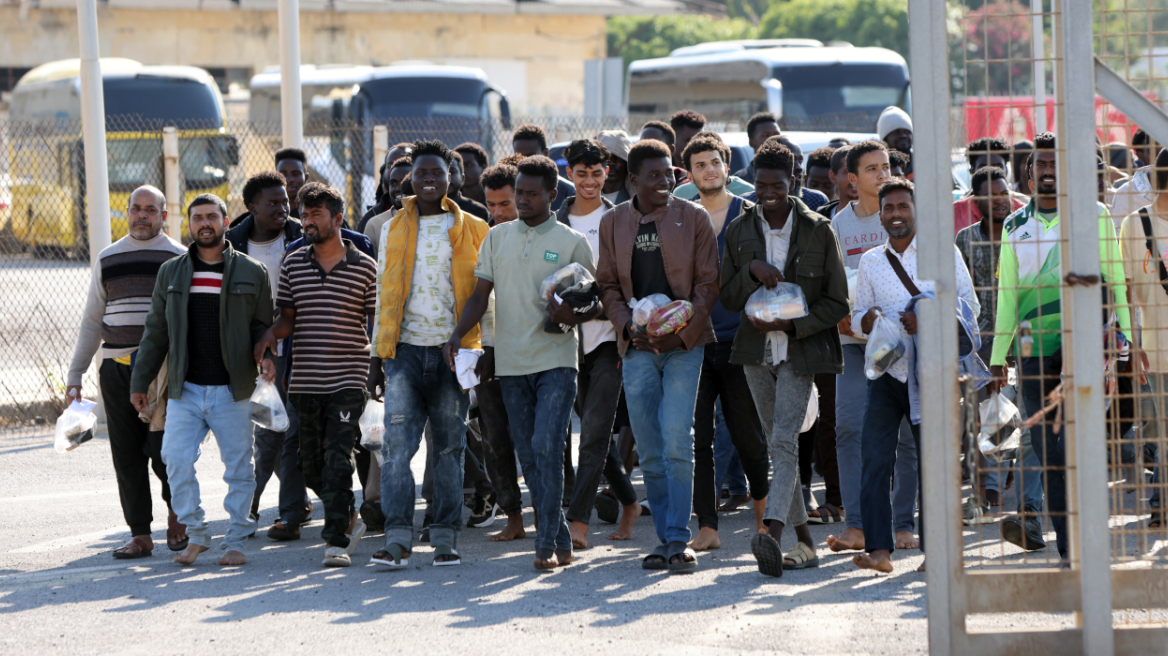
European efforts to establish the first return hubs outside the European Union, specifically in Africa, are entering a decisive phase. These centers would be able to receive illegal migrants who no longer have the right to remain in a member state, including those who have received a final negative decision on their asylum application.
The initiative is being promoted by a group of five countries consisting of Germany, Austria, the Netherlands, Denmark and Greece, with contacts with third countries having intensified and the next crucial milestone being the meeting of the relevant ministers in Copenhagen on September 4. Denmark’s Ministry of Immigration has officially confirmed that the five countries have jointly undertaken the initiative for the practical implementation of the return centers and that the relevant work has now entered the “decisive phase.”
African countries are at the center of the negotiations. A report by Kathimerini states that Uganda appears to be the country with which discussions have progressed the furthest, with the agreement providing for financial compensation and aiming to have the first facility operational in 2027. All five European countries are participating in the contacts, while technical teams are expected to travel to Africa by the end of August to continue the talks.
Strong prospects for Rwanda as well
According to information obtained by protothema.gr, Rwanda also has strong prospects, as it is one of the options being seriously considered as part of the negotiations.
Rwanda’s main advantage is that it already has infrastructure and previous experience in receiving and temporarily hosting migrant and refugee populations. This means that, provided the two sides reach an agreement, such a scheme could begin operating within a considerably shorter timeframe.
Rwanda already operates a temporary reception center under the Emergency Transit Mechanism, in cooperation with the United Nations High Commissioner for Refugees. Since 2019, more than 3,000 refugees and asylum seekers have been transferred to the country from Libya, most of whom were subsequently resettled in third countries. At the same time, special infrastructure had been prepared in Kigali as part of the agreement with Britain for the transfer of asylum seekers, before London ultimately abandoned the plan.
According to InfoMigrants as well, the Rwandan government has confirmed that talks are underway with the European side regarding the possibility of hosting a return hub. This development reinforces the impression that Kigali is not merely a theoretical option, but a country with which there is a genuine basis for negotiations.
Moreover, Rwanda had already been included in June among the countries being considered as possible locations for the European return hubs, alongside Uganda, Kenya and Uzbekistan.
The initial plan calls for the center to operate on a pilot basis for 5,000 to 10,000 people whose asylum applications have been rejected.
The crucial September 4 meeting
The next decisive move will take place in Copenhagen. Danish Minister for Immigration and Integration Morten Bødskov has invited his counterparts from Germany, the Netherlands, Austria and Greece on September 4 to determine the next steps.
According to the Danish government’s official announcement, the aim is to reach an agreement in 2027, so that the first foreigners who do not have a legal right to remain can be transferred from a member state to a center outside the EU.
Greece’s role
Athens is at the heart of the initiative and is participating in the negotiations alongside Berlin, Vienna, The Hague and Copenhagen. Greece’s plan is being handled by Minister for Migration and Asylum Thanos Plevris.
The timetable is particularly important for Athens as well, since the plan is for the first temporary facility of this type in Africa to be operational in 2027, a period during which Greece will also assume the rotating presidency of the Council of the European Union in the second half of the year.
The possible completion of the agreement on the return hubs is also a personal challenge for Mr. Plevris, who has placed a strong emphasis on tightening the migration framework, both through the new law and the “deportation or imprisonment” doctrine, as well as through the return hubs, which send a clear message that even if an irregular migrant manages to reach European territory, they will not remain here.
Ask me anything
Explore related questions




