





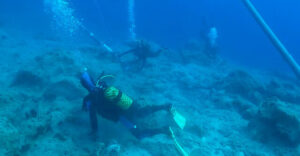
Archaeologists working off the coast of Turkey claim to have discovered the world’s oldest known shipwreck, estimated to be between 4,400 and 4,700 years old. The vessel dates back to the Early Bronze Age, roughly the period when the Great Pyramid of Giza was being built in Egypt.
The discovery was made near the island of Kekova, in the Antalya region, at a depth of approximately 30 metres. Although none of the ship’s wooden hull has survived, researchers found more than 30 ceramic vessels used for transporting and storing goods, as well as three large stone anchors. Some of the vessels still contain traces of substances they held thousands of years ago.
Researchers believe the ship was approximately 10 metres long and was used to transport goods across the Mediterranean. The expedition, organised by the Mediterranean Archaeology Association, was led by Professor Hakan Öniz of Turkey’s Akdeniz University, who described the wreck as a “time capsule on the seabed”.
Mavi Vatan’da, dünyanın en eski batığının izlerini gün yüzüne çıkarıyoruz. Kekova’da yürüttüğümüz su altı kazılarında çıkarılan, 4.700 yıl öncesine uzanan amforalar, Anadolu kıyılarının deniz ticaretindeki köklü geçmişine ışık tutuyor. Zeytinyağı ya da şarap taşımak için kullanıldığı düşünülen bu kaplar, Doğu Akdeniz’deki ticaretin ve kültürler arası etkileşimin önemli izlerini taşıyor. Kil analizleri, amforaların muhtemelen Ürdün Vadisi’ndeki atölyelerde üretildiğine işaret ediyor. Benzer örneklerin Mısır, Troya ve Girit’te de bulunması, farklı coğrafyaları deniz yoluyla birbirine bağlayan ticaret ağlarını anlamamız açısından büyük önem taşıyor. Buluntular arasında, üzerinde dokuz farklı işaret ve gövdesinde iki delik bulunan bir amfora da dikkat çekiyor. Peynir ya da tereyağı yapımında yayık olarak kullanılmış olabileceği düşünülen bu kap, denizcilerin uzun yolculuklarda kendi yiyeceklerini üretmiş olabileceklerine dair ipuçları sunuyor. Anadolu’nun denizcilik tarihini yeni bulgularla aydınlatmaya, su altındaki kültürel mirasımızı koruyarak gelecek nesillere aktarmaya devam ediyoruz. Kazıların bilimsel sorumluluğunu üstlenen Doç. Dr. Hakan Öniz’i ve emeği geçen tüm çalışma arkadaşlarımızı kutluyorum.
— Mehmet Nuri Ersoy (@MehmetNuriErsoy) October 14, 2026
How researchers determined the shipwreck’s age
The complete absence of surviving wood meant that techniques such as radiocarbon dating, which measures a form of carbon in organic materials, could not be used to establish the shipwreck’s age. Instead, researchers examined the ceramic vessels and compared them with similar artefacts discovered elsewhere.
The vessels recovered from Kekova have a distinctive shape, featuring two handles, a protrusion around the middle and a flat base. According to Öniz, they closely resemble pottery found in Egypt and the Middle East dating back between 4,400 and 4,700 years.
“By comparing the decoration techniques, we can say with certainty that the shipwreck belongs to the Early Bronze Age. We are 100% sure,” the professor said.
Divers recovered the vessels from the seabed, and they are now undergoing conservation after spending thousands of years underwater. Particularly remarkable is the fact that some were found intact and still contain substantial quantities of a thick, glossy substance whose composition has yet to be identified.
Archaeologist Karin Sowada of Australia’s Macquarie University, who examined the artefacts after their recovery, described her astonishment at discovering how much of their original contents had survived.
“I looked inside and nearly fainted. I couldn’t believe how much material was still visible. It wasn’t just a few traces. There was a large amount left,” she said.
Scientists are now trying to establish what products the ship was carrying, with olive oil, wine and natural tree resins among the possibilities.
Sowada cautioned, however, that the residues might have come from the vessels being reused at a later date. She explained that these were large storage containers that were not necessarily used for a single voyage. Once their cargo had been delivered, they could be emptied and reused for many years.
The discovery also provides new evidence of the trade networks linking civilisations across the eastern Mediterranean during the Bronze Age.
Öniz said that during his dives, he often thinks about the people connected to the vessel, from its sailors to those who made and transported the ceramic containers.
“We are the first people to touch these objects in 5,000 years,” he said. “We always think about the sailors, the people who made the vessels, the person who carried them to the ship, and the women who waited for their husbands, who unfortunately never made it home.”
Ask me anything
Explore related questions




