





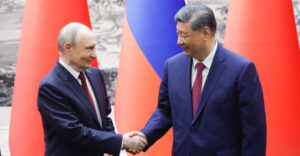
CNN is shedding light on developments along Russia-controlled Northern Sea Route (NSR), a frozen and inaccessible sea for much of the year that can be traversed without icebreakers for only a short period during the summer, in a report on how Beijing and Moscow are drawing closer as the former seeks energy and the latter needs money.
An analysis by the U.S. network of shipping-traffic data compiled by Norway’s Centre for High North Logistics shows that, since the beginning of Russia’s invasion of Ukraine, international traffic along the route has been dominated by one player: China.
This trade—which supports Russia’s war economy and strengthens China’s energy security—is accompanied by an expansion of Chinese shipping activity in the region, as well as growing concern in the West that China’s footprint there could foreshadow future military use, CNN reports.
Analyzing shipping-movement data along the Northern Sea Route, CNN observes that it has evolved into a fast route for China to gain access to fuel subject to U.S. sanctions. “Now, as a U.S.-led conflict—this time in the Middle East—has grounded oil and gas tankers and restricted global trade, China and Russia are preparing for what could be a record season along this alternative maritime route.”
For China, this also means a landmark year in a region where it has long sought to expand its presence as a self-described “near-Arctic state”—and where melting ice could open up longer periods of navigation and more routes over the coming decades.
Putin and Xi Jinping’s visions
Russian President Vladimir Putin has long envisioned, according to the U.S. network, the 3,500-mile route along Russia’s Arctic coast becoming a major commercial corridor and a driver of investment in Russian ports and oil and gas fields. In recent months, he has argued that disruptions to trade caused by conflicts around the Red Sea and the Strait of Hormuz demonstrate that the seasonal route is “the safest, most reliable and efficient.”
Chinese leader Xi Jinping, too, has for years dreamed of a “Polar Silk Road” in the Arctic, a frozen extension of the flagship Belt and Road Initiative, a plan that was introduced in 2018 and would expand Chinese influence in the region from Russia to Scandinavia and potentially beyond.
However, the huge Chinese investments expected in polar ports and infrastructure never materialized. At the same time, the high costs and dangerous conditions along the route had already complicated Putin’s vision—even before Russia’s war against Ukraine drove international players away from the Russian Arctic.
Chinese state-owned shipping and energy giants also pulled back. Nevertheless, the situation has created a “window of opportunity” for Beijing, according to Marc Lanteigne, a professor at the University of Tromsø, to use its influence as a key partner helping Moscow develop the route, thereby strengthening its role in the Arctic.
It is telling that over the weekend, a newly established Singapore-based shipping company under Chinese management, Sea Legend, is expected to launch the first regular seasonal container service between China and Europe, advertising a transit time of 20 days—roughly half the time of a typical route through the Suez Canal—while “avoiding the risks of geopolitical disruptions.”
Another Chinese company, New New Shipping, which was also established after Russia’s invasion of Ukraine in 2022, launched a new service last month from the Chinese port of Tianjin to Murmansk, Russia’s largest Arctic port.
Overall, at least six Chinese shipping companies are expected to make more than 50 voyages along the route this season, using container ships, bulk carriers and multipurpose vessels, with the overwhelming majority of crossings taking place between China and Russia, according to schedules published by the China Shipowners’ Association.
As for the cargo, “China and Russia are now the only ones actually using this route—they clearly see it as part of their close cooperation,” said Kiel Stockvig, CEO of the Centre for High North Logistics (CHNL) at Norway’s Nord University, which monitors traffic along the Northern Sea Route.
Trade along the route remains small compared with major maritime corridors such as the Suez Canal and is dominated by Russian oil and natural gas, which—along with some other Asian LNG buyers—is primarily destined for China.
China’s LNG imports from Russia, through all routes, increased by nearly 28% in volume during the first half of the year, as LNG exports from the Middle East were frozen due to the U.S.-Iran war. Europe remains by far the largest buyer of Russian LNG from facilities not subject to sanctions, such as Yamal LNG, but not via the NSR. The EU’s impending ban on seaborne purchases of Russian LNG in 2027 will change this situation.
All eight oil tankers that made a full transit of the NSR last year with China as their direct destination had been blacklisted by the United States because they were carrying sanctioned cargoes, according to CNN’s analysis of CHNL shipping-traffic data based on the vessels’ identification numbers.
Meanwhile, the spread of so-called “shadow fleet” vessels, often older ships that use tracking-avoidance techniques, is increasing environmental risks along the route, according to experts, because of demand from the world’s second-largest economy.
Analysts and shipping-industry figures also say that Chinese entities have quietly supplied essential equipment to the Arctic LNG-2 facility, which is under stringent U.S. sanctions. The project’s foreign investors—including two Chinese state-owned companies, France’s TotalEnergies, and a Japanese consortium—have frozen or withdrawn their stakes.
The West remains cautious
The West is closely monitoring developments in the Arctic, with U.S. President Donald Trump citing the possibility of Russian and Chinese vessels patrolling the waters of the North Atlantic near Greenland as justification for his threat of a forced U.S. takeover. Washington has also signed a shipbuilding agreement with Finland to expand the U.S. icebreaker fleet, as it monitors the expansion of China’s corresponding fleet.
For her part, EU foreign-policy chief Kaja Kallas warned earlier this year that China could use Arctic sea routes and supply chains to transport weapons and weapons systems. NATO Secretary General Mark Rutte said in July that the alliance must coordinate to address a “huge risk of Russia and China gaining ever greater access to the Arctic.”
Western observers have been alarmed by indications of an emerging expansion of Russia-China security cooperation in the far north. They also argue that Chinese research missions, such as the current deployment of the country’s growing polar fleet in the region for a four-month mission, could provide critical data to the Chinese military.
Beijing has repeatedly rejected these claims, saying they are intended to exaggerate the “China threat” and create divisions in the region. It defends its activities in the Arctic as being “aimed at promoting peace, stability and sustainable development,” in accordance with international law. Beijing has also long defended its trade with its close partner, Russia, and rejects unilateral sanctions.
Moscow, meanwhile, is widely considered to remain cautious about opening the door to Chinese involvement in Arctic security, hoping instead that China will continue buying energy and expand its role in developing a profitable Northern Sea Route.
Ask me anything
Explore related questions




