





Turkey’s decision to declare two marine parks, in the Northern Aegean and the Eastern Mediterranean, is unilateral and illegal, Greece’s Foreign Ministry said in a statement.
The ministry first points out that the marine parks “extend beyond Turkish territorial waters.”
It stresses that “to the extent that these parks cover international waters, their establishment is illegal, since under the Law of the Sea no state has the right to unilaterally establish marine protected areas in areas outside national jurisdiction. Furthermore, the marine parks are illegal to the extent that they extend into the Greek continental shelf.”
Ankara’s move “produces absolutely no legal effect, either with regard to international waters or with regard to our rights over the Greek continental shelf,” the ministry further stresses.
The Foreign Ministry’s statement
Through Presidential Decrees dated August 15 and published today in the Turkish Government Gazette, Turkey declared two “national marine parks” in the northeastern Aegean and the Eastern Mediterranean, which extend beyond Turkish territorial waters.
To the extent that these parks cover international waters, their establishment is illegal, since under the Law of the Sea no state has the right to unilaterally establish marine protected areas in areas outside national jurisdiction. Furthermore, the marine parks are illegal to the extent that they extend into the Greek continental shelf. Consequently, this is an action that produces absolutely no legal effect, either with regard to international waters or with regard to our rights over the Greek continental shelf.
Turkey’s unilateral establishment of “national” marine parks, including in areas outside its jurisdiction, cannot create a fait accompli, nor can it in any way affect rights arising from international law.
It is recalled in this regard that Greece took the initiative to establish National Marine Parks in the Ionian Sea and the Aegean Sea, in full compliance with the Law of the Sea and exclusively within Greek territorial waters.
Actions seeking to create a fait accompli or unilaterally alter the status of maritime zones in the Aegean and Eastern Mediterranean violate international law, do not contribute to establishing a climate of good-neighborly relations, and seriously undermine efforts to maintain relations of mutual understanding between the two countries.
Greece will continue to act consistently and decisively to protect its sovereign rights, safeguard the freedoms of the high seas as provided for under the Law of the Sea, and protect the marine environment in accordance with international law.
Cutting off Kastellorizo, “wedging” between Samothrace and Lemnos
It is recalled that Turkey has taken another step toward consolidating its claims under the “Blue Homeland” doctrine, presenting it as a response to Greece’s establishment of marine parks. Specifically, by publishing Presidential Decrees establishing two marine parks in the Aegean and Eastern Mediterranean, Ankara has created zones that overlap areas of Greek sovereign rights and Greece’s undelimited continental shelf.
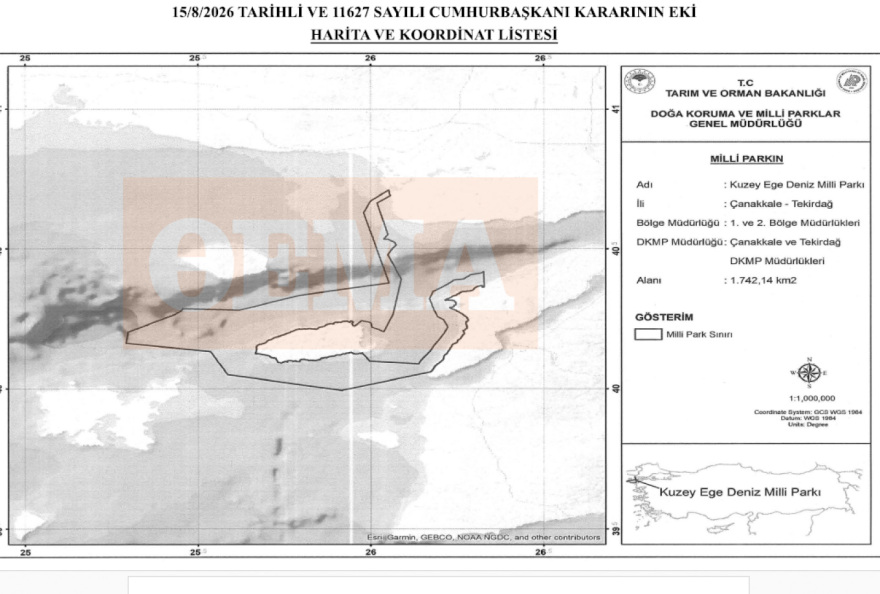
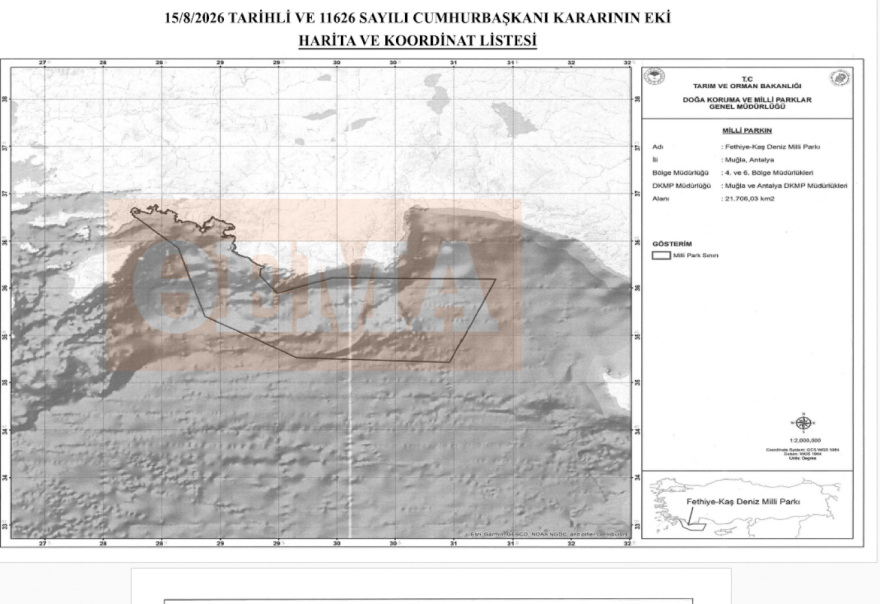
The presidential decrees, signed by Tayyip Erdoğan and already published in the Turkish Government Gazette, establish two marine parks: one in the Northern Aegean, extending between Lemnos and Samothrace, and the other covering a very large area in the Eastern Mediterranean, completely cutting off Kastellorizo from Rhodes.
See the maps of the marine parks:
Map showing the boundaries of the Turkish marine park in the Eastern Mediterranean
With these two Marine Parks, which are supposedly being established to protect the marine environment and biodiversity, Turkey is attempting to impose its claims on the ground against Greece and consolidate its “Blue Homeland” claim.
These marine parks completely overlap Greece’s Marine Spatial Planning, as presented in 2025, and at a time when its official submission to the competent EU directorate is pending. Given that Greece has already established two Marine Parks, which extend within the territorial waters of the islands and islets they cover, Turkey, through this move, is also adopting the position that the islands have no rights beyond their 6-nautical-mile territorial waters and continues to advocate drawing a median line between the two countries’ mainland coasts.
See the Turkish Presidential Decrees for the Northern Aegean Park and the Eastern Mediterranean Park
With the Marine Park in the Northern Aegean, Turkey, following its longstanding position on the median line between the two countries’ mainland coasts and ignoring the existence of the Greek islands, is inserting the Marine Park between Samothrace and Lemnos in an area of international waters that falls within Greece’s undelimited continental shelf and extends into the potential 12-nautical-mile territorial waters of the Greek islands. The marine park also follows Turkey’s longstanding claim over the Greek continental shelf, as expressed as early as the 1970s through the granting of exploration licenses to TPAO.
The other Marine Park declared by Turkey isolates and restricts Kastellorizo to the zone of its existing 6-nautical-mile territorial waters and covers the entire area east of Rhodes extending to Kastellorizo, which it turns into a Marine Park. According to the Law of the Sea, this area forms part of Greece’s undelimited continental shelf, and Turkey’s move is viewed as yet another attempt, through an unrelated process such as marine environmental protection, to create a fait accompli. It is clear from both Turkish maps accompanying the presidential decrees that Turkey is arbitrarily depicting its “Blue Homeland” claims. It is also characteristic that, on the map presented by Turkey, Kastellorizo and the other islands are shown without any maritime boundary line, not even the 6-nautical-mile line, apparently reflecting the view that there are no maritime borders between Greece and Turkey in the Aegean.
According to Turkish media, the move was decided as a response to Greece’s actions, which since 2025 has submitted its Marine Spatial Planning, including the undelimited EEZ with external boundaries—where no agreement exists—based on the boundaries established by Law 4001/2011, as well as the establishment of the two Marine Parks in the Ionian Sea and the Southern Cyclades.
Turkey had also reacted through Foreign Ministry statements and a letter to the United Nations over Greece’s Marine Spatial Planning, as well as over the delineation of the offshore blocks south of Crete awarded to Chevron, whose external boundaries are likewise based on Law 4001/2011.
The establishment of the Turkish Marine Parks comes as the adoption of the “Blue Homeland” law is expected in the autumn, a move that is expected to cause renewed tensions in Greek-Turkish relations.
Ask me anything
Explore related questions




