





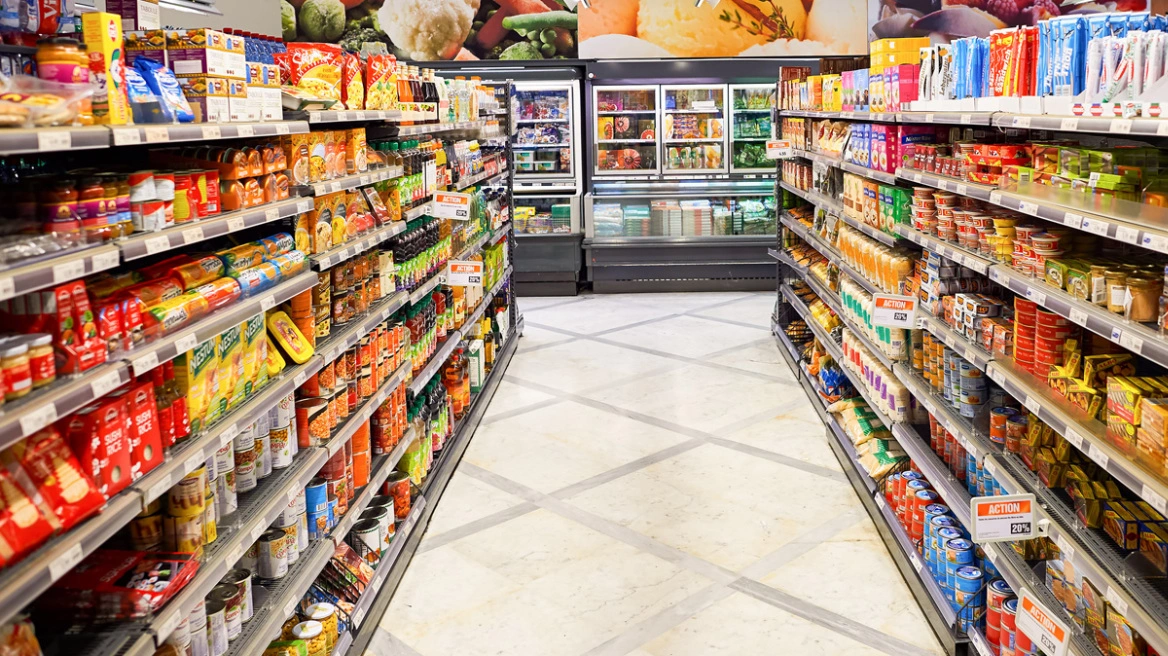
With more than 1,660 product codes and an average price reduction currently standing at around 7%, the National Price Reduction Initiative is being expanded and will begin tomorrow, Monday, August 31, with Development Minister Takis Theodorikakos stressing that the aim is to provide meaningful support to households and contain the cost of basic goods.
The initiative, which is still ongoing and remains open to new participants, covers basic food and everyday consumer products, school supplies, private-label products and meat, while the list is expected to be expanded further by tomorrow, Monday.
According to the latest available data, around 900 branded product codes are participating, with an average price reduction of approximately 7% and reductions ranging from 5% to 30% per product. At the same time, more than 450 school-supply codes are recording an average reduction of around 10%, approximately 250 private-label products are being reduced by an average of 7%, while the average reduction among the 60 meat codes stands at 7.2%. The latter category includes both Greek and imported meat, while beef is also included among the codes.
So far, more than 90 suppliers, 12 supermarket chains and three toy and school-supply chains have joined the initiative, while the process remains open and new participants are expected to join.
The Development Minister has described the initiative as a “national social agreement” to support households, stressing that reductions on basic food products start at 5% but are significantly higher in several cases.
Particular importance is being attached to the presence on the list of branded products that are purchased daily by Greek households. The participation of branded pasta products, for example, is significant, while the effort is focused on products that are purchased frequently.
Additional reductions from the supermarket chains
The final benefit for consumers is expected to be greater than the current average reduction of 7%, as the suppliers’ price cuts will be supplemented by contributions from the supermarket chains themselves.
This additional discount will not be the same for all businesses. As a result, the same product may have a different final price depending on the chain where it is sold.
Despina Tsangari, president and governor of the new Independent Authority for Market Control and Consumer Protection, said in an interview with OPEN that the additional contribution from supermarkets is expected to be reflected over the weekend, increasing the overall percentage reduction.
How consumers will see the price reductions
The reduced prices will be displayed on store shelves with special signage, while from Monday consumers will also be able to obtain information digitally through the “PosoKanei” digital platform.
Through the platform, consumers will be able to easily find information about the businesses participating, the product codes included in the initiative and the reductions being applied. For branded products, a range of reductions will also be displayed, taking into account the different additional discount that may be applied by each chain.
Duration of two to four months
The duration of the initiative varies depending on the businesses and product codes and ranges from two to four months. For businesses that have committed to participating for two months, it has been agreed that new product codes will be included during the following two-month period, while there are already products for which the commitment is for four months.
In relation to the total number of product codes available in supermarkets, the exact proportion and contribution of these 1,660 products participating in the initiative is expected to be calculated next week. The estimate is that in a supermarket—not one of the very large ones—where the total number of product codes may range between 15,000 and 20,000, approximately one in nine products has so far been included in the initiative.
However, the significance of the initiative is not determined solely by the quantity, but also by the type of products participating, since the 1,660 codes include many products that form part of the household’s everyday shopping basket.
Positive early signals for inflation
Ms. Tsangari expressed satisfaction both with the number of participants and with the content of the list, while also estimating that the number of product codes will increase further.
Regarding the course of supermarket inflation, she described the initial signals from August as very positive, estimating that food inflation could move into negative territory.
An estimate of the monthly monetary value corresponding to the price reductions on the products participating in the initiative is also expected to be presented from Monday, in order to quantify the potential benefit for consumers.
Market inspections continue
At the same time, market inspections concerning price developments are continuing. According to Ms. Tsangari, the data available so far show no increases in branded products during July and August, with the exception of one branded company, with which contact has been made and which, it is noted, is not participating in the initiative.
She pointed out that companies’ promotional activities may in some cases create confusion regarding the actual evolution of prices, making continuous monitoring of the market necessary.
Mr. Theodorikakos has stressed that efforts to tackle high prices are continuing and that “we are neither triumphalist nor complacent,” as international developments and geopolitical tensions continue to create uncertainty and pressure on prices.
According to Eurostat data cited by the minister, food prices fell by 2.3% from June to July, while on an annual basis food inflation stood at -0.4%.
The full details on all the products participating in the National Price Reduction Initiative, as well as the estimate of the total financial benefit that could result for households, are expected to be presented on Monday.
Ask me anything
Explore related questions




