





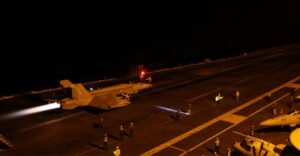
A new and dangerous escalation is unfolding in the Middle East following U.S. strikes on the Iranian island of Larak and Tehran’s immediate response. The Islamic Revolutionary Guard Corps announced that it had attacked U.S. military facilities in Jordan with ballistic missiles and unmanned aerial vehicles, in retaliation for the bombing of two Iranian launchers, which Iran said resulted in deaths and injuries.
The U.S. armed forces carried out their first strikes against Iran in approximately a month on Sunday, hitting Larak Island, near the Strait of Hormuz.
U.S. Central Command (CENTCOM), the joint command responsible for U.S. military operations in the Middle East, said that two Iranian launchers were the targets of the operation.
“Earlier (…) U.S. forces struck two Iranian launchers on Larak Island,” CENTCOM spokesperson Captain Tim Hawkins said.
According to the U.S. side, members of the Revolutionary Guards had been detected preparing to launch missiles loaded with naval mines toward the Strait of Hormuz.
The Revolutionary Guards said the U.S. strikes caused “deaths and injuries,” without providing a specific casualty figure, and announced that retaliation would follow.
Iranian retaliation against U.S. facilities in Jordan
Shortly afterward, the Revolutionary Guards announced that they had responded by launching attacks against U.S. military facilities in Jordan.
According to their statement, the operation involved ballistic missiles and unmanned aerial vehicles and was carried out as direct retaliation for the U.S. strikes on Larak.
The Iranian attacks targeted technical facilities and maintenance infrastructure, as well as aircraft stationed at two bases in Jordan.
The Revolutionary Guards also warned that “any further hostile action” would trigger “even stronger retaliation.”
Jordan’s armed forces said they intercepted and destroyed eight missiles after they entered the country’s airspace, without specifying where they had been launched from. The statement came shortly after the Iranian Revolutionary Guards announced that they had targeted U.S. military facilities in the Hashemite Kingdom with missiles and drones.
In their statement, Jordan’s armed forces said they had “successfully destroyed” the missiles after Tehran announced retaliatory strikes against two bases hosting or used by U.S. military personnel, in response to the American bombing of Larak Island.
New escalation despite previous de-escalation
The latest exchange of strikes comes at a time when hostilities in the region had subsided, although sporadic incidents continued to be reported, particularly in and around the Strait of Hormuz.
The strategically important waterway, through which approximately one-fifth of the world’s hydrocarbons consumed globally passed before the war, remains effectively closed following a decision by Tehran.
Iran has periodically targeted commercial vessels attempting to cross the strait without its authorization, while the United States has responded by imposing a blockade on Iranian ports in the Gulf.
CENTCOM: Mine-clearing operation completed
Captain Tim Hawkins also said that CENTCOM had completed a mine-clearing operation last week along international shipping routes in the Strait of Hormuz.
“U.S. forces are closely monitoring the area and remain ready to protect the free flow of commerce through this essential maritime route,” he added.
From the outbreak of war to the ceasefire
The war in the Middle East began on February 28, when the United States and Israel jointly launched airstrikes against Iran.
Tehran responded by targeting Washington’s allies in the Gulf.
A ceasefire agreed in April brought an end to 40 days of intensive exchanges of airstrikes and attacks involving ballistic missiles and unmanned aerial systems.
In mid-June, the so-called “Islamabad Memorandum of Understanding” was signed, theoretically opening the way toward an end to the armed conflict.
The agreement, however, collapsed in July, hostilities resumed, and the diplomatic process has since reached an impasse.
Washington increases economic pressure
Alongside its military operations, the U.S. administration has signaled that it intends to further intensify economic pressure on Iran, which has faced U.S. and international sanctions for decades.
U.S. Treasury Secretary Scott Bessent announced a new round of so-called “secondary” sanctions last Monday. These measures do not directly target Tehran but instead target its commercial partners.
The measures cover sectors including maritime transport, aviation, digital assets, technology and gold.
Washington also announced new sanctions against 60 individuals, companies and vessels that it accuses of helping Iran generate oil revenues, acquire weapons and conduct cyberwarfare operations.
China also in Washington’s crosshairs
China, the world’s second-largest economy and a key economic partner of Tehran, is among the countries at the center of U.S. pressure.
Beijing responded to the U.S. measures, saying it would “firmly” defend Chinese interests and its cooperation with Iran.
Iranian President Masoud Pezeshkian has acknowledged that the country is facing “many economic difficulties,” but the Islamic Republic insists that Washington will achieve “nothing” through economic pressure.
Tehran has also ruled out returning the Strait of Hormuz to its previous status.
The situation is considered unacceptable by the United States and its regional allies, who are demanding the full reopening of the waterway.
U.S. President Donald Trump has even said in recent weeks that the Strait of Hormuz would become “U.S. territory.”
Ask me anything
Explore related questions




