





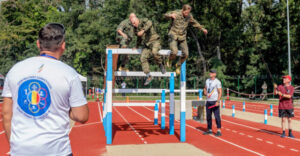
It was not simply a routine Greek participation in yet another international military conference. Behind the presence of Greek reserve officers in Bucharest were days of intensive preparation, demanding military tests and participation in exercises simulating real operational conditions. At the end of this effort came a notable achievement: one Greek reserve officer took first place, while another finished fourth.
The Greek delegation of the Supreme Panhellenic Federation of Reserve Officers (APOEA), headed by its president, Dr. Filippos Kostaras, participated in the annual summer congress of the Interallied Confederation of Reserve Officers (CIOR), the largest and oldest international organization of reserve officers, which cooperates with NATO on reserve-force matters.
The congress took place from August 3 to 8 in Bucharest, but the significance of the Greek participation lies mainly in what took place before and during the event.
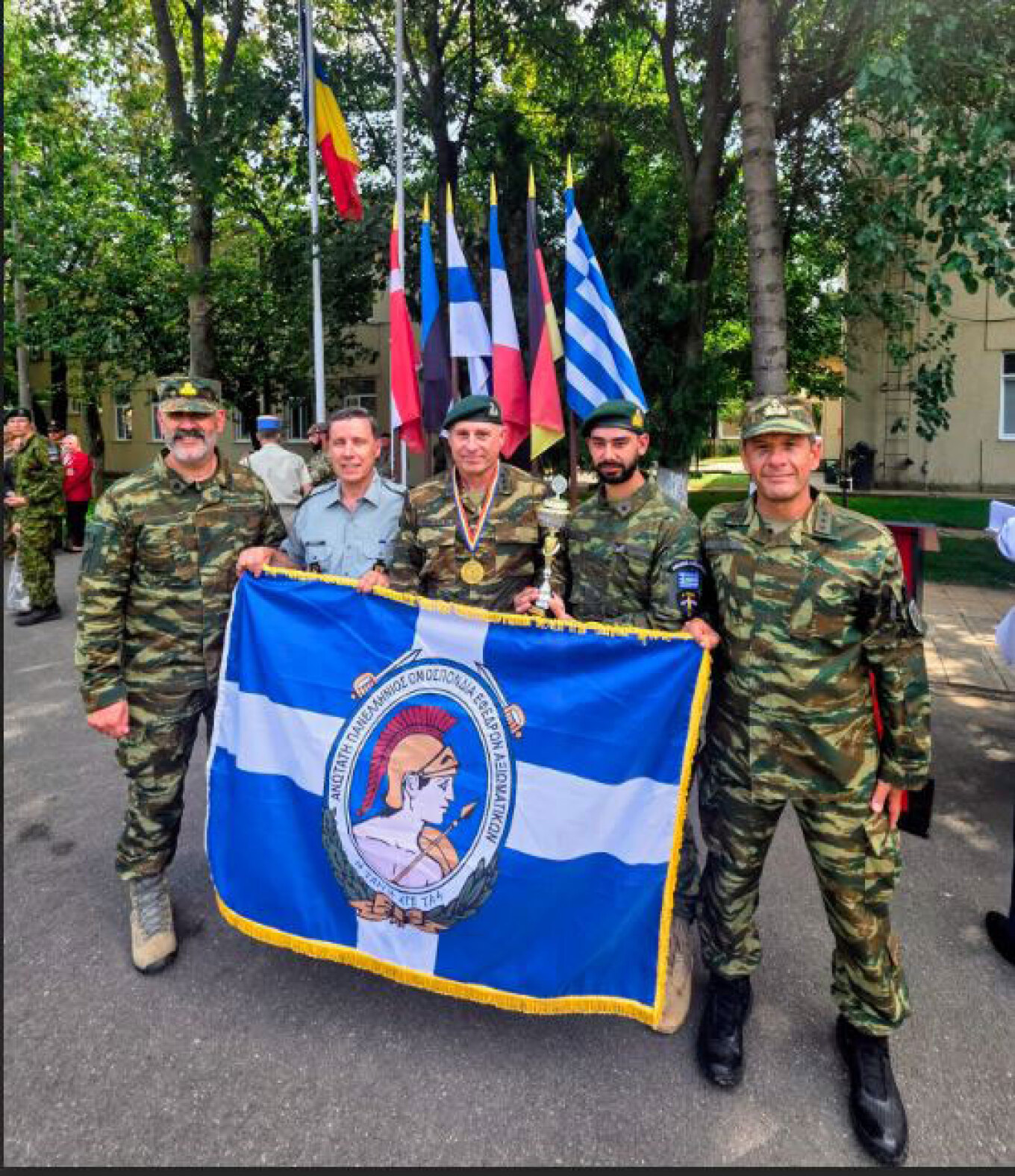
The Greek delegation with the trophy. From left to right: Reserve Major (Logistics) Thrasyvoulos N. Ladopoulos, Deputy Team Leader and Mission Officer; Reserve Major (Logistics) Filippos G. Kostaras, APOEA President and Mission Leader; Reserve Captain (Infantry–Special Forces) Vasileios Tokas, competitor; Reserve Second Lieutenant (Infantry–Special Forces) Panagiotis Skordas, competitor; and Reserve Captain (Infantry) Antonis Nanakis, coach.
The MILCOMP competition
The most demanding component was the MILCOMP military competition. A total of 130 reserve officers, organized into 37 teams from ten countries, were required to complete a complex program testing physical endurance, military knowledge, accuracy and decision-making under pressure.
The challenges included a land-navigation course, an obstacle course, combat swimming in an obstacle-filled pool, navigation and range estimation without electro-optical equipment, pistol shooting at 25 meters and rifle shooting at 200 meters, combat casualty care (TCCC), as well as a written examination on the Law of Armed Conflict.
It was in this demanding environment that the Greek delegation achieved its success. Reserve Infantry–Special Forces Captain Vasileios Tokas took first place with the international team “Int. 3,” while Reserve Infantry–Special Forces Second Lieutenant Panagiotis Skordas finished fourth with “Int. 1.”
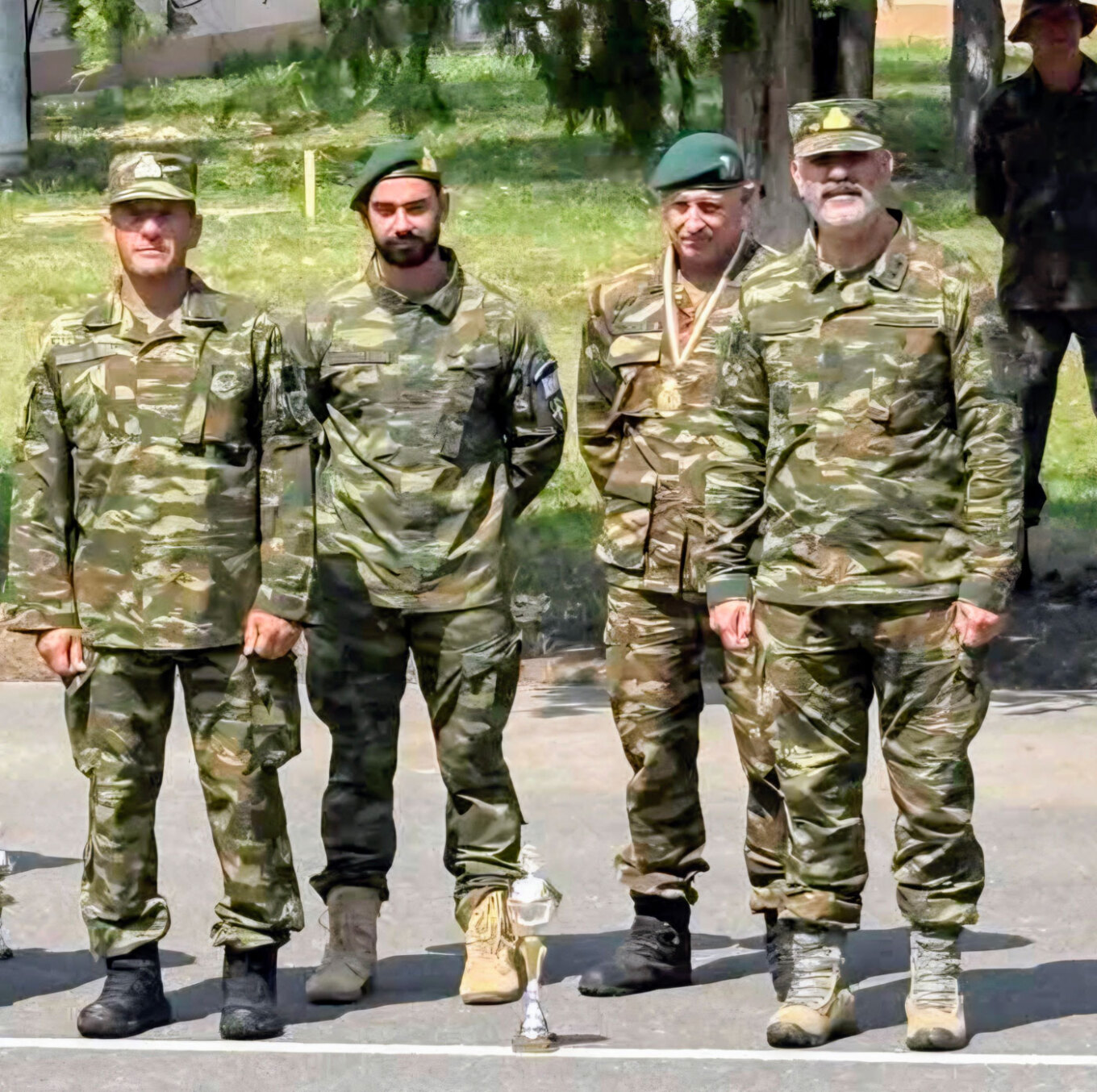
The Greek delegation at the Military Pentathlon competition in Romania. From right to left: Reserve Major (Logistics) Thrasyvoulos N. Ladopoulos, Deputy Team Leader and Mission Officer; Reserve Captain (Infantry–Special Forces) Vasileios Tokas, competitor; Reserve Second Lieutenant (Infantry–Special Forces) Panagiotis Skordas, competitor; and Reserve Captain (Infantry) Antonis Nanakis, coach.
Intensive preparation
The Greek athletes were trained by Reserve Captain Antonis Nanakis, a Physical Education professor at the Hellenic Military Academy. The team was led by APOEA president Filippos Kostaras, while the federation’s secretary-general, Thrasyvoulos Ladopoulos, served as deputy team leader and competition officer.
The achievement did not come without preparation. Before traveling to Romania, the facilities of the Hellenic Military Academy were made available for one week for the Greek team’s accommodation, meals and, above all, training. U.S. reserve officers also trained at the same location, effectively creating a small multinational training environment even before the competition began.
The Hellenic National Defence General Staff, the Hellenic Army General Staff, the Army’s National Guard and Mobilization Directorate, and the leadership of the Hellenic Military Academy contributed to the effort. Volunteer support was also provided by members of reserve officers’ associations.
Beyond the competition
The Greek presence, however, was not limited to the military competition. Reserve officers participated in CIOR committees dealing with military, legal and civil-military issues, while members of the delegation took part in CIMEX 2026, an exercise held at Romania’s “Carol I” National Defence University.
The exercise scenario was particularly relevant given today’s geopolitical environment: it focused on the mass arrival of NATO forces through the port of Constanța and the way military and civilian structures would have to cooperate to support such an operation.
The program also included the symposium “Winning the War on Narratives” at the Palace of the Parliament in Bucharest, focusing on the battle over information and narratives in the contemporary security environment.
At the same time, reserve-officer preparation is not limited to weapons, physical fitness and military exercises. APOEA also sent a representative to the CIOR Language Academy, where intensive training is provided in English-language military terminology, enabling participants to operate effectively in a multinational environment.
This may be the element that gives the Greek participation its broader significance. The modern reserve officer is not simply expected to maintain the military knowledge acquired during their service or training. They must be able to operate in a far more complex environment — from treating a casualty in the field and using a map without electronic aids, to cooperating with military personnel from other countries and understanding the rules governing a modern military operation.
And it was precisely in this test that the two Greek achievements in Bucharest provided a measurable result in an effort built on preparation, voluntary participation and many hours of training away from the public spotlight.
If you want, I can also make this more natural/native English for publication, rather than a close translation of the Greek.
Ask me anything
Explore related questions




