





Athens is not simply buying David’s Sling, Spyder and Barak MX. For the first time, it is creating a single, multi-layered network that will see, assess and respond to different threats as one integrated system. Israeli analyst and former intelligence officer Dan Feferman explains exclusively to Proto Thema why the agreement signals something far larger than an arms purchase, and how it affects Greece, Israel, Cyprus and Turkey.
Perhaps the most significant detail of the agreement signed on 31 August in Tel Aviv is not found in its value of three billion euros, nor in the names of the Israeli systems set to join the Greek arsenal. It lies in the word “architecture”.
For the first time, Greece is not simply replacing an ageing air defence system with a newer one. It is attempting to bring sensors, radars, various interceptors, existing Greek assets and a single command and control system together under one common umbrella. Both governments describe it in exactly these terms: an air, anti-ballistic and anti-drone defence system, organised around a unified command and control structure, with the programme beginning immediately and expected to be fully operational within 35 months.
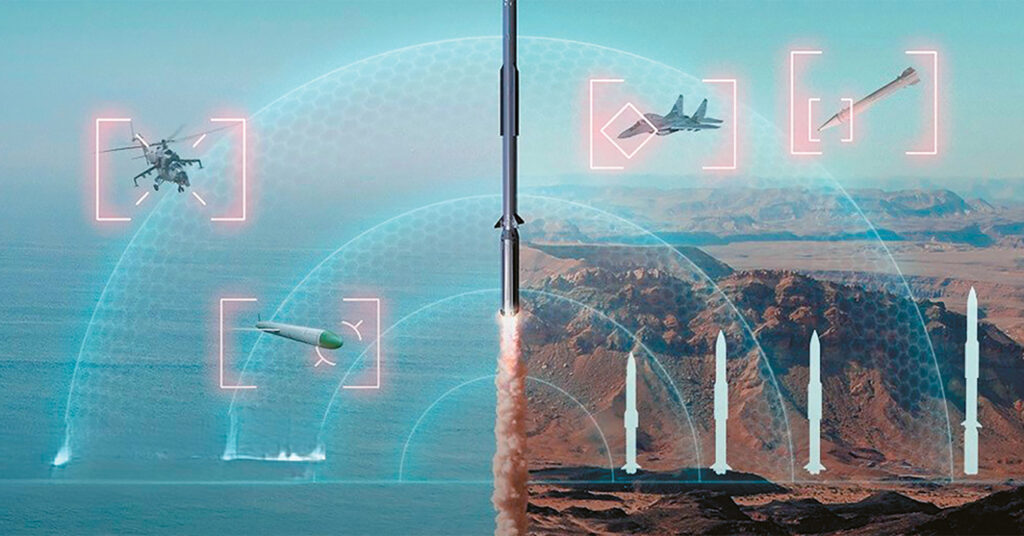
The new network will incorporate Rafael’s David’s Sling and Spyder, Israel Aerospace Industries’ Barak MX, and ELTA’s multi-function MMR radars. What matters, however, is not the list of participating companies’ names. The “Achilles Shield” is being asked to do something that has never been an automatic feature of Greek air defence: to take different weapons and different sensors and turn them into components of a single system.
BREAKING:
— Visegrád 24 (@visegrad24) August 31, 2026
Israel has signed a record €3 billion arms export deal with Greece to build a comprehensive, multi-layered air defense system called “Achilles Shield.”
The deal includes Israeli-made systems such as David’s Sling, SPYDER, and BARAK MX.
It is the largest defense… pic.twitter.com/rq7e5vYGNZ
A photograph showing the BARAK MX defence system in operation, which will reinforce the unified dome of Greek air defence
The aim is for information about a drone, a cruise missile, a fighter jet or a ballistic threat to reach the same centre, be assessed according to its trajectory, target and level of danger, and then be matched with the most appropriate means of response. The system is designed to work alongside assets the Greek Armed Forces already hold and those due to be added in coming years, as part of a broader procurement plan worth roughly 28 billion euros through to 2036.
“We are bringing you into the inner circle”
Feferman knows the Israeli system not only as an analyst. He is a major in the Israeli Defence Forces reserves, has served as an intelligence officer and foreign policy and national security analyst, and is today co-founder and co-editor-in-chief of Middle East 24.
Major Dan Feferman argues that Greece will now have an integrated, interactive air defence system. In his exclusive interview with Proto Thema, he insists from the outset that, from Israel’s perspective, the agreement should be read on two levels. The 3.5 billion dollars is in itself a substantial sum for a country whose annual defence exports now run into the tens of billions. But the real substance, he says, lies elsewhere. “What Greece is buying with the Greek Armed Forces is not a specific technology. It is an entire, integrated and interactive air defence system.”
Israel arrived at this model because it was forced to deal simultaneously with entirely different types of threat coming from different directions: short-range rockets, drones, cruise missiles, ballistic weapons and air threats. The logic, therefore, is not to have one magic system that intercepts everything, but rather different layers of defence that share the same picture of the battlefield.
A shared radar and command network decides which layer needs to be activated, so that an expensive interceptor is not wasted on a cheap target, while at the same time a genuinely dangerous threat does not fall between the responsibilities of different systems. “One system, one command and control structure, one radar structure, and then different interception units operating within the same mechanism” is how Feferman describes it.
The phrase that really conveys the scale of the agreement comes a little later. Buying this kind of architecture, he explains, is nothing like visiting a defence expo where a customer picks a product off the shelf. “In essence, Israel is telling Greece: we are bringing you into our inner circle, the inner strategic circle of countries we consider to face similar threats.” This, he argues, shifts the relationship between Greece and Israel, and the wider Greece-Cyprus-Israel axis, onto a different level.
BREAKING:
— Visegrád 24 (@visegrad24) August 31, 2026
Israel has signed a record €3 billion arms export deal with Greece to build a comprehensive, multi-layered air defense system called “Achilles Shield.”
The deal includes Israeli-made systems such as David’s Sling, SPYDER, and BARAK MX.
It is the largest defense… pic.twitter.com/rq7e5vYGNZ
Hundreds of possible targets
The Israeli model cannot simply be copied wholesale. Geography is perhaps the biggest difference. Israel is a narrow, relatively compact strip of land, where critical centres (metropolitan areas, military bases, energy facilities and infrastructure) can be organised within a more clearly defined space. Greece, by contrast, has a large mainland area, mountainous terrain, extensive sea zones and hundreds of inhabited islands. There can therefore be no single dome placed over the entire country.
Feferman believes this changes the layout rather than the underlying philosophy. Greek authorities will need to decide which points constitute critical nodes: military and air bases, airports, ports, energy facilities, key civilian infrastructure, major population centres and, of course, specific islands. Different air defence hubs will then be built around these points, though they will not function as isolated pockets of technology.
Everything has to feed back into the same operational picture. The point, he stresses, is to avoid gaps between different capabilities, while also avoiding a situation where two or three systems end up expending valuable munitions against the same threat.
This is where a shift emerges that has more to do with twenty-first century warfare than with traditional Greek thinking on air defence. The war in Ukraine, the attacks in the Red Sea and, above all, Israel’s successive conflicts have shown that the most expensive missile is not always the most significant threat. A large-scale attack using dozens or hundreds of far cheaper drones can simply be designed to saturate the defence and exhaust interceptor stockpiles. The problem, then, is also an economic one. It makes little sense to shoot down a target worth a few thousand euros with a missile costing hundreds of thousands, when a cheaper and equally safe alternative exists.
Artificial intelligence
Software today appears to be becoming just as important as the missile itself. The Greek command and control system will gather information from different sensors and use artificial intelligence applications for faster identification and classification of threats, and to select the most appropriate response. The Greek side has, moreover, made clear that access to the Command and Control source code is a condition of national control over the system.
Defence Minister Nikos Dendias has publicly described the prospect of the Armed Forces holding such a system without the ability to intervene in its architecture as unthinkable, precisely because it would create dependency even on a friendly and allied country.
Feferman takes a different view, comparing it to triage in a hospital emergency room. An incoming missile or drone can be identified by the network, its likely target area calculated, and the system can then help the operator decide whether it needs to be intercepted, which weapon should be used, or whether its trajectory does not justify expending a valuable interceptor. Artificial intelligence, he stresses, speeds up this process but does not replace the human element. “There is a human element at the end,” he says, particularly when available munitions are limited and choices have to be made.
Israel’s experience adds a second dimension here that is often missing from discussions about interceptors: passive defence. Even the best systems do not achieve an absolute success rate. Israel therefore invested heavily in an extensive population warning system, capable of narrowing an alert down to specific cities and, in some cases, to specific areas within a city.
Feferman points out that public education, shelters and the ability of the population to know within minutes what to do are all part of the same defence equation. For Greece, then, the “Shield” is gradually opening up a discussion that goes beyond military bases: how civil protection should be organised in the face of a modern missile attack or mass drone assault.
Control of the system
Perhaps the most sensitive aspect of the negotiations was the one that does not appear in any photograph from the signing ceremony: who will actually control the heart of the system. The Greek demand for access to the source code carries weight that goes well beyond technical detail. It means Greece wants to be able, in future, to integrate new assets, change parameters and evolve the network without having to face a closed Israeli “black box” every time.
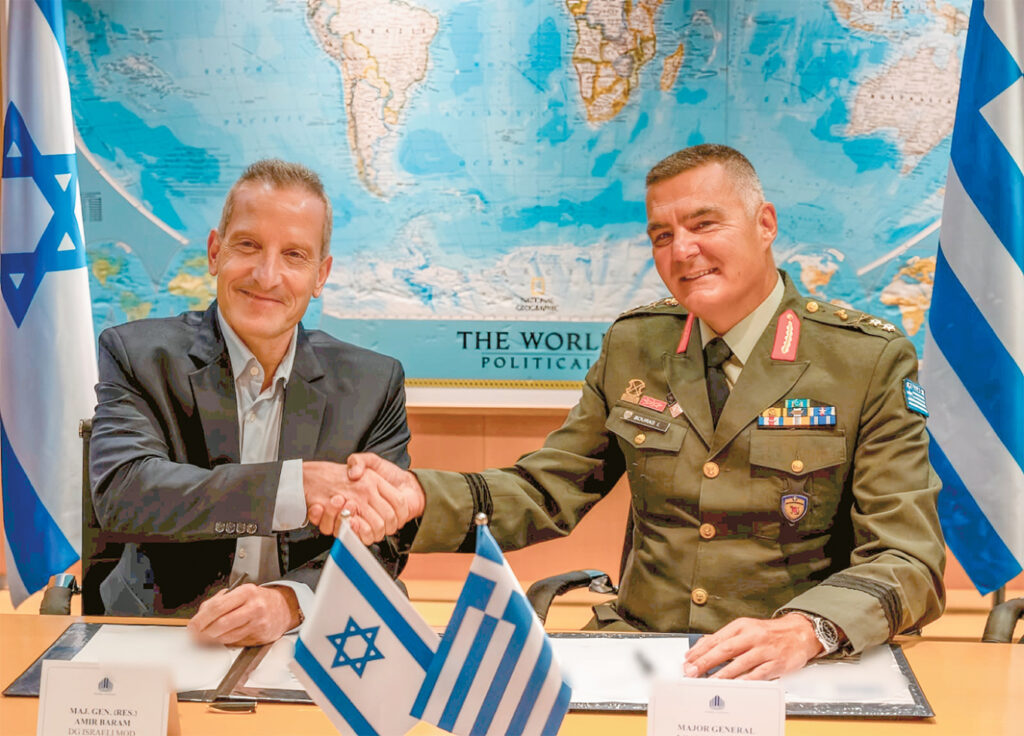
Feferman puts it even more plainly. “Technological sovereignty,” in his view, “is probably even more critical than the tools, the hardware and the weapons systems themselves.” At the same time, though, he warns that it would be a mistake for Greece to interpret this sovereignty as a complete break from Israel. At the higher levels of defence relationships, he says, cooperation does not end once the last crate is delivered. “It isn’t ‘here are the weapons, good luck.’ It’s ‘we are here, we operate together, we upgrade together with you, and we do it in real time.'” This, he argues, builds a level of strategic trust with consequences that go far beyond the sale of weapons systems.
The agreement also provides for Greek industrial participation of at least 25 per cent, worth more than 700 million euros, with twelve Greek companies already linked to the programme. Feferman insists this dimension carries real strategic weight: beyond training, and the exchange of know-how and intelligence, contact is now being established even at the level of the two countries’ defence industries. For Athens, the stakes are clear: the 700 million euros must translate into more than Greek subcontracting work, and instead into genuine know-how that remains in the country when the “Shield” needs modernising in the next decade.
A shared picture
For Greece, the agreement is, above all, an attempt to close a decades-old gap. The country has a strong air force, new ships and Patriot batteries, but modern warfare is no longer decided simply by who has more or better fighter jets. A threat can now take the form of a ballistic missile, a low-flying cruise missile, a swarm of drones, an electronic or cyber attack, and, within a few years, increasingly a combination of all of these.
The real value of the “Shield” lies in its attempt to give a shared picture to assets that, until now, were never designed from the outset to operate as a single network. At the same time, Greece is gaining access to technology developed under real conditions of repeated missile and drone attacks. Success, of course, will not be judged by the purchase itself but by integration: whether the new and existing systems are genuinely connected, whether the Greek Armed Forces gain full operational control of the software, and whether domestic industrial participation creates the capacity to develop the system further rather than merely maintain it.
For Israel, the three billion euros matters, but it is not the whole story. This is the largest defence export agreement in the history of relations between the two countries, and one of the largest the Israeli state has ever signed. At the same time, it represents a powerful vote of confidence in systems that Israel now presents as combat-tested under real conditions.
More significant still is that Israel is installing in Greece not simply products, but its own air defence doctrine. This creates a bond that will last decades, since upgrades, training, maintenance, software development and new subsystems will keep the two sides at the same table long after the first 35 months are complete. Tel Aviv thereby secures a stable technological and defence partner on the European side of the Eastern Mediterranean.
For Cyprus, the agreement carries particular weight precisely because Nicosia is not outside this equation. The Republic of Cyprus already operates the Israeli Barak MX, while Greece, Cyprus and Israel have signed a Joint Action Plan for 2026 that includes joint operational activities, special forces training and staff-level consultations.
Benjamin Netanyahu chose to present the “Achilles Shield” publicly as a “direct continuation” of the Eastern Mediterranean relationship built a decade ago with Greece and Cyprus. This does not mean a joint Greek-Cypriot-Israeli dome exists today; such a claim would go beyond the available evidence. It means the three states are increasingly using compatible technologies, training together and developing a shared operational vocabulary and, crucially, familiarity with one another. In a region where distances are short and reaction times are measured in minutes, if not seconds, this convergence carries strategic significance in its own right.
For Turkey, finally, the reading is inevitably different. Athens has not officially presented the “Achilles Shield” as a system designed against Turkey, and that matters. Feferman, however, while making clear he is not speaking on behalf of Greece’s defence leadership, believes it “would be obvious that Turkey represents the principal threat scenario for Greece” in strategic planning. He points in particular to Turkish investment in mass, relatively low-cost drone production, a threat that, he says, requires a different logic from the one used against a ballistic missile.
Ankara, for its part, is already watching the agreement closely, with Turkish media linking the possible deployment of Israeli systems on the islands to Turkey’s long-standing position on their demilitarisation. Recep Tayyip Erdoğan’s fresh remarks on the arming of the islands came just days after the signing between Tel Aviv and Athens.
The core issue for Turkey is not that Greece is acquiring another missile. It is that, within three years, it could face a considerably more difficult environment for planning any air, missile or drone attack.
There is a final layer to this, perhaps broader than the “Shield” itself. Two decades ago, the current relationship between Athens and Tel Aviv could hardly have been taken for granted. For years, Israel maintained a close strategic and military relationship with Turkey, while Greece traditionally struck different balances in the Middle East. The gradual deterioration of Israeli-Turkish relations and the convergence of interests between Greece, Cyprus and Israel in the Eastern Mediterranean changed that picture.
BREAKING:
— Visegrád 24 (@visegrad24) August 31, 2026
Israel has signed a record €3 billion arms export deal with Greece to build a comprehensive, multi-layered air defense system called “Achilles Shield.”
The deal includes Israeli-made systems such as David’s Sling, SPYDER, and BARAK MX.
It is the largest defense… pic.twitter.com/rq7e5vYGNZ
Strategic convergence
Feferman sees the agreement today as part of a much larger regional realignment. He describes an Eastern Mediterranean and a Middle East where different networks of cooperation are forming, with Turkey seeking to strengthen its own regional role while Israel looks for stable partners connected to Europe, the Gulf and India. Within the same equation, he places the dramatic shift of Israeli tourism towards Greece and Cyprus, and the steadily deepening economic and social ties between the two sides.
This is his own analysis rather than official Israeli state doctrine, but it reflects how part of the Israeli strategic community now views Greece: not as just another customer of Rafael or IAI, but as a country with which a multi-layered relationship can be built. He returns, in the end, to where he began: no one needs to create enemies, nor present these new partnerships as inevitable alliances against third parties. What is needed, he stresses, is vigilance and the careful selection of partnerships capable of delivering stability, military strength and economic prospects.
The “Achilles Shield” will take almost three years to become fully operational. Much could change in the region before then, and the last five years have shown just how risky any prediction about the Eastern Mediterranean and the Middle East can be. What has already changed, however, is the starting point.
With the signing in Tel Aviv, Greece did not simply choose which weapons it will use in the next generation of its air defence. It chose the architecture on which much of its defence will rest for decades to come, and, with it, a partner that will inevitably sit far deeper inside Greek defence planning.
The true scale of the agreement may ultimately lie not in the three billion euros it costs, but in the fact that the “Achilles Shield” represents Greece’s own strategic choice.
The David’s Sling and Spyder air defence systems, which will be integrated into the unified dome of Greek air defence
Unified system
For the first time, Greece is not simply replacing an ageing air defence system with a newer one. It is attempting to bring sensors, radars, various interceptors, existing Greek assets and a single command and control system together under one common umbrella.
Interception
A shared radar and command network decides which layer needs to be activated, so that an expensive interceptor is not wasted on a cheap target, while at the same time a genuinely dangerous threat does not fall between the responsibilities of different systems.
Information
The Greek command and control system will gather information from different sensors and use artificial intelligence applications for faster identification and classification of threats, and to select the most appropriate response.
Civilians
For Greece, the “Shield” is gradually opening up a discussion that goes beyond military bases: how civil protection should be organised in the face of a modern missile attack or mass drone assault.
Ask me anything
Explore related questions




