





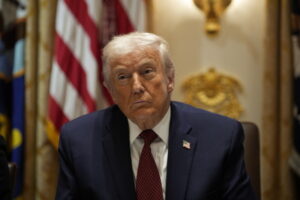
US President Donald Trump escalated his trade dispute with Canada on Tuesday night, banning the import of certain Canadian products into the United States and raising tariffs on others.
The announcement came after Ottawa imposed new tariffs on American imports in response to the additional tariffs Washington announced on 22 August targeting Canadian goods.
A US government official told reporters that Canada had been warned its response would worsen the situation.
Among the Canadian products now banned from entering the United States are alcoholic beverages, dairy products and large-capacity motorcycles. The ban takes effect from 29 September, under an executive order signed by Trump.
From 15 September, additional tariffs of 50% will also be imposed on a range of products, from mattresses and golf carts to motorised boats.
Some Canadian products, by contrast, will be exempt from the new tariffs, although the exemption list is considerably shorter. Toilet paper is among the items spared.
To justify the ban on Canadian alcohol imports, Trump pointed to Canada’s boycott of American alcoholic drinks.
Since last year, American wines and other alcoholic beverages have disappeared from shop shelves across most Canadian provinces, as Canadians sought to express their anger at the new US tariffs and at Trump’s repeated suggestions that their country become the 51st US state.
More recently, the Republican president’s order to rename Lake Ontario “Lake America” also drew a backlash.
The Gamble
Canadian minister for Canada-US relations Dominic LeBlanc said on X that Ottawa was “looking into” these “unjustified” actions, adding that he was in contact with US Trade Representative Jamieson Greer.
The Government of Canada is assessing the latest tariff measures from the United States.
— Dominic LeBlanc (@DLeBlancNB) September 9, 2026
As has been the case for the last 18 months, our first priority remains on protecting and supporting Canadian workers, farmers, families, and businesses from these unjustified actions.…
“When the US is ready for dialogue, our government will work in good faith and constructively to build safer, mutually beneficial trade relations that fully respect Canadian sovereignty,” he added.
For now, though, there is no sign of a way out of the crisis.
Canadian Prime Minister Mark Carney warned on Tuesday that his government’s strategy to reduce reliance on the United States would carry a short-term economic “cost”.
Carney, who has the backing of Canadian public opinion, is taking an economically risky gamble. Almost 60% of Canada’s imports come from the United States, and roughly 70% of Canadian exports are destined for its neighbour.
Trump also announced on Tuesday that Canadian companies would be excluded from the US government’s federal procurement programme, in a post on Truth Social.
Ask me anything
Explore related questions




