





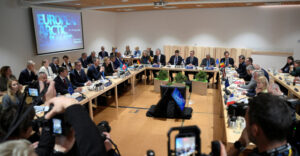
“A strategic and more proactive role”: At the summit held today in the northern Finnish city of Rovaniemi, twelve countries called on the European Union to strengthen its presence in the Arctic, where geopolitical tensions are intensifying amid Russian threats and Donald Trump’s territorial ambitions.
“Security in the Arctic must be ensured collectively,” the countries—including Finland, France, Germany, Denmark, the Netherlands, Sweden and Greece—said in a joint statement following the conclusion of the summit.
Seven months have passed since the American president threatened—for the third time—to take control of Greenland, the vast autonomous territory of Denmark, triggering a major crisis among Western allies.
Since then, tensions between Europeans and Americans have somewhat eased.
However, European leaders have not forgotten those threats and now want to work together to find ways to strengthen their presence in the region, while also taking into account the presence of a hostile Russia on the other side of Finland’s long border with the country.
As they argue, Moscow represents a “significant and enduring threat” to security.
Close
German Chancellor Friedrich Merz and Danish Prime Minister Mette Frederiksen attended the summit in Rovaniemi. Leaders of countries with no direct stake in the Arctic were also present, including Romanian President Nicușor Dan.
The goal, European Council President António Costa said at a press conference, was to show that “what is happening here is not a regional issue. It is a European issue.”
The summit focused on the new shipping routes emerging as Arctic sea ice retreats, as well as untapped deposits of raw materials and security threats arising from Russian and Chinese military activities.
No formal decisions were taken at this summit.
However, the meeting comes as the European Commission is expected to present a new strategy for the Arctic in the coming weeks. The document aims to set out Brussels’ main policy directions for the region over the coming years.
The countries and their leaders still have an opportunity to influence the content of the final document. “We should strengthen the European Union’s commitment to this region in order to complement NATO’s efforts,” Merz said during the leaders’ joint press conference in Rovaniemi.
Danish prime minister says she is “optimistic” about talks with the Americans over Greenland
Frederiksen, for her part, said that discussions within the working group established earlier this year between Greenland, Denmark and the United States regarding the Arctic island are generating cautious optimism.
Frederiksen has had to deal with U.S. President Donald Trump’s persistent desire to bring Greenland under U.S. control, an autonomous territory belonging to the Kingdom of Denmark. Trump argues that Denmark cannot protect the large Arctic island from Russia and China.
Greenland is not part of the European Union. Last week, European Commission President Ursula von der Leyen visited the island and announced closer cooperation, as well as a €200 million investment package, which will be used in part to create the infrastructure needed to extract valuable raw materials.
“It is too early to draw conclusions, but I am quite optimistic about our ability to find a solution,” Frederiksen said at a press conference on the sidelines of the summit.
“As long as the working group continues its work, nothing can be finalized, but obviously I hope to find a peaceful path, including with the Americans,” she added.
Since the establishment of this working group earlier this year, which aims to discuss U.S. security concerns regarding the autonomous Danish territory, little information has emerged about the nature of the negotiations.
According to several media outlets, the United States wants to open three new military bases in southern Greenland, in addition to the Pituffik base already operating in the northern part of the island. A 1951 defense agreement, updated in 2004, already gives U.S. armed forces essentially complete freedom to deploy facilities in Greenland, provided they notify the authorities.
“When I became prime minister of Denmark, the Arctic region was not really on the agenda of either the European Union or NATO. Today, we have 19 allies conducting exercises together in Greenland,” the Danish prime minister said.
Ask me anything
Explore related questions




