





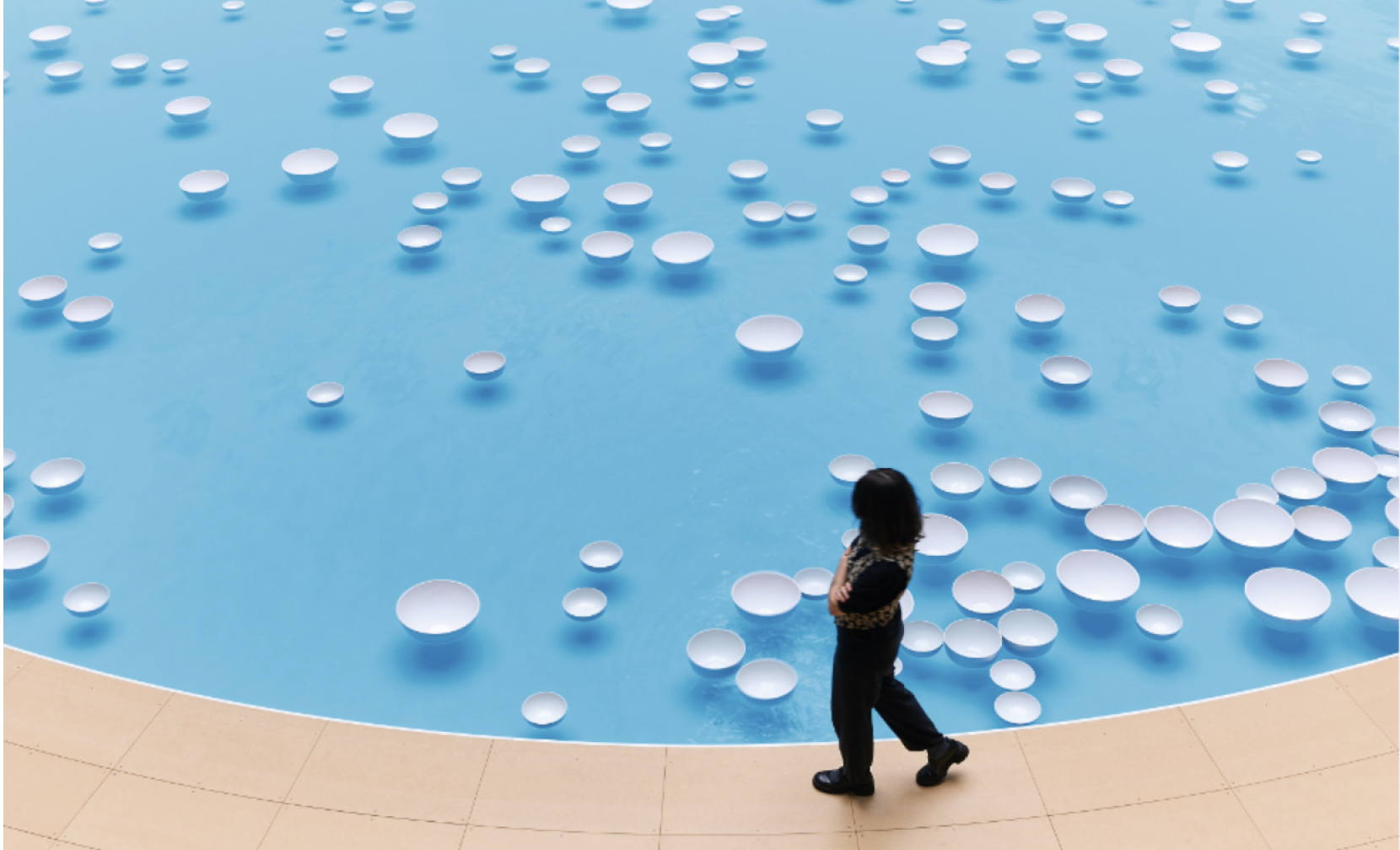
A multisensory installation that has gone viral from Paris to New York, “clinamen” by award-winning French composer and visual artist Céleste Boursier-Mougenot, is making a stop in Athens and will be hosted from September 26 to January 5 at Onassis Mandra, on Dionysiou Areopagitou Street.
“I am interested in giving form to visitors’ senses, offering them both direction and space to daydream. The only message I want to convey is an invitation to inhabit a space that I have designed specifically for them,” the artist explains.
With “clinamen,” he invites us to synchronize with the sound of silence, creating an intensely blue aquatic landscape with hundreds of white ceramic bowls floating in three specially designed pools. For the first time, the impressive “clinamen” takes on a new dimension, as it is presented outdoors and surrendered to the shade, the air, the voices, the sounds and echoes of Athens, as well as to the power of natural elements and weather phenomena—the light, wind and rain—at the only surviving Athenian open-air theatre of the Belle Époque. It is a work that effortlessly wins our time.
A visual artist, musician and composer, the award-winning French artist has spent decades exploring the boundaries between art and everyday life. Rather than composing music in the traditional way, he creates live systems made up of objects, water, movement and space. The simplest materials are transformed into unexpected musical instruments that produce sounds in real time, without the intervention of a human performer.
Boursier-Mougenot first developed “clinamen” in 1997. The title of the installation comes from the Ancient Greek word “paregklisis” (swerve), a key term in Epicurean philosophy that describes the unpredictable deviation in the movement of atoms: a slight divergence that leaves room for chance, freedom and the unexpected.
Each time it is presented, “clinamen” adapts to the architecture and atmosphere of the space that hosts it. In Athens, it is not simply transported to a new location but is re-tuned to the sound of the city and to changes in the weather and light of the Attic sky. Visitors are invited to stand within a landscape of water and sound, to listen, observe and allow time to pass differently. And if it rains, the sound of the rain will become part of the score.
With “clinamen,” the renovated Onassis Mandra is once again introduced to the public, bringing back into the spotlight the only surviving Athenian open-air theatre of the Belle Époque: a historic space next to the Onassis Library and Dionysiou Areopagitou. There, the installation transforms the space into an open invitation to listening and respite, inviting us to surrender to an almost addictive experience of contemplation and daydreaming.
Ask me anything
Explore related questions




