





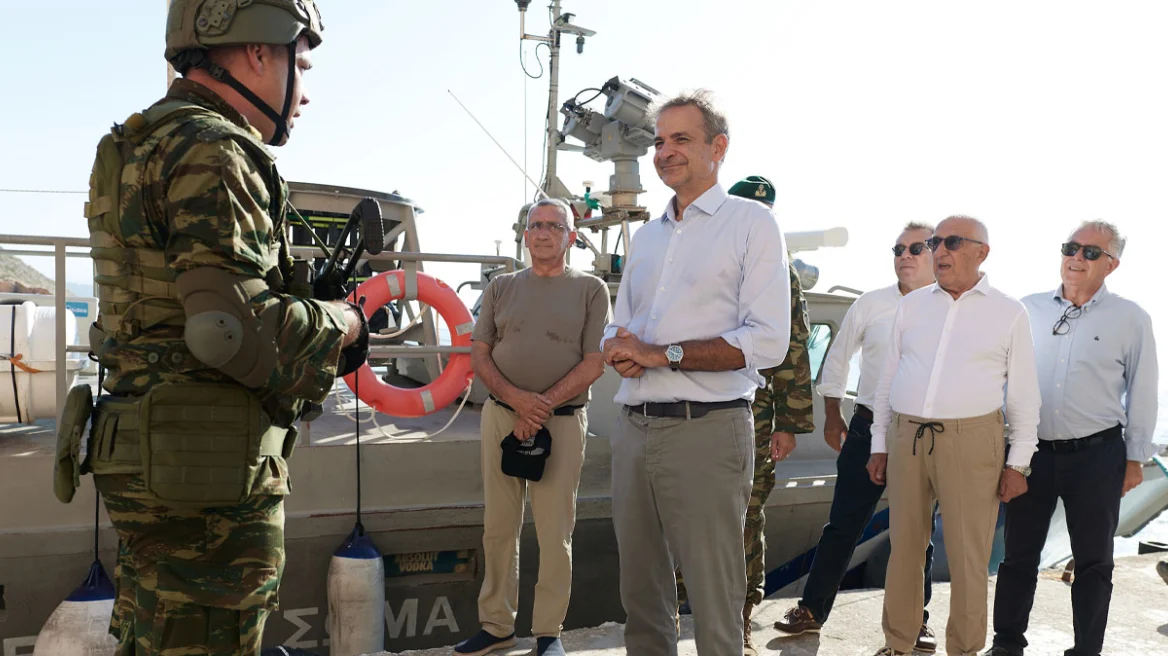
The Turkish Defense Ministry made provocative statements regarding Kyriakos Mitsotakis’ visit to Kastellorizo, claiming that the presence of military forces and a warship on the island is incompatible with the status that, according to Ankara, is provided for by the 1947 Treaty of Peace with Italy.
The Turkish ministry said it had “closely” monitored the Greek prime minister’s visit, as well as his meetings with military forces on the island, while claiming that such actions “do not contribute to peace and stability.”
Responding to journalists’ questions regarding Kyriakos Mitsotakis’ visit to Kastellorizo, the Turkish Defense Ministry stated: “The visit of the Greek prime minister to Kastellorizo, together with his entourage, and his contacts with the military elements stationed there were closely monitored by us.”
Ankara then reiterated its claims concerning the island’s demilitarization, stating that “the presence of military elements and a warship on Kastellorizo, which was ceded to Greece on the condition that it have a demilitarized status under the 1947 Treaty of Peace with Italy, as well as the public display of these elements in the context of high-level visits, are incompatible with the status of the island and do not contribute to peace and stability.”
“It Will Not Be Accepted by Our Country”
In particularly strong terms, the Turkish ministry also referred to the geographical position of Kastellorizo, attempting to link its proximity to the Turkish coast with its allegations concerning militarization.
“We once again emphasize that efforts to create faits accomplis that run counter to the demilitarized status of Kastellorizo, which is located extremely close to the Turkish coast, are incompatible with international obligations and will not be accepted by our country,” it said.
At the same time, Ankara attempted to link these specific allegations with references to the need for dialogue between Greece and Turkey. As it claimed, Turkey supports transforming the Aegean and Eastern Mediterranean into areas of “peace and stability” and supports the development of Greek-Turkish relations on the basis of “good neighborliness and dialogue.”
Immediately afterward, however, it added that this approach “does not mean that the disregard of rights and obligations arising from international treaties or the creation of faits accomplis on the ground will be tolerated.”
The Turkish ministry also called on Greece “to comply with its obligations arising from international treaties and to refrain from activities on islands with a demilitarized status that are incompatible with that status.”
Concluding its statement, the Turkish Defense Ministry insisted that the country would continue what it describes as a “constructive” policy toward Greece, while reiterating that it would defend what it considers its rights and interests in the region.
“While our country continues its constructive approach in favor of good neighborliness and dialogue in the Aegean and Eastern Mediterranean, it will continue with determination to protect its rights and interests arising from international law,” the statement said.
Ask me anything
Explore related questions




