





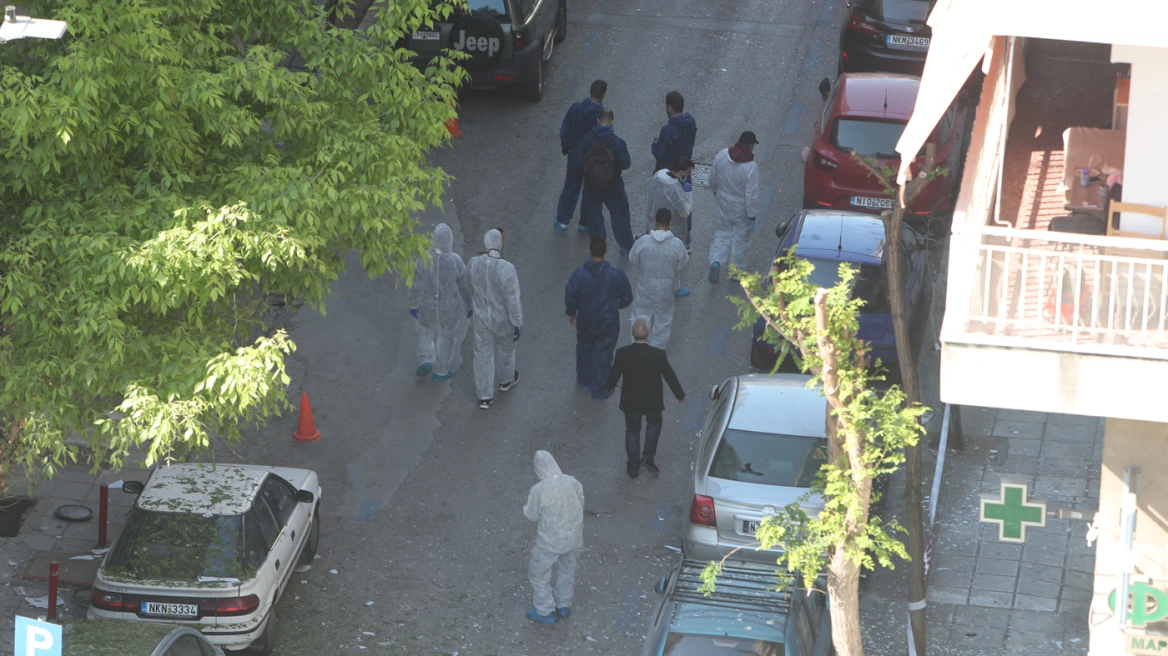
“The target was the automated teller machines (ATMs), and I wanted to take the money. It’s not my fault that ‘Maria’ was killed; she was paid to do it and she didn’t go there for nothing, nor with a gun to her head,” the main defendant in the bombing case said in his testimony. The explosion occurred on May 3, 2025, outside a bank branch in central Thessaloniki and claimed the life of the 38-year-old woman who had planted the device.
The trial at the Three-Member Court of Appeals for Felonies began today and was adjourned after the testimonies of the three defendants appearing before the court. They include a 37-year-old man who had rented the hideout apartment in Ladadika and transported the bag containing the materials used to construct the bomb; a 43-year-old man whose fingerprint was found on the bag containing the explosive device; and the third defendant, who is incarcerated and has admitted that he himself organized the bombing from inside the prison.
They have been charged with felony offenses including participation in a criminal organization, explosion, procurement, possession and manufacture of explosives, damage to third-party property, and other offenses, as applicable.
Continuing his testimony, the third defendant claimed that he himself organized the attack using the explosive device and, in fact, gave instructions via video call to the 38-year-old woman so that she could assemble it, even though he was inside prison.
“I met ‘Maria,’ as we all knew her, 20 years ago. I have been in prison since I was a young child, going in and out, and I met her at a party and we kept in touch. She had sent me a message on Facebook and we communicated in order to arrange something. I knew that she was addicted to drugs and needed money,” he said.
He admitted that the target was the bank’s ATMs, but said that the 38-year-old woman left the bomb in the wrong place. “Two days before the explosion, I sent her to the bank and watched her through the camera. I wanted to take the money from the three machines. I sent her to check it out and she was recording video, so I decided we would hit that place and whatever happened, happened. At that moment I chose her because I didn’t want us to kill anyone. We wanted to make money. I have never worked a day in my life; this is how I make money and I continue to make money,” he said characteristically.
“The plan was not for her to leave the device where she left it. I had obtained the materials for constructing it from a friend of mine, and I am not going to tell you his name. I am knowledgeable about this and I constructed the explosive device through a camera that I used to show Maria what to do while I was in prison,” he said. When the bench asked him how he had access to a mobile phone, etc., from inside the prison, he smiled and replied: “No one monitors us in prison. Did you expect me to tell you what prisons are like today? On the camera I would tell her, ‘Put on gloves, get some modeling clay and shape it,’ etc.”
“You can only do things like this with a drug user and not have to pay tens of thousands of euros. I took advantage of her addiction to drugs. She didn’t die for nothing; she was paid to do it, she didn’t go there with a gun to her head,” he said.
Regarding his co-defendant, who is accused of and has admitted to transporting the bag containing the materials for constructing the device—without knowing what was inside—to the Airbnb apartment that was being used as a hideout and which he had rented, the 42-year-old claimed that they had contacted each other again through social media and that he offered him the “job,” paying him €500.
“I am well-known in prison; a lot of people know me. I have many friend requests on Facebook and Instagram, and the next day he called me. He told me that he was having financial difficulties, and I remembered that. The next day I told him to download the ‘Signal’ app and call me there. I offered him a job, but he knew that I was inside for terrorism and told me he couldn’t do those things. I replied that he would only be transporting a bag, and the next day he agreed. He didn’t know what was inside the bag,” he added.
As for the other person sitting alongside him in the dock, the 42-year-old said that he had absolutely no connection with him and had never seen or communicated with him in his life. “You are talking about a criminal organization, while I organized it myself. One person transported a bag and the deceased woman left the device. What kind of criminal organization is that? The other man has nothing to do with it; he is being held for one of my own cases, and this bothers me a lot. I even have a name,” he concluded.
“I Didn’t Know What Was in the Bag, I Wanted the Money”
For his part, the 37-year-old accused of renting the Airbnb and undertaking to transport the bag by train, following instructions from the 42-year-old incarcerated defendant, claimed that he did not know what was inside it and that he received €500 to do so.
“I came to Thessaloniki in November 2024 and stayed for several months at the homeless shelter in the city center. After that I lived in a tent and on the streets as a homeless person. I needed the money. We communicated with the third defendant through Facebook, as I knew him. I explained to him how I was living and that I was struggling for five hours to make €20. He asked me if I wanted to make €500, and I agreed because I was in financial difficulty. He told me to go to Athens and bring back a bag. I was sure it was something illegal, but I didn’t know what was inside; I didn’t ask. Would he have paid me to bring something legal?” he claimed.
He then explained that he left the bag at the rented apartment and received the money in Thessaloniki. “I left the bag and didn’t stay there any longer. I don’t know anything else, nor who planted the explosives. I left the bag, the deceased woman came, I gave her the keys, I was paid and I left. I didn’t ask anything. Not even when he told me to rent the apartment.”
Regarding how he learned that the explosion had occurred at the bank and what the outcome had been, he said: “As soon as I saw it all over the news, I fell into depression. I was crying, I wasn’t well, and I went down and turned myself in. He hadn’t told me what purpose I would be delivering it for. On Monday they called my mother and on Tuesday afternoon I went down and turned myself in. The bag was a backpack and I had it over my shoulder. I knew for sure that it was something illegal; he wouldn’t have paid me to transport clothes. I cannot explain how my genetic material was found on the fuse; I didn’t open it,” he said.
Finally, the third defendant in the case claimed that he had absolutely no involvement and that he had been hosting the 38-year-old woman at the home where he lived with his wife in Dendropotamos, Thessaloniki. He said that his fingerprint was found on the bag because he had brought some things to the 38-year-old woman—eggs and sweets—and she had probably used the bag afterward, since it was an ordinary shopping bag from a store.
“We took the deceased woman eggs, tsoureki and a small lamb in this bag so she could eat. She used it to transport the explosive device. I have no other involvement. I learned about the explosion from my lawyer. I was at the hair salon and he told me, ‘It must be Maria.’ He asked me whether I was involved and, of course, I denied it. I panicked and was shocked. Nothing like this has ever happened to me before. I had nothing to hide. The 38-year-old woman had not given us any reason to suspect anything. She said, ‘I’m going to do a job, I’ll transport drugs from Athens to Thessaloniki,’ and I told her, ‘Cut the nonsense, you’ll end up in prison again,’ and she nodded her head. I knew nothing about the explosion at the bank,” he said.
“There Was Complete Chaos”
It is noted that police officers, the owner of the Airbnb, owners of vehicles and apartments that suffered damage, the manager of the bank branch, relatives of those involved, and others testified in court. People living near the site of the explosion said that the windows and balcony doors of 20 homes in the area were shattered, while everyone rushed outside in terror.
Testifying in court, the police officer who was the first to arrive at the scene after receiving a dispatch from the Emergency Response Center about a possible explosion described what he saw: “At around 5:30 in the morning, we received a call about an explosion and a possible fire at a bank ATM. We were very close and arrived very quickly. We saw smoke coming out and complete chaos. We informed the center of a possible explosion at the scene.” As he said, they found pieces scattered on the ground and then a person: “We immediately radioed the center and requested an ambulance. We asked for it to come immediately. When we found the woman, she appeared to be very seriously injured, but she was alive. Shortly afterward, when EKAV arrived, we learned that it was very difficult for her to survive, and later we were informed by phone that she had died.”
The 38-year-old woman’s cousin testified as a witness in court and said that the woman had told her she was going to do a job because she needed money for an operation. “She was saying, ‘Don’t be afraid, everything will be fine.’ She used substances. She said she was going to do a job. I had a feeling inside me.”
It is recalled that the 37-year-old man who rented the hideout apartment and transported the bag has been remanded in custody in connection with the case, as has the 43-year-old man whose fingerprint was found on the bag containing the explosive device. The third defendant, as an incarcerated prisoner, has assumed responsibility for the bomb explosion and had sent a document to the first regular investigating magistrate handling the case, admitting that he himself organized the Thessaloniki bombing.
Following the defendants’ testimonies, the court adjourned until tomorrow, when proceedings will continue with the closing arguments of the defense lawyers and, most likely, the verdict.
Ask me anything
Explore related questions




