





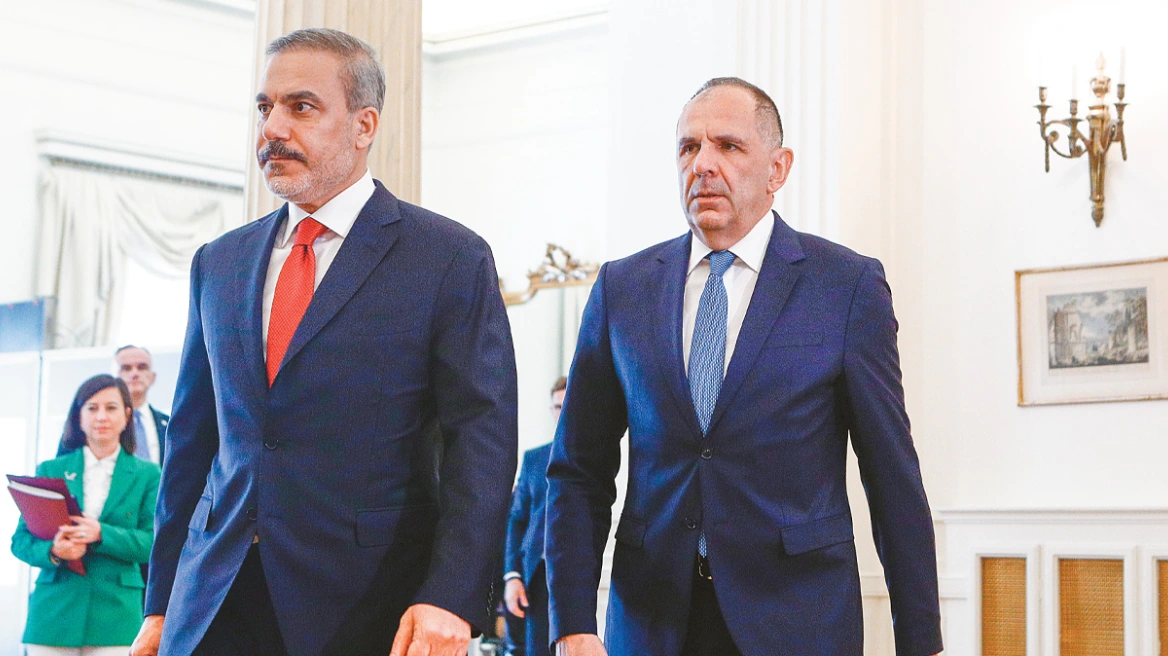
Ankara is removing any remaining room for understanding in Greek-Turkish relations, opening up the full range of its demands, which it is now also tying to its broader ambitions in the region and its regional rivalry with Israel. It is no coincidence that for some time there has been no regular contact or meetings between the foreign ministers of the two countries, George Gerapetritis and Hakan Fidan respectively, while neither leader, Kyriakos Mitsotakis and Recep Tayyip Erdogan, sought to arrange one of their customary meetings on the sidelines of the UN General Assembly in New York, where they will, of course, be there at the same time for only a few days.
It is indicative that the only high-level channel of communication used recently was that of the head of Turkey’s intelligence service MIT and close associate of the Turkish president, Ibrahim Kalin, who came to Athens for a scheduled meeting with his Greek counterpart, EYP chief Themistoklis Demiris, while also conveying messages both on the issue of demilitarisation and on cooperation with Israel. Although Kalin is always characterised by moderation, he did not hide from his interlocutors the need for cautious steps, noting that, although Turkey frequently reiterates that it has no intention of provoking a military confrontation, moves that could lead to uncontrollable incidents should be avoided.
The Turkish demands and its revisionist policy towards Greece are now also being given a new strategic dimension, as Ankara sees Greece as an “ally” of Israel, in a relationship between the two countries that Ankara views as an attempt to manipulate and constrain its regional hegemonic ambitions.
Defensive reinforcement
The demand for the disarmament of the islands, which Turkey presents as an alleged obligation to demilitarise them and which has risen to the top of the Turkish leadership’s agenda in recent times, is not something new. As early as 1976, when Greece, following the Turkish invasion of Cyprus and the later creation of the 4th Army of the Aegean on the Asia Minor coast, took its first tentative steps towards strengthening the islands’ defences, Turkey attempted to create a new “dispute”, even sending letters to the UN Security Council.
Now, however, Turkey is raising the issue of demilitarisation and focusing on it, seeking, through the issuing of threats as well, to “move” Washington and Brussels, so that they become convinced that military cooperation between Greece and Israel is directed against Turkey itself and destabilises the entire region, at a time when another source of crisis is not wanted.
The Turkish leadership, trapped in a siege mentality, sees the strategic relationship between Greece and Israel as a plan to restrict its presence and influence in the wider region. Moreover, the possibility of installing advanced Israeli air-defence systems on the islands would not only constitute a strong deterrent measure against Turkey’s officially declared threat (casus belli and “grey zones”), but also an extension and broadening of the front it has with Israel, from the Middle East to the Aegean and the Eastern Mediterranean.
For Greece, it is obvious that Turkey’s demand for the disarmament of the islands cannot be accepted, still less any acceptance of “co-management” of the country’s defence arrangements. Athens has responded through statements by the Prime Minister, Mr Gerapetritis and Defence Minister Nikos Dendias, through the latest announcements by the Foreign Ministry, and through letters to the UN, setting out the reasons that legitimise the adoption of measures for the security and defence of the islands, also within the framework of Article 51 of the UN Charter concerning self-defence. When there is a continuously renewed threat of war through the casus belli, as well as challenges to Greek sovereignty through the “grey zones”, taking measures to defend the islands is not a choice for Greece, but a necessity created and imposed by Turkey itself.
Destabilisation
The most serious escalation of Ankara’s demand came in 2021, when, in a letter to the UN dated 14 July 2021, it directly linked the “violation” of the alleged obligation to demilitarise the islands with recognition of Greek sovereignty over them. Ankara’s objective, through threats and blackmail, is to prevent the strengthening of the islands’ defences, so that its pressure on Greece remains strong and, at the same time, by presenting the issue as a pretext for regional destabilisation, to “frighten” both Washington and Europe and thus restrain strategic cooperation between Greece and Israel. At the same time, it seeks to “undermine” the very status of the islands and thereby bargain for acceptance of its arbitrary position that the islands have no maritime zones beyond their six-nautical-mile territorial waters.
Believing that it has legal arguments based on references in the treaties, against which there is, of course, strong counterargument that has also been formally put forward by Greece, and capitalising on the negative climate surrounding Israel, due to Netanyahu’s policies, both in Europe and in the US, Ankara hopes that a request will be made for, if not a suspension, at least an slowing of the strategic relationship between Greece and Israel.
Ankara also notes that while Turkey, despite being a candidate for EU membership, is facing serious obstacles to joining SAFE, Israel, through the co-production of weapons systems in Greece and Cyprus, is gaining access to European funding for Europe’s rearmament programme.
The initial messages, at least from the US, were negative for Ankara, however, as the State Department welcomed Greece’s cooperation with Israel and the agreement for Greece to acquire Israeli systems, while, regarding Cyprus, Washington’s decision to extend for one year the lifting of the arms embargo on the Republic of Cyprus also provoked anger in Ankara.
Turkey is expected to continue raising the rhetoric over the issue of demilitarisation, but it is also considered extremely difficult and high-risk for it to attempt interventions on the ground when the transfer of Israeli systems to Greece begins and the possible installation of such systems on the Greek islands takes place. As far as Greek-Turkish relations are concerned, however, the most immediate issue that will test the resilience and determine the real intentions remains that of the Cyprus-Crete electricity interconnection.
What was initially a technical issue has now become pivotal for relations between the two countries, as the survey line for determining the route of the cable essentially brings into conflict two critical strategic choices of the two countries: the continental shelf provided for under the Law of the Sea, as well as Greece’s lawfully delimited EEZ with Egypt, on the one hand, and the “Blue Homeland” doctrine and its cornerstone, the illegal Turkish-Libyan Memorandum, on the other.
That is precisely what makes it extremely difficult for either side to back down and has so far created conditions of deadlock.
Turkey had not only prevented the Ievoli Relume in July 2024, in the well-known Kasos incident, from carrying out work just outside the island’s territorial waters, within Greece’s delimited EEZ and within the zone where Greece is entitled to extend its territorial waters.
A few months later, in February 2025, when, albeit belatedly, NAVTEX notices were issued for surveys at a point north of Malia and Agios Nikolaos, just outside the territorial waters, by the NG Worker, Turkey reacted in milder terms, as the corvette monitoring the vessel harassed it by radio, stating this time that the surveys were being conducted in an undelimited continental shelf under a NAVTEX allegedly issued by an unauthorised station (the Heraklion Station).
The research vessel
In this way, while Turkey had already prevented surveys east of Kasos by invoking the tenuous argument that the area was part of the Turkish continental shelf, in the second case it demanded that the surveys be halted because the continental shelf was not delimited, referring to the inactive Bern Protocol, as well as to its position that the islands do not possess a continental shelf/EEZ. According to a highly informed source, the technical preparations have almost been completed and, as soon as the “closure” of the research vessel is announced, the process will begin with the submission of a request, most probably by the embassy of the country from which the company originates (because of Meridiam, this will most likely be the French Embassy). Following the opinion of the Interministerial Committee, the Coast Guard services will then undertake its approval and the process of issuing the relevant NAVTEX by the Hydrographic Service.
Of particular interest is the position (which reflects personal views) expressed by Dr Anastasia Strati, Expert-Ambassador at the Ministry of Foreign Affairs, in November 2025 at the Nafplio International Relations Meetings organised by the Centre for International Law and Diplomacy, entitled “The Laying of Submarine Cables, the Freedom of the High Seas and Turkish Claims”.
According to this study, under Article 79(2) of UNCLOS, it is mandatory to notify the coastal state of the intention to carry out the works on the continental shelf on which the cable will be laid, with a complete file including details of the vessels to be used for the laying, the methodology and nature of the works, and the geographical coordinates of the cable route, so that it can also issue the necessary navigational warnings (NAVTEX) for maritime safety.
In Greece, based on established practice, Ms Strati states, all relevant requests are submitted through the embassy of the state of nationality of the company responsible for implementing the overall project or acting as contractor (subcontractor) for the individual works, and which determines all the relevant specifications, including the vessels to be used (as, according to UNCLOS, the holders of the relevant rights are states and not private individuals).
Turkey is seeking a peculiar regime of co-management, while the eminent legal expert points out that it is inconceivable to carry out seabed surveys and/or lay a submarine cable without notifying the coastal state, whether this takes the form of an authorisation request or simply a notification of the works.
In June 2024, Turkey, through two NAVTEX notices (0592/24 and 0615/24), designated an area in the Eastern Mediterranean for surveys by the Italian research vessel TELIRI for the BlueMed fibre-optic cable, in an area that included both the Greek continental shelf and EEZ (under the Greek-Egyptian agreement), as well as an area under Greek jurisdiction for issuing NAVTEX. The Turkish NAVTEX notices even stated that the surveys concerned an area of the “Turkish continental shelf”. Athens issued almost identical NAVTEX notices, stressing that they concerned an area of the Greek continental shelf and EEZ, but refrained from issuing a cancelling NAVTEX. Thus, the two sides recorded their positions and exchanged statements, but the surveys continued, with each side maintaining that they were conducted under its own NAVTEX.
It was not made known whether the company had submitted a request to both countries or simply, on the basis of the notification of the surveys, Turkey considered that a request for the issuance of a NAVTEX had been submitted. This would be a model that could also be employed in the case of the GSI, although that case is very different.
The issuance of the NAVTEX
The GSI is a project of Greek interest, in which the Independent Power Transmission Operator (ADMIE) also participates, and therefore any initiative to submit, even indirectly, a request for the issuance of a NAVTEX by Turkey must be ruled out, as this would mean Greece accepting Turkey’s claims and demands.
According to a senior diplomatic source, Athens does not expect France to choose to intervene, even militarily, if a French-flagged vessel operating on behalf of the GSI (whose main shareholder is the French company Meridiam) is obstructed. Instead, there is an expectation that France will probably find, through the channels it maintains, a compromise solution with Turkey, with Greece’s knowledge and without leaving any “shadows”, so as to make it possible for the surveys to resume.
The alternative prospect is not easy, as, as a senior source points out, this would lead to a new confrontation, and no one knows whether Turkey would limit itself to radio harassment and the unilateral issuance of its own NAVTEX, or whether it would choose a dangerous escalation. The timetable being given, however, is sufficiently flexible to allow time for these behind-the-scenes efforts.
Ask me anything
Explore related questions




