





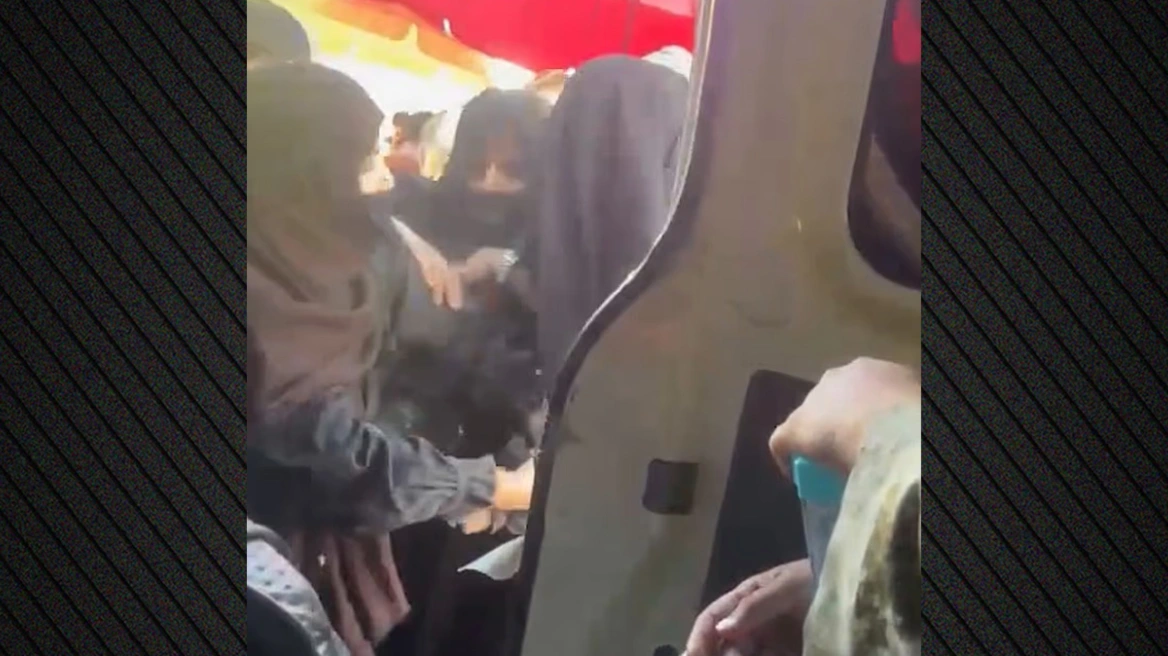
New arrests of women in Afghanistan, this time in Kabul, have been recorded as part of the continuing tightening of restrictions imposed by the Taliban on public life.
Around 20 women were arrested by the “morality police” in Kabul’s Shah-e Do Shamshira area, according to Afghan outlet Kabul Now, while around 16 of them are reportedly still in detention. Footage that has emerged shows a woman, reportedly a member of the Taliban’s so-called “morality police”, attempting to force another woman into a van.
The woman resists, while inside the vehicle a male Taliban official can be seen alongside several other women. According to reports, four of the approximately 20 women were subsequently released after the authorities checked their mobile phones. The exact reason for the arrests has not been made known.
Arrests in Herat
The incident in Kabul comes just days after at least nine women were arrested in Herat, according to Afghan network Amu TV. The women were reportedly wearing hijabs, yet were arrested by the Taliban’s “morality police”.
A resident of Herat said that women are increasingly afraid to leave their homes, alleging that they are harassed in the streets under the pretext of enforcing “morality” rules. “Women are arrested, intimidated and subjected to psychological abuse, but no one listens,” she said.
In another incident in Herat, women had gathered for a protest that was broken up by armed men. Among the protesters were also women wearing full coverage.
The spokesperson for the Herat police, Sayed Masoud Hosseini, told the state-run Bakhtar News Agency that the gathering had caused “tensions” and disrupted public order, prompted by opposition to Islamic dress, which he described as a religious obligation.
Amu TV reported that dozens of women, including at least 21 whose detention was independently confirmed, had been detained by officials from the Taliban ministry responsible for the Promotion of Virtue and Prevention of Vice.
Restrictions since the Taliban returned to power
The new arrests form part of the broader restrictions imposed on women and girls since the Taliban returned to power in August 2021.
The authorities have banned girls from secondary and university education, imposed restrictions on women’s employment, and tightened rules concerning their appearance and movement in public spaces.
Women remain excluded from education beyond primary school, while a ban on their higher education has been in force since December 2022.
In November 2025, graduation examinations for health professions were held for the second consecutive year without the participation of women, following the ban on their attendance at medical institutions introduced in December 2024.
At the same time, women deemed not to comply with the requirement to wear a chador, the traditional Islamic garment that covers the entire body, have been removed from public transport and faced restrictions on access to markets and public services.
A law that has come into force also provides for restrictions on women seeking to leave a marriage, while a mediation process is предусмотрed for women seeking to leave an abusive husband.
Ask me anything
Explore related questions




