





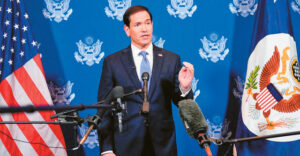
A significant step, carrying emblematic messages about the high level and dynamic prospects of the Greece-US strategic relationship, is the two-day visit to Greece by US Secretary of State Marco Rubio, who is due to arrive in Athens on Tuesday, according to the schedule.
Rubio’s visit is aimed at holding the sixth round of the Strategic Dialogue between the two countries. However, the fact that, amid an extremely fluid international environment and the challenges facing US foreign policy, the head of the State Department has decided to come to Greece during one of his increasingly rare foreign trips is indicative of the importance the US, and Rubio personally, attaches to relations with Greece.
According to reports, the US Secretary of State will come to Greece after a visit to Iceland and will then continue to Portugal. The fact that he is not combining his visit to Athens with a simultaneous visit to Ankara is considered particularly positive. For decades, the State Department’s diplomatic tradition has been to maintain a balance, with every visit by a US Secretary of State to the region being combined with visits to both Ankara and Athens. The only exceptions over the past 50 years have been the visits of John Kerry on 2 December 2015 and Mike Pompeo on 5 October 2019.
Personal interest
The sixth Strategic Dialogue was initially scheduled for December 2025, but developments in Venezuela and subsequently in the Middle East, with the war in Iran, led to repeated postponements. Its being held now also indicates Rubio’s personal desire to come to Greece, even before the US midterm elections.
The head of the State Department is highly knowledgeable about the region and has been at the forefront, since 2019, together with Democratic Senator Bob Menendez, of the adoption of the important legislative acts known as the Eastern Mediterranean Security and Energy Partnership Act, which redesigned the US strategy for the region, highlighting the US alliance with Greece, Cyprus and Israel, and the U.S.-Greece Defense and Interparliamentary Partnership Act (2021), which took the Greek-American defence relationship a step further.
The personal decision of the US Secretary of State to come to Greece at an international juncture that is particularly demanding and burdensome for him demonstrates his personal interest in the region and in the strategic relationship with Greece. It is all the more significant because Rubio is not an incidental politician, but a leading political figure who aspires to assume an even more important role, possibly also as the Republican Party’s candidate to succeed Donald Trump.
The State Department’s announcement on Rubio’s visit to Greece describes the framework for the talks, stressing that they are intended to “deepen our cooperation on key administration priorities, including defence cooperation and regional and energy security”.
For Athens, beyond reaffirming the high level of strategic cooperation with the US, the presence of the US Secretary of State in Greece sends another strong message amid Turkey’s escalating challenge to Greece’s sovereign rights, as well as initiatives that have been undertaken with the agreement and support of the US. Turkey has repeatedly reacted to the upgrading of Greek-American cooperation centred on Alexandroupoli, views the alternative route for transporting energy to the Balkans through the Vertical Corridor as a competitor, and has, of course, threatened the GSI and connectivity projects that have US support.
Legacy
Among the achievements of recent years is the Greece-US Mutual Defense Cooperation Agreement (MDCA), whose revised version was signed in 2021 by Nikos Dendias and Antony Blinken and entered into force in 2022.
Another important document is the Pompeo letter of 2020, which included, among other things, the US guarantee for Greece’s “security and prosperity”.
Rubio’s visit, which has been in preparation for some time and has also been at the centre of regular telephone communications with George Gerapetritis, will begin with their meeting at the Ministry of Foreign Affairs, while the Strategic Dialogue will also get under way. Its coordination will be overseen by Deputy Foreign Minister Alexandra Papadopoulou, with the participation of representatives of the relevant ministries on the issues of bilateral cooperation that will be at the centre of the talks.
Marco Rubio will also be received by Prime Minister Kyriakos Mitsotakis for a comprehensive review of Greek-American relations and regional developments, with an emphasis on the Middle East, the Eastern Mediterranean, as well as the war in Ukraine and Iran. The Greek side will seek reaffirmation from the head of the State Department of Greece’s role as a pillar of stability and provider of security in the region.
After the meetings conclude, the joint communiqué of the sixth Greece-US Strategic Dialogue will be issued. The document is still under negotiation, with the main responsibility resting with Foreign Minister George Gerapetritis, Deputy Foreign Minister Alexandra Papadopoulou and Greece’s ambassador in Washington, Antonis Alexandridis.
The joint communiqué is expected to include a detailed assessment of the course of Greek-American relations so far, which is considered particularly positive, as well as detailed references to the next steps, covering all areas: energy and connectivity — energy and data — security, defence, trade and investment, culture, as well as a specific reference to Artificial Intelligence.
Vertical Corridor
In the energy sector, the Vertical Corridor will have a primary position. It is a strategic choice for the energy independence of the countries of the Western Balkans and Eastern Europe through the supply of US LNG. High-level statements during the Strategic Dialogue are expected to send reassuring messages amid the public debate prompted by the recent Wall Street Journal report.
The start of drilling and exploration by US companies ExxonMobil and Chevron in the blocks granted by Greece for hydrocarbon exploration and exploitation will also be examined. Official US support for the activity of the American oil giants in Greece, particularly Chevron south of Crete, is particularly significant because of the challenges raised by the Libyan side, invoking the so-called “Turkish-Libyan Memorandum”.
An important chapter of the Strategic Dialogue concerns defence cooperation, which has advanced and acquired greater depth in recent years, with the upgrade of the F-16 Vipers and the launch of implementation of the agreement to purchase F-35s.
According to reports, the Hellenic Air Force General Staff is preparing a Letter of Interest addressed to the US side in order to request additional equipment for the upgraded F-16 Vipers as well as the F-35s. According to the same reports, this includes air-to-air missiles, anti-ship missiles and significant strike weapons, such as AMRAAM, AIM-260 JATM, AIM-120D and AIM-9X Sidewinder. There is also interest in the AGM-158 JASSM-ER strategic missile and the AGM-84 Harpoon anti-surface-ship missile.
Greece is also expressing interest in advancing an agreement to upgrade the remaining 38 F-16s to the Viper configuration. The Armed Forces are also seeking to acquire used Stryker 8×8 wheeled armoured vehicles for the Army, as well as operational Bradley vehicles from US Army stocks.
The US side has expressed concern over the fact that significant Greek defence procurement has been directed towards European and Israeli companies. Among other things, there is strong interest in promoting one of three US companies for the supply of a self-protection system for the F-16s, although, according to reports, there is a more competitive proposal from Israel, both in terms of cost and system security.
3+1 cooperation
The 3+1 cooperation framework — Greece, Cyprus, Israel and the US — will also be discussed during the talks. However, according to reports, partly for reasons related to recent developments, the US side is not inclined to hold such a meeting at foreign minister level, while there is expected to be follow-up at energy minister level. Thus, following the 3+1 meeting in Houston, the next meeting in this format will most likely take place in Jerusalem in December.
As part of the Strategic Dialogue, the renewal of the Cultural Agreement, which provides for the return of stolen cultural artefacts, is also expected to be signed.
As part of the broader approach to the Eastern Mediterranean, the US has also made significant progress in deepening its strategic cooperation with Cyprus, despite Turkey’s reactions. Recently, there was another renewal of the lifting of the embargo on the sale of US defence equipment to Cyprus. Washington also sent a clear message by participating in the annual military parade in Nicosia marking the anniversary of the independence of the Republic of Cyprus, alongside contingents from Egypt and France and a 17-member contingent of US Marines from the destroyer USS Roosevelt.
Indeed, in his message on Cypriot Independence, Marco Rubio stressed that the US remains steadfast in its support for a Cyprus-led settlement of the Cyprus issue, under UN mediation, that would reunify the island as a bizonal, bicommunal federation, in accordance with United Nations Security Council resolutions. The statement directly rejects the Turkish position, as expressed by President Recep Tayyip Erdoğan from the United Nations podium, which points towards a “two-state” solution.
Of particular significance is also the reference in the State Department statement that “US-Republic of Cyprus cooperation in defence and energy has strengthened regional security”, which essentially also responds to Turkish claims, both regarding the measures taken by the Cypriot government to strengthen defence deterrence and the now intensified process, with the participation of US oil giants, of developing the natural gas deposits identified in Cyprus’s Exclusive Economic Zone.
A significant step, carrying emblematic messages about the high level and dynamic prospects of the Greece-US strategic relationship, is the two-day visit to Greece by US Secretary of State Marco Rubio, who is due to arrive in Athens on Tuesday, according to the schedule.
Rubio’s visit is aimed at holding the sixth round of the Strategic Dialogue between the two countries. However, the fact that, amid an extremely fluid international environment and the challenges facing US foreign policy, the head of the State Department has decided to come to Greece during one of his increasingly rare foreign trips is indicative of the importance the US, and Rubio personally, attaches to relations with Greece.
According to reports, the US Secretary of State will come to Greece after a visit to Iceland and will then continue to Portugal. The fact that he is not combining his visit to Athens with a simultaneous visit to Ankara is considered particularly positive. For decades, the State Department’s diplomatic tradition has been to maintain a balance, with every visit by a US Secretary of State to the region being combined with visits to both Ankara and Athens. The only exceptions over the past 50 years have been the visits of John Kerry on 2 December 2015 and Mike Pompeo on 5 October 2019.
Personal interest
The sixth Strategic Dialogue was initially scheduled for December 2025, but developments in Venezuela and subsequently in the Middle East, with the war in Iran, led to repeated postponements. Its being held now also indicates Rubio’s personal desire to come to Greece, even before the US midterm elections.
The head of the State Department is highly knowledgeable about the region and has been at the forefront, since 2019, together with Democratic Senator Bob Menendez, of the adoption of the important legislative acts known as the Eastern Mediterranean Security and Energy Partnership Act, which redesigned the US strategy for the region, highlighting the US alliance with Greece, Cyprus and Israel, and the U.S.-Greece Defense and Interparliamentary Partnership Act (2021), which took the Greek-American defence relationship a step further.
The personal decision of the US Secretary of State to come to Greece at an international juncture that is particularly demanding and burdensome for him demonstrates his personal interest in the region and in the strategic relationship with Greece. It is all the more significant because Rubio is not an incidental politician, but a leading political figure who aspires to assume an even more important role, possibly also as the Republican Party’s candidate to succeed Donald Trump.
The State Department’s announcement on Rubio’s visit to Greece describes the framework for the talks, stressing that they are intended to “deepen our cooperation on key administration priorities, including defence cooperation and regional and energy security”.
For Athens, beyond reaffirming the high level of strategic cooperation with the US, the presence of the US Secretary of State in Greece sends another strong message amid Turkey’s escalating challenge to Greece’s sovereign rights, as well as initiatives that have been undertaken with the agreement and support of the US. Turkey has repeatedly reacted to the upgrading of Greek-American cooperation centred on Alexandroupoli, views the alternative route for transporting energy to the Balkans through the Vertical Corridor as a competitor, and has, of course, threatened the GSI and connectivity projects that have US support.
Among the achievements of recent years is the Greece-US Mutual Defense Cooperation Agreement (MDCA), whose revised version was signed in 2021 by Nikos Dendias and Antony Blinken and entered into force in 2022.
Another important document is the Pompeo letter of 2020, which included, among other things, the US guarantee for Greece’s “security and prosperity”.
Rubio’s visit, which has been in preparation for some time and has also been at the centre of regular telephone communications with George Gerapetritis, will begin with their meeting at the Ministry of Foreign Affairs, while the Strategic Dialogue will also get under way. Its coordination will be overseen by Deputy Foreign Minister Alexandra Papadopoulou, with the participation of representatives of the relevant ministries on the issues of bilateral cooperation that will be at the centre of the talks.
Marco Rubio will also be received by Prime Minister Kyriakos Mitsotakis for a comprehensive review of Greek-American relations and regional developments, with an emphasis on the Middle East, the Eastern Mediterranean, as well as the war in Ukraine and Iran. The Greek side will seek reaffirmation from the head of the State Department of Greece’s role as a pillar of stability and provider of security in the region.
After the meetings conclude, the joint communiqué of the sixth Greece-US Strategic Dialogue will be issued. The document is still under negotiation, with the main responsibility resting with Foreign Minister George Gerapetritis, Deputy Foreign Minister Alexandra Papadopoulou and Greece’s ambassador in Washington, Antonis Alexandridis.
The joint communiqué is expected to include a detailed assessment of the course of Greek-American relations so far, which is considered particularly positive, as well as detailed references to the next steps, covering all areas: energy and connectivity — energy and data — security, defence, trade and investment, culture, as well as a specific reference to Artificial Intelligence.
Vertical Corridor
In the energy sector, the Vertical Corridor will have a primary position. It is a strategic choice for the energy independence of the countries of the Western Balkans and Eastern Europe through the supply of US LNG. High-level statements during the Strategic Dialogue are expected to send reassuring messages amid the public debate prompted by the recent Wall Street Journal report.
The start of drilling and exploration by US companies ExxonMobil and Chevron in the blocks granted by Greece for hydrocarbon exploration and exploitation will also be examined. Official US support for the activity of the American oil giants in Greece, particularly Chevron south of Crete, is particularly significant because of the challenges raised by the Libyan side, invoking the so-called “Turkish-Libyan Memorandum”.
An important chapter of the Strategic Dialogue concerns defence cooperation, which has advanced and acquired greater depth in recent years, with the upgrade of the F-16 Vipers and the launch of implementation of the agreement to purchase F-35s.
According to reports, the Hellenic Air Force General Staff is preparing a Letter of Interest addressed to the US side in order to request additional equipment for the upgraded F-16 Vipers as well as the F-35s. According to the same reports, this includes air-to-air missiles, anti-ship missiles and significant strike weapons, such as AMRAAM, AIM-260 JATM, AIM-120D and AIM-9X Sidewinder. There is also interest in the AGM-158 JASSM-ER strategic missile and the AGM-84 Harpoon anti-surface-ship missile.
Greece is also expressing interest in advancing an agreement to upgrade the remaining 38 F-16s to the Viper configuration. The Armed Forces are also seeking to acquire used Stryker 8×8 wheeled armoured vehicles for the Army, as well as operational Bradley vehicles from US Army stocks.
The US side has expressed concern over the fact that significant Greek defence procurement has been directed towards European and Israeli companies. Among other things, there is strong interest in promoting one of three US companies for the supply of a self-protection system for the F-16s, although, according to reports, there is a more competitive proposal from Israel, both in terms of cost and system security.
3+1 cooperation
The 3+1 cooperation framework — Greece, Cyprus, Israel and the US — will also be discussed during the talks. However, according to reports, partly for reasons related to recent developments, the US side is not inclined to hold such a meeting at foreign minister level, while there is expected to be follow-up at energy minister level. Thus, following the 3+1 meeting in Houston, the next meeting in this format will most likely take place in Jerusalem in December.
As part of the Strategic Dialogue, the renewal of the Cultural Agreement, which provides for the return of stolen cultural artefacts, is also expected to be signed.
As part of the broader approach to the Eastern Mediterranean, the US has also made significant progress in deepening its strategic cooperation with Cyprus, despite Turkey’s reactions. Recently, there was another renewal of the lifting of the embargo on the sale of US defence equipment to Cyprus. Washington also sent a clear message by participating in the annual military parade in Nicosia marking the anniversary of the independence of the Republic of Cyprus, alongside contingents from Egypt and France and a 17-member contingent of US Marines from the destroyer USS Roosevelt.
Indeed, in his message on Cypriot Independence, Marco Rubio stressed that the US remains steadfast in its support for a Cyprus-led settlement of the Cyprus issue, under UN mediation, that would reunify the island as a bizonal, bicommunal federation, in accordance with United Nations Security Council resolutions. The statement directly rejects the Turkish position, as expressed by President Recep Tayyip Erdoğan from the United Nations podium, which points towards a “two-state” solution.
Of particular significance is also the reference in the State Department statement that “US-Republic of Cyprus cooperation in defence and energy has strengthened regional security”, which essentially also responds to Turkish claims, both regarding the measures taken by the Cypriot government to strengthen defence deterrence and the now intensified process, with the participation of US oil giants, of developing the natural gas deposits identified in Cyprus’s Exclusive Economic Zone.
Ask me anything
Explore related questions




