





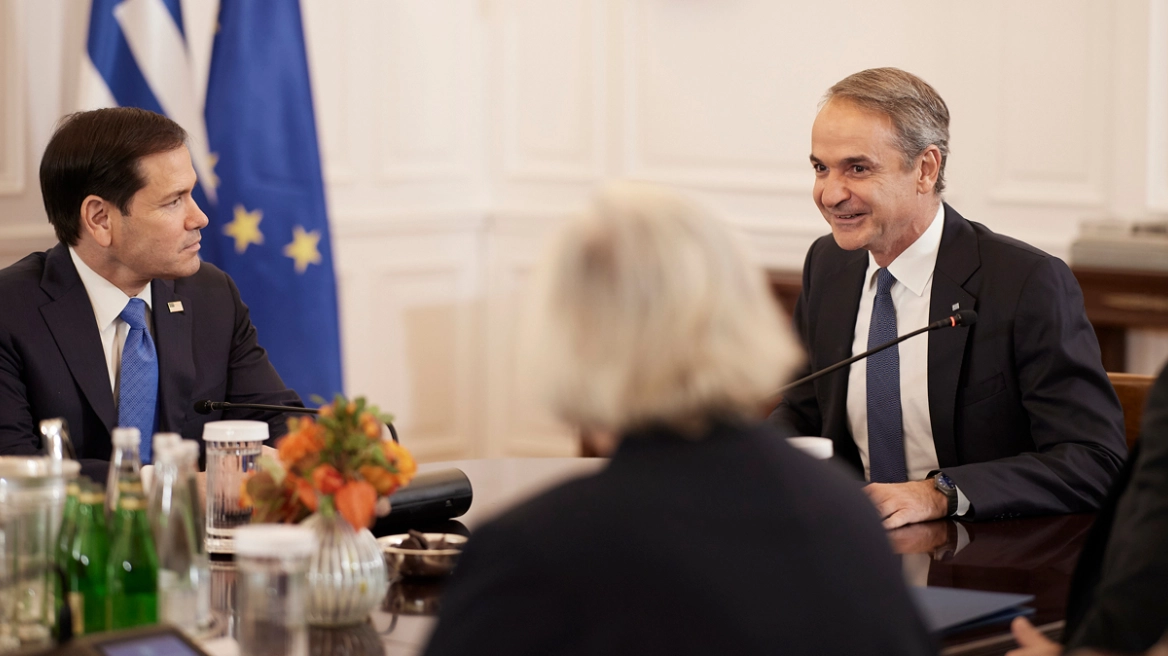
With the renewal and upgrading of the Greece-US strategic relationship, the $4 billion defense agreements, strong support for all the energy projects currently under way in Greece, as well as a unique showcase of both ancient Greek civilization and modern Greece through the live broadcast around the world of Marco Rubio’s speech at the Pnyx, the US Secretary of State’s visit to our country has concluded.
The talks Mr. Rubio held in Athens with Kyriakos Mitsotakis and George Gerapetritis highlighted not only the broad scope of bilateral cooperation across all sectors, but also the depth of the strategic relationship, as there is a common approach to regional issues and US strategic choices in the region are fully compatible with Greek initiatives on security, regional stability, the promotion of energy security in the Balkans and Europe, and the securing of alternative energy sources.
This is what Marco Rubio himself described as a “common understanding of the threats facing our societies and a common understanding of how to address them.” And Kyriakos Mitsotakis, during their meeting, highlighted “Greece’s role as a pillar of stability and security in the Eastern Mediterranean, as a reliable partner and ally, with a key role in the security of partners and allies at a time of major geopolitical shifts and instability in the wider region.”
This is a role that was publicly acknowledged at several points in the US Secretary of State’s public interventions, and he himself also made sure to incorporate it into his landmark speech at the Pnyx, stressing that “Greece is a model ally and Europe should follow its example.”
A speech that American analysts interpreted as Rubio’s first “campaign” speech, as he seeks to establish his own political (conservative) profile ahead of developments that have also presented him as a potential contender for the Republican nomination in the 2028 presidential election.
Turkey
Athens has chosen to decouple Greek-US relations from Greek-Turkish relations. For this reason, George Gerapetritis, in his public remarks at the press conference, avoided specifically referring to Turkey, but nevertheless raised the need to address revisionist threats, referring to the security architecture of the Eastern Mediterranean, where he highlighted the need to resolve the Cyprus issue on the basis of the decisions of the UN Security Council, so as to end the illegal occupation of the island.
Turkey-related issues were nevertheless raised during the bilateral meeting between the two foreign ministers. According to information, and with maps being presented, the threat posed both to Greece and to regional stability by Turkish revisionism was highlighted, as was the irrationality of Turkey’s challenges and claims.
Defense Procurement
The particularly positive atmosphere in which the talks took place as part of the 6th Round of the Strategic Dialogue was sealed by the announcement of $4 billion in agreements for defense procurement programs under the Foreign Military Sales (FMS) program, in support of Greece’s long-term defense planning and with the aim of further strengthening interoperability.
According to information, these agreements concern weapons for the new fleet of F-16 Viper and F-35 fighter aircraft, the upgrade of 38 F-16s to the Viper configuration, and FOS programs for all newly acquired weapons systems, while part of the agreements will be further specified in the coming period and incorporated into the new Unified Medium-Term Defense Development and Modernization Program (EMPAE). In addition, the Greek side’s request for the provision of Stryker vehicles to Greece was approved.
Energy
Energy occupies a major place in the talks, as well as in the Greek-US strategic relationship, with the Vertical Corridor being a critical project. It is transforming the country into an important hub for transporting energy to the Balkans and Eastern Europe and, at the same time, into a major gateway for US LNG exports.
Responding to a question during the press conference, the US Secretary of State expressed his full support for the other energy projects under way as well, such as ExxonMobil’s drilling operation scheduled for early 2027 in Block 2 in the Ionian Sea, Chevron’s exploration activities in the blocks south of Crete, as well as the electricity interconnections with Egypt and with Cyprus-Israel. It is interesting, however, that the Joint Statement refers to the Vertical Corridor and hydrocarbon exploration, but not to the electricity interconnections.
The visit, of course, could not resolve the immediate problem facing Athens concerning the electricity interconnection with Cyprus, which is still awaiting the green light for the resumption of surveys due to Turkish reactions.
Marco Rubio, at the press conference, supported all of Greece’s energy projects, but did not fail to refer to sensitivities involving other countries that complicate the matter, implicitly referring, of course, to Turkey. As he said, these issues must be resolved through diplomacy and not at press conferences.
Of course, any American intervention on the issue of the electricity interconnection could not concern the substance of the impasse that has arisen, but only a possible effort, through diplomatic channels, to prevent a dangerous escalation of tensions between the two allied countries in the Eastern Mediterranean. The Americans have done this in the past as well, although with not particularly positive results for our country.
Because, regarding the issue that arose over Turkey’s reactions to the cable project, it should be noted that neither Turkey nor, however, the United States are parties to UNCLOS, and nor, of course, are the United States competent to rule on or act as an arbitrator in an issue concerning the exercise of our country’s sovereign rights. Such a development, moreover, would mean Greece accepting the existence of a dispute that would, in fact, require third-party arbitration for its resolution.
The Other Agreements
As part of Rubio’s visit, agreements and Memoranda were signed extending the Agreement on the Protection of Cultural Heritage, reaffirming their commitment to protecting cultural property and combating the networks involved in its illegal trafficking; cooperation between the Armed Forces and the Florida National Guard; and cooperation in the maritime sector, including the certification of American seafarers serving on Greek-flagged vessels.
Finally, as part of Greece’s participation in the Pax Silica initiative, the two sides welcomed the expansion of cooperation in the fields of superintelligence, high-performance computing, cybersecurity and advanced technologies.
Ask me anything
Explore related questions




