





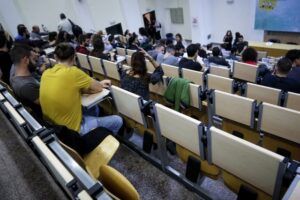
Athens is set to become a new hub for international academic cooperation in the humanities and social sciences with the establishment of the Hellenic Institute for Advanced Study in the Humanities and Social Sciences (HESTIA). The first initiative of its kind in Southeast Europe, the Institute aims to strengthen research, bring together scholars from different academic disciplines and foster new internationally oriented collaborations.
The Institute’s official launch, held at Panteion University of Social and Political Sciences, marked the beginning of an initiative bringing together four major academic and research institutions in Greece. HESTIA was founded by the French School at Athens, the National and Kapodistrian University of Athens, Panteion University and the National Hellenic Research Foundation. Its central objective is to establish an international environment where researchers can exchange ideas, develop joint academic projects and address complex issues through collaboration across disciplines.
The initiative is particularly significant for Greece, as it seeks to connect research conducted at Greek universities and research institutions with a broader international network of scholars, while drawing on the country’s geographical and historical position at the crossroads of Europe, the Balkans and the Mediterranean.
Four Institutions, One Common Initiative
The creation of HESTIA is based on cooperation between four institutions with distinct academic profiles and complementary research expertise.
The French School at Athens, founded in 1846, is one of the oldest foreign research institutions established in Greece. It has a long tradition of research on Greece and the wider Balkan and Mediterranean regions, as well as an international network of collaborations in the humanities.
The National and Kapodistrian University of Athens, the oldest university in Greece, contributes its broad range of academic disciplines and international academic presence.
Panteion University of Social and Political Sciences, with its specialisation in the social and political sciences, is one of Greece’s leading academic institutions for the study of social transformations, political systems and contemporary social phenomena.
The National Hellenic Research Foundation, through its work in scientific research, completes the partnership by connecting the initiative with Greece’s wider research infrastructure.
Cooperation between the four institutions was set in motion as early as November 2025, when a Memorandum of Understanding was signed to establish the Institute. The aim was to create a strategic hub for high-level research activities, with an emphasis on interdisciplinary approaches and international collaboration. The inaugural event now marks the next substantial step towards bringing this vision to fruition.
Why an Institute for Advanced Study?
Institutes for Advanced Study occupy a distinctive position in the international academic landscape. Unlike conventional university structures, which are organised primarily around degree programmes, departments and specific academic disciplines, these institutes place particular emphasis on research, scholarly exchange and creating the conditions for new ideas to emerge. Their fundamental aim is to give researchers the opportunity to step away temporarily from their daily teaching and administrative responsibilities and devote time to exploring complex academic questions.
Bringing scholars from different disciplines together in a shared environment can facilitate the development of new research approaches that might be more difficult to pursue within the boundaries of a single university department. This is particularly important for the humanities and social sciences, as many of the issues they investigate cannot be confined to one academic discipline.
Migration, social inequalities, political participation, national identities, cultural change, international relations and the impact of technology on societies often require the combined application of historical, sociological, political, philosophical and other scholarly approaches.
In this context, HESTIA aspires to serve as a meeting place for creative exchange, placing the emphasis on research collaboration rather than simply bringing different academic disciplines together under one roof.
The Balkans and the Eastern Mediterranean at the Heart of Its Research
The Institute’s geographical focus is one of the defining features of the initiative. The Balkans and the Eastern Mediterranean constitute a complex historical, social and political landscape where different languages, religions, cultural traditions and political experiences intersect. These regions have also long been at the centre of population movements, conflicts, economic and social transformations, as well as processes of cooperation and interaction.
Their study therefore requires approaches that transcend national borders and traditional divisions between academic disciplines.
For Greece, this focus is also linked to the opportunity to draw on its position at the intersection of Southeast Europe and the Eastern Mediterranean. Athens can become a point of reference for researchers studying historical trajectories, social change, political developments and cultural interactions across the wider region.
Beyond strengthening research on the Balkans and the Mediterranean, another key objective is to foster academic debate in which the societies of the region are studied as active agents in their own histories, rather than exclusively through interpretative frameworks developed elsewhere. This perspective was highlighted in the keynote address at the Institute’s inaugural event.
“How to Think About the Balkans”
The keynote address was delivered by Professor Diana Mishkova, director of the Centre for Advanced Study in Sofia, under the title “How to Think About the Balkans: An Inside-Out View.” The address was introduced by Professor Christina Koulouri, rector of Panteion University.
The subject of the lecture relates to a longstanding question in Balkan studies: how the Balkans are defined and interpreted, and the extent to which these interpretations are shaped by the perspectives through which the region is examined.
The history of the Balkans has often been presented through external classifications, geopolitical frameworks and generalisations that treat the region as a unified and homogeneous whole. Yet its societies are characterised by diverse historical experiences, cultural trajectories and political developments.
The “inside-out” approach points to the need to examine the region’s societies through their own historical experiences, internal differences and relationships with one another, without overlooking the broader European and international context.
Debates over how the Balkans are defined and studied are particularly important for the development of the social sciences and humanities, as they influence not only historiography but also political science, sociology and international relations. The choice of this theme for HESTIA’s launch therefore highlighted the importance of critically examining established interpretative frameworks and strengthening scholarly debate about the region.
An Interdisciplinary Approach to Research
The keynote address was followed by a roundtable discussion focusing on emerging directions in the humanities and social sciences in the Balkans and the Eastern Mediterranean.
Participants included Professor Angelos Chaniotis of the Institute for Advanced Study in Princeton, Ioanna Rapti, Directrice d’études at the École Pratique des Hautes Études, and Professor Vasiliki Georgiadou of Panteion University, director of the National Centre for Social Research (EKKE). The discussion was moderated by Angelos Dalachanis, director of Modern and Contemporary Studies at the French School at Athens.
The panel brought together scholars with diverse academic backgrounds and research traditions, highlighting the international character that the new Institute seeks to develop. Interdisciplinarity, academic freedom and the distinctive role of Institutes for Advanced Study were among the central themes.
As emphasised during the discussion, interdisciplinarity requires meaningful dialogue between different methodologies, theoretical tools and interpretative approaches, allowing new questions to emerge and new research conclusions to be reached.
Similarly, academic freedom is a fundamental prerequisite for the advancement of scientific knowledge. The ability to investigate questions without predetermined conclusions and critically examine established assumptions is an essential component of an independent research process.
Ask me anything
Explore related questions




