





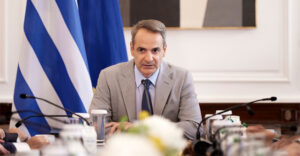
Prime Minister Kyriakos Mitsotakis has addressed measures to support households and businesses amid the energy crisis, the decisions taken at the recent European Council summit, and government initiatives to protect minors on social media in his regular Sunday review of the week.
The Prime Minister places particular emphasis on the €0.40-per-litre subsidy on heating oil, the 30% increase in the heating allowance, and the reduction in petrol and diesel prices until 31 October. He also describes as a significant development the fact that three Greek initiatives—on fiscal flexibility in response to the energy crisis, tackling hybrid threats involving migration, and protecting children from social media—have been discussed at European level.
In his post, he also refers to the bill banning children under the age of 15 from accessing social media, school meals, additional places in nurseries and childcare centres, the modernisation of the Athens–Piraeus Electric Railway trains, and developments in healthcare. He makes particular mention of the 251 organ transplants carried out since the beginning of the year, thanking the families of organ donors for their generosity.
Kyriakos Mitsotakis’s post
The full post by Prime Minister Kyriakos Mitsotakis reads as follows:
The majority of your comments on the previous review were in favour of the new structure. So we will keep it, and, as you will see, I have incorporated some of the ideas you shared with me.
I will start with the European Council summit, which concluded on Friday and had a strong Greek dimension, as three major Greek initiatives were discussed at length and received the green light from European leaders for further development.
I am referring to our proposal for an exceptional adjustment to European fiscal rules because of the energy crisis, allowing countries with budget surpluses, such as Greece, to provide targeted support to households and businesses for as long as the crisis lasts. The summit asked the European Commission to come forward with proposals on this issue without delay.
I am also referring to a European mechanism to tackle hybrid threats involving migration, such as the situation we experienced at Evros in 2020 and, more recently, in Ceuta, Spain, as well as the introduction of a stricter age-limit framework governing children’s access to social media.
These are all Greek proposals that are becoming European policies. Europe needs to move faster on all three fronts, and we are here to continue pressing in that direction. Greece now has a strong voice in Europe and is using it in the interests of Greeks and, of course, European citizens.
As far as we are concerned, this week we introduced new measures to limit the impact of the energy crisis on households and businesses.
First of all, heating. We are subsidising heating oil by €0.40 per litre, with the cost shared between the state and refineries, and increasing the heating allowance by 30%, regardless of the heating method used. As a result, heating oil will be available at €1.55 per litre instead of €1.95, while for those who also receive the allowance, the cost falls to around €1.35 per litre. In total, the support covers almost 1.2 million households.
We are also intervening in motor fuels, reducing the pump price of diesel by €0.20 per litre and unleaded petrol by €0.10 per litre until 31 October, with no applications required and no income criteria. The reduction is passed directly on to the price paid by drivers.
I know that the pressures remain considerable and that no single measure is enough to eliminate them. That is why we will monitor international developments and adjust our interventions accordingly, while keeping resources in reserve for the difficult months ahead.
We are adding support for fishers to these measures. In addition to what we announced last week, we are increasing the subsidy for fishing fuel from €0.16 to €0.40 per litre for September and October. We are also making €15 million available to compensate small-scale coastal fishers for damage to their nets caused by protected marine species, resolving a problem that has affected them for years.
Beyond energy, this week:
1. Text messages have begun going out inviting people to free preventive breast cancer screening under the “Prolambano” programme, which is now a permanent national health policy. I believe one of the most important changes we have made to the National Health System (ESY) is bringing prevention into people’s everyday lives and beginning to build a new culture of health. Once again, I urge you not to ignore the message if you receive one!
2. We handed over the new Chronic Illness Treatment Centre in Kilkis, a project that had remained unfinished for years. It is a modern, entirely public facility with 50 beds, which is already accommodating 38 of our fellow citizens. The Hellenic Shipowners’ Association and the Region of Central Macedonia made decisive contributions, and we thank them very much.
3. We are making more places available in nurseries and childcare centres through two changes introduced by the Ministry of Social Cohesion and Family Affairs.
First, children will move from infant nurseries to childcare centres at the age of two rather than two and a half, freeing up places primarily for babies, without compromising safety in any way.
Second, centres in Attica and Thessaloniki will be allowed to accommodate up to 15% more children, compared with the previous limit of 10%.
4. The distribution of school meals has also begun. This year, the programme will reach approximately 2,000 primary schools in 160 municipalities, providing up to 250,000 meals a day—18,000 more than last year. Since 2019, coverage has almost doubled, and the programme now reaches nearly one in every two children.
I should stress that the Organisation for Welfare Benefits and Social Solidarity (OPEKA) and the Hellenic Food Authority (EFET) systematically inspect the preparation and transportation of the meals to ensure their quality and safety.
5. Our important initiative to protect children from the dangers of social media is now in its final stages.
The bill establishing a minimum age of 15 for access to social media, effective from 1 January 2027 for children born in 2013 and later, is now being debated in Parliament, with the vote scheduled for next Thursday.
We cannot expect parents alone to protect their children when they are up against platforms whose algorithms are designed to keep them constantly glued to a screen. Under the new framework, responsibility for age verification will fall on the platforms themselves, with the help of Kids Wallet and safeguards for personal data.
6. The first of the 14 fully reconstructed trains for the Electric Railway, Metro Line 1, is now ready. This week, I had the opportunity to board it and see the improvements at first hand.
A further 10 trains will be refurbished. At the same time, we are upgrading 12 trains on Lines 2 and 3, adding air conditioning, and moving ahead with the procurement of 19 new trains, seven of which will serve the airport.
7. In Nees Karyes, Thessaly, we inaugurated Greece’s largest standalone battery energy storage facility, one of the largest in Europe. The project was developed by Metlen and the Karatzis Group.
Put simply, it stores surplus energy generated by the sun and wind so that it can be fed into the grid whenever it is needed.
8. We signed an agreement with LAMDA Development to create the “Home of Gymnastics” at Ellinikon.
Hangar B at the former airport will be given a new lease of life, becoming one of Europe’s most modern training facilities. It will be granted to the Hellenic Gymnastics Federation for 30 years, allowing our national teams and thousands of athletes to train there. It is, after all, the least we owe them.
9. In the field of culture, 22 antiquities that had been illegally removed from our country have been returned from Israel.
This is the first time antiquities have been repatriated from that particular country, and it is certainly an important step in our cooperation to protect cultural heritage and combat the illegal trafficking of antiquities. Our marathon effort to bring such objects home will, of course, continue.
I have saved for last an important development in healthcare concerning organ transplantation.
Since the beginning of the year, 251 transplants have been performed thanks to 114 organ donors. It is encouraging that transplantation in Greece is progressing and that more patients are able to receive the treatment they need.
However, I particularly want to acknowledge the donors’ families: people who, while experiencing such a difficult loss, made a decision that saved other lives. We owe them a heartfelt thank you. The same goes for the doctors, nurses and everyone else involved in making these transplants possible.
There is another important development: Onassis Hospital is now performing kidney transplants from living donors even in very low-weight children. Eight children have already received treatment here in Greece, without having to travel far from their families.
That is all for this week. I look forward to your comments and suggestions once again.
Have a good Sunday!
Ask me anything
Explore related questions




