





A major political upheaval unfolded in Serbia on Sunday night, as Aleksandar Vučić acknowledged defeat in the country’s snap parliamentary elections, bringing an end to 14 years of dominance by the Serbian Progressive Party in the country’s political life.
“We do not yet have final results, but based on a sample (…) it is clear that we have lost these elections. The Student List has won. They will have between 135 and 140 seats and we will have 105. No one else will enter parliament,” the outgoing prime minister said.
The Student List emerged as the winner, securing approximately 2.2 million votes, or 52%, and 138 seats, while Vučić’s party received around 1.72 million votes, equivalent to 32.3%, and won 104 seats in Serbia’s 250-member parliament.
Voter turnout reached almost 70%, the highest recorded since the breakup of the former Yugoslavia in 1992.
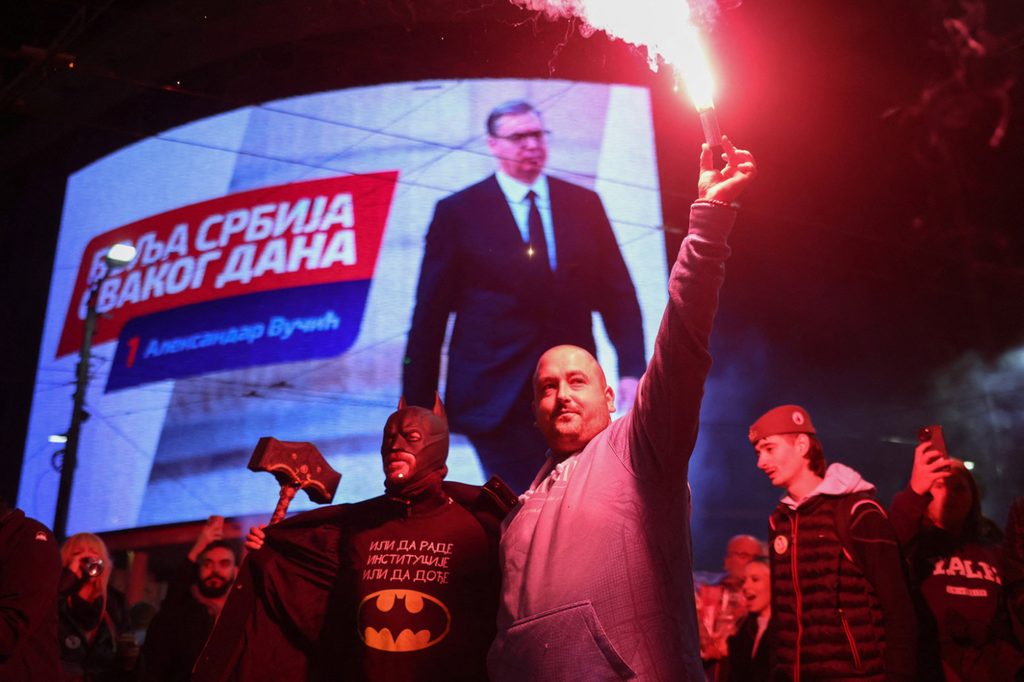
Celebrations in Belgrade
Following Vučić’s admission of defeat, celebrations erupted across Belgrade. Cars sounded their horns as students took to the streets chanting “Victory” and “It’s over.”
Student List supporters poured into the Serbian capital to celebrate their party’s landmark electoral victory, many draped in Serbian flags while others waved them above their heads.
Crowds danced in the streets to music and the sound of whistles, raising their fists in celebration.
The election attracted exceptionally high turnout after nearly two years of mass anti-government protests, which began following the collapse of a concrete canopy at the Novi Sad railway station in November 2024, killing 16 people.
The student movement transformed widespread public anger over corruption and the functioning of state institutions into an organised political challenge.
Its victory now opens the way for a change of government in Belgrade, with potentially significant implications for Serbia’s relations with the European Union, Russia and other Western Balkan countries.
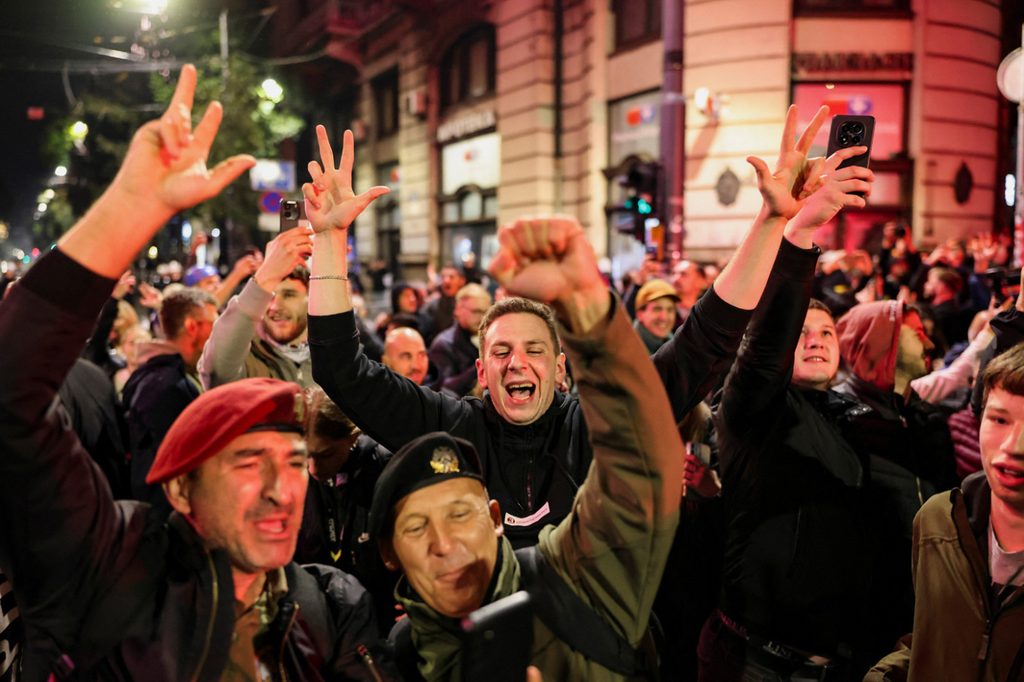
“Tonight we celebrate victory, tomorrow we build the future”
“Dear Serbia, tonight the voice of the people was heard,” said Radomir Sajčić, a professor at the University of Belgrade, speaking on behalf of the students at the movement’s headquarters.
“Tonight we celebrate victory, tomorrow we build the future,” he added.
The Student List’s real political test, however, is only beginning.
As analysts point out, winning an election requires mobilisation, a powerful message and the ability to unite voters around a desire for change. Governing demands something different: functioning institutions, experienced personnel, economic policies, compromise and the ability to take responsibility for difficult decisions.
For Serbia, the election therefore represents both a political rupture and a moment of uncertainty.
The central question is no longer whether students can challenge the established political order. They have already demonstrated that they can.
The question now is whether they can replace it – and what kind of Serbia they intend to build in its place, election analysts observe.
Allegations of irregularities during voting
The electoral process was not without problems, however. Organisations reported irregularities involving alleged vote-buying, duplicate voter registers and attacks on voters.
A serious incident occurred in the city of Pančevo, outside a polling station housed in the local Agricultural School.
A group of masked individuals physically attacked young men who were waiting to vote. Videos circulating on social media showed at least one young man with a bloodied face.
Police officers arrived to investigate the incident, while medical assistance was provided to those injured.
Another video circulating online showed hundreds of young men dressed in black and wearing hoods moving along a major boulevard in Belgrade.
Meanwhile, security forces maintained a heavy presence throughout the capital.
Numerous riot police vehicles were spotted in central Belgrade on Sunday afternoon. Earlier in the day, a convoy of approximately 20 heavy police vehicles was seen travelling towards the capital along the Belgrade–Niš motorway.
The vehicles deployed in Belgrade had first appeared during the summer 2025 demonstrations in Novi Sad, when police used them to push protesters away from major roads and central thoroughfares.
Serbia 🇷🇸: victory celebrations in the capital Belgrade tonight. https://t.co/vAGeu2FN2z
— Thomas van Linge (@ThomasVLinge) October 25, 2026
What is the Student List and how was it created?
The Student List – Students Win (Studentska lista – Studenti pobeđuju) is not a conventional political party.
It emerged from the student protest movement that swept across Serbia following the November 2024 disaster at Novi Sad railway station, when the collapse of part of the station’s canopy killed 16 people.
The tragedy sparked mass demonstrations amid serious allegations of corruption, poor construction standards and inadequate oversight of public works.
Students demanded accountability and the publication of documents related to the station’s renovation.
Gradually, the protests developed into a broader anti-government movement.
Demonstrations spread nationwide, with students denouncing corruption, the lack of accountability and the increasing concentration of power in Vučić’s hands.
For almost two years, the movement maintained its momentum through university assemblies, occupations, marches and mass rallies, evolving into the most serious political challenge Vučić had faced since his party came to power in 2012.
Why none of the 250 candidates were students
One of the Student List’s most unusual characteristics is that, although it was created and organised by students, none of its 250 parliamentary candidates was a student.
Rather than seeking parliamentary seats themselves, the young organisers selected candidates from a wide range of professional and social backgrounds, prioritising people who had not previously held senior political positions.
The list included academics, doctors, artists, businesspeople, farmers, social activists and athletes, reflecting an effort to represent a broad cross-section of Serbian society.
Candidates were selected through university student assemblies, with proposals subsequently discussed at the national level.
This approach was intended to break with the traditional model of Serbian political parties, in which decisions are typically made by a powerful leader and a small circle of close associates.
Students explained that they were not looking for television personalities or people experienced in party negotiations, but individuals they considered capable of serving public institutions responsibly.
Their central principle was that a parliamentary seat should not be regarded as a personal privilege or a stepping stone to a political career, but as a public responsibility towards citizens.
A cardiologist at the top of the list and a rejection of the “strong leader” model
The leading candidate was Ilija Srđanović, a cardiologist and academic who had been largely unknown to the wider public before the election campaign.
Despite heading the list, he avoided presenting himself as the movement’s leader.
The decision was deliberate.
The students sought to create a political force that did not revolve around a single personality, contrasting collective decision-making with Vučić’s model of government.
Notably, the Student List did not include its leading candidate’s name in its official electoral title, despite this being a widespread practice in Serbian politics.
The candidate list was submitted on September 14, 2026, and approved the following day by the relevant electoral commission.
To qualify for the election, the movement collected more than 69,000 verified signatures, far exceeding the 10,000 required under Serbian electoral law.
Serbia: Celebrations kicking off in Slavija Square, Belgrade. https://t.co/Ns8ctnnKOw
— Pierre Davide Borrelli (@PierreDavideB) October 25, 2026
What does the Student List stand for?
The Student List’s election campaign was built around a cross-party approach aimed at restoring democratic institutions and fighting corruption.
Its principal priorities include judicial independence, transparency in public procurement, combating corruption, reforming state institutions and rebuilding the country’s economy.
In September, the movement presented an 11-point policy framework that included establishing a specialised police service to support prosecutorial investigations and confiscating illegally acquired assets.
Its programme also includes social measures such as free school textbooks and substantial reductions in medicine prices.
The Student List sought to avoid divisive ideological debates over issues such as Kosovo, Serbia’s accession to the European Union and relations with Russia, instead prioritising domestic problems.
This strategy enabled the movement to attract citizens with differing political beliefs, united by their desire to change the way the country is governed.
Dejan Bodiroga and his active involvement in the movement
One of the Student List’s most prominent candidates, particularly from the perspective of European basketball, was Dejan Bodiroga.
The Serbian basketball legend and current EuroLeague president went beyond expressing symbolic support for the students and decided to become directly involved in their political campaign.
His name appeared in 24th place on the electoral list, among the 250 candidates for the Serbian parliament.
Bodiroga, who played for Panathinaikos, Real Madrid and Barcelona, is one of Serbia’s most recognisable sporting figures, with considerable international appeal.
During the election campaign, he repeatedly travelled to Serbia, participated in major rallies organised by the movement and made public statements supporting political change.
On election day, after casting his ballot in Belgrade, Bodiroga said the country was fighting for its freedom and to reclaim a state that, in his words, had been “hijacked.”
“Serbia is voting today to decide which direction it will take, towards the future or towards the past,” he said.
His participation carries particular significance because one of the greatest basketball players in Serbian history chose to publicly associate his name with a political project that challenged Vučić’s dominance.
How students won over voters in Vučić’s strongholds
The Student List’s electoral success was not based solely on support from young people or residents of major urban centres.
Students organised a nationwide campaign, undertaking long bicycle rides and marches to reach voters in small towns and rural areas.
Many of these communities had traditionally been electoral strongholds of Vučić and the ruling Serbian Progressive Party (SNS).
Their strategy of direct contact with citizens, combined with youthful energy and the image of a movement operating outside the traditional political system, helped broaden their appeal.
At the same time, the students faced strong criticism from pro-government media, while Vučić repeatedly accused them of serving the interests of foreign powers. The movement rejected those allegations.
The campaign was also marked by allegations of pressure on voters, surveillance of activists, cyberattacks and unequal access to the media.
On election day, independent observers reported incidents raising suspicions of vote-buying, intimidation and other electoral irregularities.
Ask me anything
Explore related questions




