





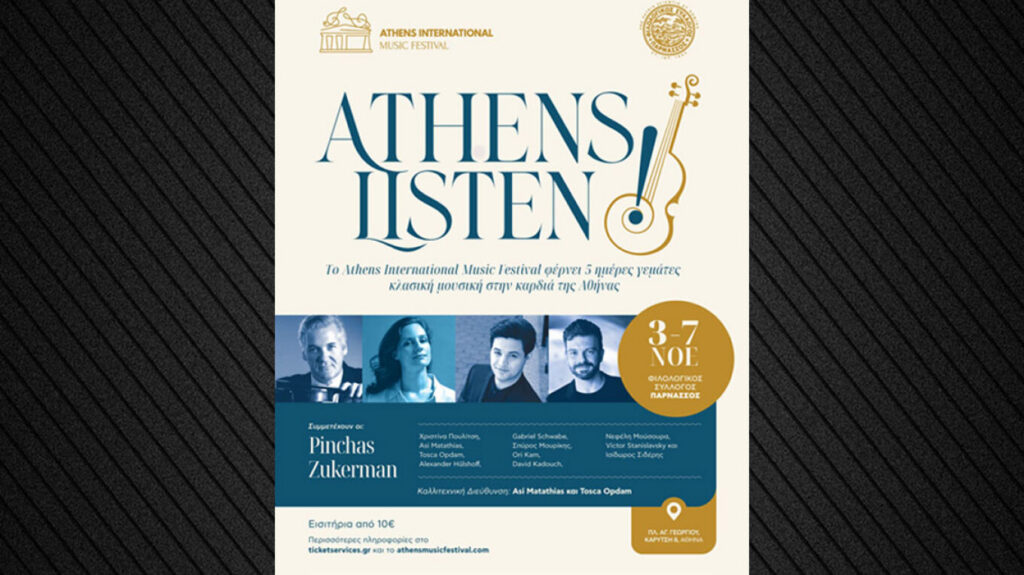
For the second consecutive year, Athens is preparing to host an international celebration of classical music.
From November 3 to 7, the Athens International Music Festival, the city’s only international classical music festival, returns with leading soloists and internationally acclaimed musicians for five days dedicated to chamber music.
Under the artistic direction of Tosca Opdam and Asi Matathias, the festival brings together an exceptional lineup of internationally renowned performers, presenting a program that celebrates chamber music and the unique power of live musical performance.
Pinchas Zukerman opens the festival
The Athens International Music Festival welcomes one of the most distinguished violinists of our time, the legendary Pinchas Zukerman, who will open this year’s event and perform in four concerts.
Joining him are prominent figures from the international classical music scene, including soprano Christina Poulitsi, violinists Asi Matathias and Tosca Opdam, cellists Alexander Hülshoff and Gabriel Schwabe, clarinetist Spyros Mourikis, violist Ori Kam, and pianists David Kadouch, Nefeli Mousoura and Victor Stanislavsky.
Music as an experience and an opportunity to learn
Education is also an important part of the festival’s program. Three violin masterclasses will be held with Pinchas Zukerman, Tosca Opdam and Asi Matathias, offering five outstanding young musicians the opportunity to learn directly from internationally acclaimed performers.
Audiences will be able to attend these sessions and observe the process through which accomplished musicians pass on their knowledge, technical expertise and artistic experience to the next generation.
The festival is also expanding its educational and social outreach through a special program for schoolchildren, young musicians from the El Sistema Greece youth orchestra, and students at the conservatory of the Kaloy Foundation for Arts and Culture in Corinth.
Five days of music in the heart of Athens
The Athens International Music Festival invites audiences to experience classical music from a different perspective: not simply as an art form associated with grand concert halls, but as a vibrant cultural experience woven into the life of the city.
And the experience goes beyond the music itself.
For five days, the historic Parnassos Literary Society will open its doors to musicians arriving in Athens from different countries and musical traditions. The venue has long been associated with important moments in the city’s artistic and intellectual history.
Dating back to 1891, this landmark building in central Athens will once again become a meeting place for live music. Its concert hall has a particularly remarkable connection to one of the greatest voices in operatic history: in April 1938, the 14-year-old Maria-Anna Kalogeropoulou, later known worldwide as Maria Callas, made her first public appearance there.
For established classical music enthusiasts, the festival offers an opportunity to experience outstanding international musicians performing in Athens. For newcomers, it provides an accessible introduction to a musical world that becomes especially immediate and compelling when experienced live.
Now in its second year, the Athens International Music Festival aims to strengthen the connection between classical music and the city, establish Athens as a destination for important international musical encounters, and highlight the Greek capital’s enduring relationship with culture, creativity and artistic exchange.
FESTIVAl PROGRAMME
November 3 – Between Two Worlds
The opening concert introduces the festival’s central theme: music as a dialogue between places, generations and people.
Mozart’s Duet for Violin and Viola, K. 424, was composed in 1783 as a gesture of support for fellow composer Michael Haydn, who was unable to complete a commission for six duets for the Archbishop of Salzburg. Mozart anonymously composed two of the pieces, helping his colleague fulfill the commission.
The program continues with Sibelius’s youthful Lovisa Piano Trio, composed in 1888 when he was just 23. Named after the town where his family spent their summers, the work remained unpublished for more than a century.
The evening culminates in Brahms’s String Quintet No. 2 in G major, Op. 111, composed in 1890 as what the composer initially intended to be his farewell to composition — a decision he ultimately reversed. Its premiere in Vienna was a triumph.
Programme
- Mozart — Duet in B-flat major for Violin and Viola, K. 424. Pinchas Zukerman (viola) and Asi Matathias (violin).
- Sibelius — Piano Trio in C major, Lovisa. Tosca Opdam (violin), Gabriel Schwabe (cello) and Victor Stanislavsky (piano).
- Brahms — String Quintet No. 2 in G major, Op. 111. Asi Matathias and Tosca Opdam (violins), Ori Kam and Pinchas Zukerman (violas), and Alexander Hülshoff (cello).
November 4 – The Poet and the Muse
This concert explores the relationship between music, theater and poetry.
Poulenc’s music for Jean Anouilh’s play L’Invitation au château brings the atmosphere of French theater to the concert hall, including a tango distinguished by its characteristic French elegance.
A highlight of the evening will be the world premiere of Delphi and Dionysus by American composer Todd Mason. The work draws inspiration from the eternal struggle between order and chaos, represented by Apollo, the god of harmony, and Dionysus, the god of ecstasy, whose presence is associated with the sanctuary of Delphi in Greek mythology.
Saint-Saëns’s La Muse et le Poète, Op. 132, written in 1909, follows. It was originally performed by the composer himself alongside celebrated musicians Eugène Ysaÿe and Joseph Hollmann.
The evening concludes with Brahms’s Piano Quartet No. 1 in G minor, Op. 25, premiered in Hamburg in 1861 with Clara Schumann at the piano. Its exhilarating final movement, Rondo alla zingarese, remains one of the most technically demanding passages in the composer’s chamber music repertoire.
Programme
- Poulenc — L’Invitation au château. Tosca Opdam (violin), Spyros Mourikis (clarinet) and Victor Stanislavsky (piano).
- Todd Mason — Delphi and Dionysus, world premiere. Victor Stanislavsky (piano), Spyros Mourikis (clarinet) and Gabriel Schwabe (cello).
- Saint-Saëns — La Muse et le Poète, Op. 132. Asi Matathias (violin), Gabriel Schwabe (cello) and David Kadouch (piano).
- Brahms — Piano Quartet No. 1 in G minor, Op. 25. Pinchas Zukerman (violin), Ori Kam (viola), Alexander Hülshoff (cello) and David Kadouch (piano).
November 5 – Between Earth and Sky
The third evening opens with Mozart’s Clarinet Quintet in A major, K. 581, composed in 1789 for his close friend, clarinetist Anton Stadler. Originally written for Stadler’s basset clarinet, the piece introduces a luminous and almost weightless musical atmosphere.
Schubert’s unfinished String Trio in B-flat major, D. 471, composed in September 1816 when he was only 19, follows.
The evening concludes with Tchaikovsky’s Piano Trio in A minor, Op. 50. Although the composer had once expressed his dislike of combining piano with violin or cello, he overcame that reluctance in 1882 to write one of his most moving works in memory of his friend Nikolai Rubinstein.
Together, the three compositions explore the space between earthly experience and something beyond it.
Programme
- Mozart — Clarinet Quintet in A major, K. 581. Tosca Opdam and Asi Matathias (violins), Ori Kam (viola), Gabriel Schwabe (cello) and Spyros Mourikis (clarinet).
- Schubert — String Trio in B-flat major, D. 471. Pinchas Zukerman (violin), Ori Kam (viola) and Alexander Hülshoff (cello).
- Tchaikovsky — Piano Trio in A minor, Op. 50. Asi Matathias (violin), Victor Stanislavsky (piano) and Alexander Hülshoff (cello).
November 6 – French Impressions
The fourth evening celebrates the elegance, color and intimacy of French music.
Fauré’s Dolly Suite, Op. 56, composed between 1894 and 1897 as a series of birthday gifts for Hélène “Dolly” Bardac, reveals a particularly tender side of the composer.
The program continues with three celebrated moments from French opera: Depuis le jour from Charpentier’s Louise, Ophelia’s mad scene from Ambroise Thomas’s Hamlet, and Juliet’s potion aria from Gounod’s Roméo et Juliette.
These operatic scenes explore three distinct emotional worlds, from happiness and ecstasy to madness and courage.
The concert concludes with Fauré’s Piano Quartet No. 1 in C minor, Op. 15. Begun in 1876 during the composer’s ultimately unsuccessful engagement to Marianne Viardot, the work was completed in 1879 and premiered the following year. Despite its melancholy origins, it retains an elegant emotional restraint.
Programme
- Fauré — Dolly Suite, Op. 56. David Kadouch and Nefeli Mousoura (pianos).
- Selection of French opera arias and songs. Christina Poulitsi (soprano) and Nefeli Mousoura (piano).
- Fauré — Piano Quartet No. 1 in C minor, Op. 15. Tosca Opdam (violin), David Kadouch (piano), Ori Kam (viola) and Gabriel Schwabe (cello).
A talk is also scheduled, with further details to be announced.
November 7 – Transformation
The festival concludes with a program dedicated to transformation.
Amanda Maier’s Violin Sonata in B minor introduces audiences to a pioneering female composer who, in 1873, became the first woman to receive the title of Musikdirektör from the Royal Swedish Academy of Music. Her career as a violinist and composer became more limited following her marriage in 1880, and her music has only begun to receive broader recognition in recent decades.
The program continues with Arnold Schoenberg’s Verklärte Nacht (Transfigured Night), Op. 4, composed in 1899 when he was 25. Inspired by Richard Dehmel’s poem about two lovers walking through a moonlit forest, the work was initially rejected by the Vienna Music Society, partly because of its unconventional harmonies and the poem’s daring subject matter.
Today, it is regarded as an important bridge between late Romanticism and musical modernism.
The festival ends with Schubert’s String Quintet in C major, D. 956, written in 1828, just months before his death. Its unusual instrumentation, featuring two cellos rather than two violas, gives the composition a particularly rich and dark sonority.
Widely considered one of the greatest chamber music works ever written, the quintet was so beloved by pianist Arthur Rubinstein that he requested it be performed at his funeral.
Together, the works of Maier, Schoenberg and Schubert bring the festival to a close with a musical dialogue across generations, exploring how artistic traditions are inherited, transformed and renewed.
Programme
- Amanda Maier — Violin Sonata in B minor. Tosca Opdam (violin) and Victor Stanislavsky (piano).
- Schoenberg — Verklärte Nacht, Op. 4. Asi Matathias (violin), Gabriel Schwabe (cello) and Victor Stanislavsky (piano), as listed in the festival program.
- Schubert — String Quintet in C major, D. 956. Pinchas Zukerman and Tosca Opdam (violins), Ori Kam (viola), Gabriel Schwabe and Isidoros Sideris (cellos).
The final day will also feature a talk titled “Geopolitics and Contemporary Art.”
Ask me anything
Explore related questions




