





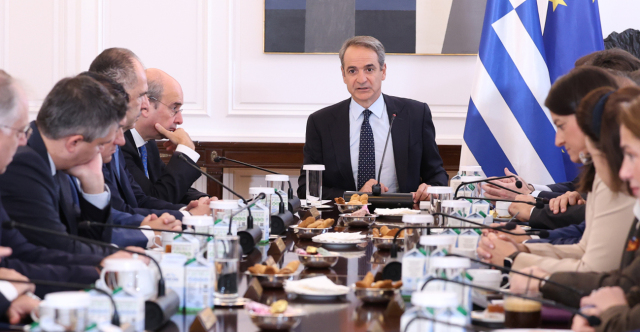
Prime Minister Kyriakos Mitsotakis has urged his ministers to set aside personal electoral ambitions and focus on completing the government’s programme, setting out 90 priorities to be delivered before the end of the four-year term.
“The pre-election hunt for votes can wait. The priority is the pursuit of results in government,” he told the Cabinet.
The prime minister reiterated his intention to serve out the government’s full term without slowing the pace of its work, stressing that “our record is our passport to credibility”. Delivering on the government’s commitments, he added, would be “the best response to the opposition’s miserable tendency to dismiss everything”.
A pointed reference to 2019
Mitsotakis struck a particularly sharp tone on tackling illegal activity, referring to recent tax evasion cases and the solving of the explosion in Plaka.
“Crime has always existed. Now, however, it is being exposed,” he said, arguing that his government was taking action on major cases which had previously remained unsolved or had not been dealt with adequately.
He also took aim at those who, as he put it, now appeared surprised by illegal activity, reminding them that “some people kept parliament open to change the Criminal Codes in 2019”.
He described the recent cases as proof that the government’s “Lawfulness Everywhere” policy was non-negotiable, praising the work of the Independent Authority for Public Revenue (AADE), the Financial Police and the Directorate for Combating Organised Crime.
He also spoke of a confrontation with entrenched practices and closed networks in public life, which had at times operated with the tolerance of the “deep state”.
The Turkey-Libya memorandum
Addressing Turkish-Libyan claims, Mitsotakis made clear that they would not affect Greece’s plans.
“Arbitrary claims that run counter to the Law of the Sea have no validity. They do not create faits accomplis, nor do they overturn our national plans,” he said.
He also referred to his proposal at the United Nations Security Council for a global maritime ceasefire, aimed at keeping vital trade routes open and limiting the impact on the cost of living.
Pressure on households
On the economy, the prime minister acknowledged the pressures caused by international turmoil.
“This is a global upheaval to which no national policy can provide an answer,” he said, adding: “I know that many of our households are under strain.”
He argued that the government was doing “what is best” and that “the reserves built up through our prudent economic policy make us cautiously optimistic”.
The 90 priorities
In the economy, the government’s plans include implementing the tax measures announced at the Thessaloniki International Fair (TIF) and introducing new provisions to support development projects, particularly in manufacturing.
In employment, they include a further increase in the minimum wage, with the aim of reaching €1,000 in early 2028, expanding the Digital Work Card and protecting workers on digital platforms.
Infrastructure projects include Thessaloniki’s Flyover and the completion of a further 25 kilometres of the Northern Road Axis of Crete (VOAK). On housing, the government is promoting the “Renovate-Rent” scheme, social land-for-housing arrangements and the construction of homes on disused military sites.
In education, plans include preparations for the National School Leaving Certificate, the renovation of a further 500 schools and the handover of student accommodation at Panteion University and in Tripoli. In healthcare, the focus will be on prevention and the health adviser service.
For the operation of the state, the plans include upgrading the Diavgeia transparency platform, linking urban planning offices with the National Cadastre and using technology in court proceedings and building inspections.
Other measures include improvements to the 112 emergency alert system, traffic monitoring, new Domestic Violence Response Offices, completion of the marine parks, urban planning and projects to tackle water shortages.
In defence, following the arrival of the second Belharra-class frigate, Nearchos, plans include taking delivery of a further seven Romeo helicopters and producing Greek-made drones.
Items on the Cabinet meeting agenda
The agenda for the Cabinet meeting includes:
- Key government priorities for each ministry through to the end of the current parliamentary term, with presentations by the relevant ministers following introductory remarks by Deputy Prime Minister and Minister of State Kostis Hatzidakis and Minister of State Akis Skertsos.
- A presentation by Deputy Minister of Infrastructure and Transport Giorgos Kotsiras entitled “Urban public transport: tangible progress and the future”.
- A presentation by Minister of Labour and Social Security Niki Kerameus of a bill on rules governing the use of artificial intelligence in the labour market, the protection of platform workers and the transposition of Directive 2024/2831.
- A presentation by Justice Minister Giorgos Floridis of a bill to turn the Judicial Police into a Security Corps.
- A presentation by Deputy Minister of Education, Religious Affairs and Sports Giannis Vroutsis of a bill to bring Greek legislation into line with the revised World Anti-Doping Code of the World Anti-Doping Agency.
- Presentations by Interior Minister Thodoris Livanios and Development Minister Takis Theodorikakos of bills consolidating and updating legislation in their respective ministries.
Ask me anything
Explore related questions




