





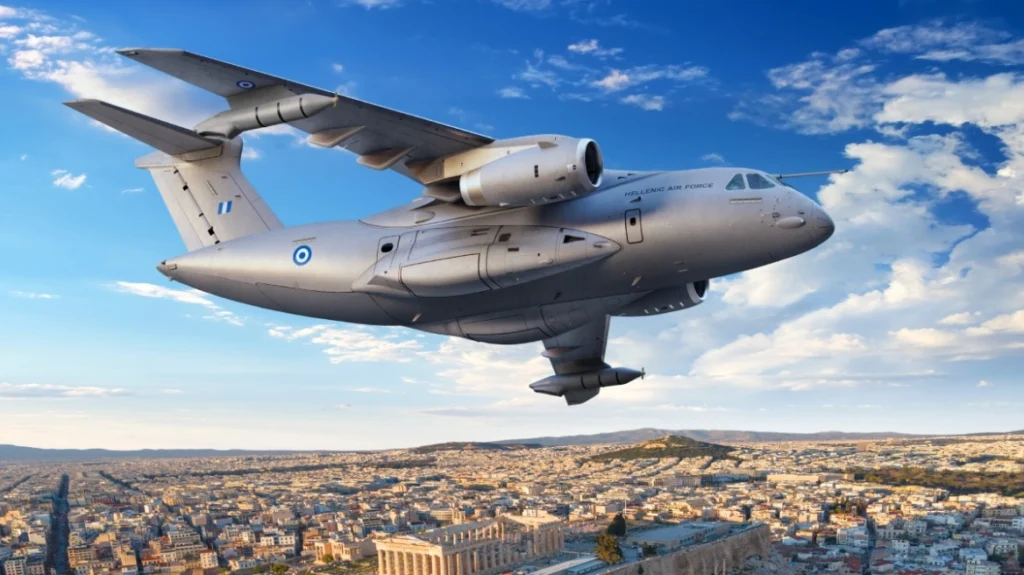
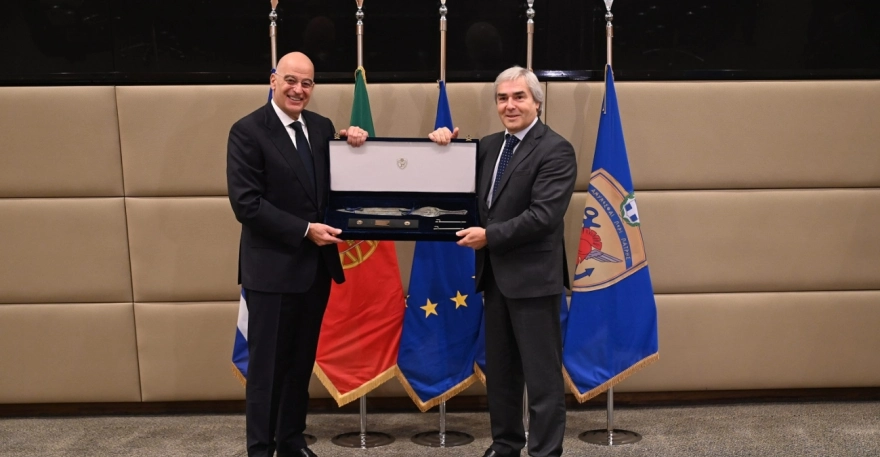
Greece has proceeded with the signing of an intergovernmental agreement with Portugal for the procurement of three Brazilian Embraer KC-390 aircraft, with the option to acquire three more. The agreement was signed today, Monday (2 November), at the Ministry of National Defence, in the presence of Nikos Dendias and his Portuguese counterpart, Nuno Melo, who is on an official visit to Athens.
The aircraft will be used for transport missions, as well as for the in-flight refuelling of Hellenic Air Force fighter jets—a capability that, according to Nikos Dendias, Greece is acquiring for the first time.
The Minister of National Defence described the agreement as particularly significant, pointing out that the acquisition of the KC-390s marks two firsts for the Hellenic Armed Forces.
“This is the first time in our history that we will acquire a jet-powered transport aircraft,” he said, adding: “And this is the first time in our history that we will acquire a tanker aircraft—that is, an aircraft capable of refuelling our fighter jets in the air. Initially, the Rafales and Mirages and, one year from now, the F-16s as well.”
What the acquisition of the KC-390s will change
Nikos Dendias placed particular emphasis on the capability for in-flight refuelling, explaining that it will allow Greek fighter jets to remain airborne for longer periods without having to return for fuel.
“I would like to say that there is no way I can adequately emphasise the enormous advantage this in-flight refuelling capability gives our fighter aircraft,” he stressed.
As he explained, with in-flight refuelling, the length of time a fighter jet can remain airborne will essentially depend on the endurance of its pilot, rather than on the amount of fuel available.
The minister also linked the importance of this capability to the events of 1974 in Cyprus, arguing that the availability of aerial refuelling aircraft could have changed the course of the Turkish invasion.
“Or, if you prefer, let me put it this way: if Greece had aircraft capable of refuelling our fighter jets in the air, the invasion of Cyprus in 1974 could not have happened, and the invasion’s bridgehead could not have been maintained,” he said.
An important part of the agreement also involves the transfer of know-how from Portugal, which will assist in training Greek pilots to operate the aircraft.
Mr Dendias also thanked the Portuguese side for the participation of a KC-390 in the flypast over Thessaloniki during the celebrations marking 28 October.
The intergovernmental agreement was signed by Major General Ioannis Bouras, Director General of the General Directorate for Defence Investments and Armaments, and António José Baptista, Director General of Armaments at Portugal’s Ministry of National Defence, in the presence of the two ministers.
Today’s development follows the visit Nikos Dendias made to Lisbon on 7 May 2026.
Cooperation on maritime drones, satellites and defence technology
Before the agreement was signed, the two ministers held a private meeting, followed by expanded talks between the Greek and Portuguese delegations.
The discussions focused on defence cooperation, innovation and the defence industry, as well as opportunities for closer coordination between the two countries within the framework of the European Union and NATO.
Nikos Dendias announced that cooperation would not be limited to the procurement of the KC-390s, but would also extend to the field of maritime drones, where Portugal has relevant experience.
As he noted, the two countries will also cooperate on the development of vessels capable of carrying and operating drones, as well as systems designed to counter unmanned vehicles.
The satellite sector was also included in the discussions. The Minister of National Defence announced that he would inaugurate the Hellenic Air Force Space Command in the coming days, noting that Portugal is one of the partners with which Greece is seeking cooperation in this field.
At the same time, Mr Dendias briefed his Portuguese counterpart on Greece’s positions regarding the Law of the Sea, Turkey’s stance and the Turkey-Libya maritime memorandum.
The two sides also discussed their mutual assistance obligations within NATO and the European Union, as well as developments in Africa, with the Greek minister underscoring the importance of a European presence in the region.
During the visit, a cooperation agreement between the Air Forces of Greece and Portugal was also signed.
Ask me anything
Explore related questions




