





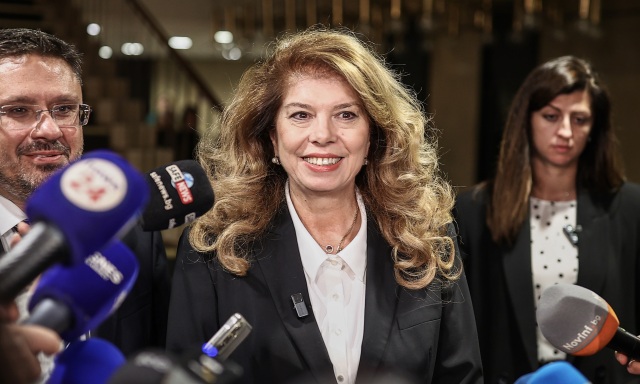
Sixty-two-year-old Iliana Iotova has made history in Bulgaria, becoming the first woman to serve as president in the country’s history following the outcome of Sunday’s election.
With 99.95% of polling stations counted, the Iliana Iotova–Valchev ticket secured 57.58% of the vote, or approximately 1.1 million votes, while their opponents, Andrey Gyurov and Georgi Kandev, received 39.47%, equivalent to approximately 749,500 votes. The electoral process, however, was marked by low turnout.
Her beginnings in television
Iotova graduated from the Department of Bulgarian Philology at Sofia University and began her professional career in journalism. Now 62, the politician started out at Bulgarian National Television, where she worked as a reporter, editor and presenter before later taking charge of the news department.
After her television career, Iotova worked in the communications department of the Bulgarian Socialist Party and was elected to the National Assembly. From 2007 to 2017, she served in the European Parliament, where, according to her official biography, she dealt with issues relating to consumer protection, fisheries, citizens’ petitions and civil liberties.
Her next political step came in 2017, when she became Bulgaria’s vice president, serving alongside Rumen Radev. In 2022, she began her second term.
In this role, Iotova served for nine years under Radev, who is considered pro-Russian and resigned from the presidency in January in order to run for prime minister.
Radev formed Bulgaria’s first stable government in years following a landslide victory for his party, “Progressive Bulgaria”. Under the Bulgarian Constitution, the prime minister has stronger powers than the president.
The shift toward Russia
Iotova’s victory is expected to consolidate Sofia’s shift in its position on Ukraine. Radev had pledged to end arms exports to Kyiv, while refraining from criticizing Moscow over its attacks in the Black Sea, following strikes on several commercial vessels near the Bulgarian coast.
The new president’s stance was particularly evident in the final days of her election campaign, when Iotova declared that “everyone should call President [Vladimir] Putin”, while describing herself as a “president of peace”.
Iotova has repeatedly supported a diplomatic solution to the war in Ukraine, arguing that peace can only be achieved through negotiations and expressing her opposition to further military support for Kyiv.
Despite her position toward Russia, she does not question Bulgaria’s membership of the European Union and NATO. Instead, she advocates an independent foreign policy, with the national interest as its main guiding principle.
With voter turnout close to historically low levels, the pro-Russian right party “Revival” claimed that its efforts to mobilize voters were what tipped the balance in Iotova’s favor, according to the Financial Times.
Ask me anything
Explore related questions




