





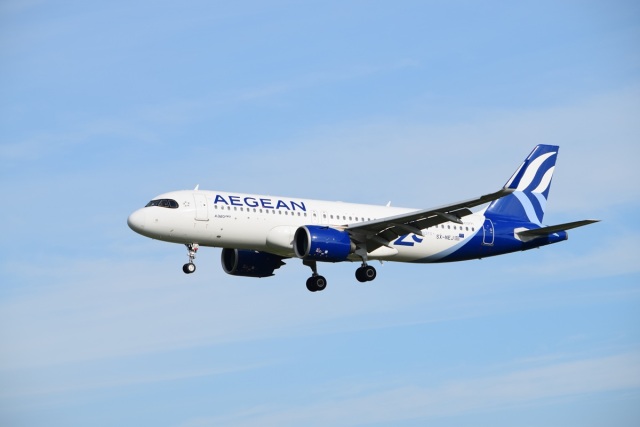
Two Aegean Airlines flights departing from Greece were targeted by bomb threats on Thursday, 5 November, with both aircraft landing safely at their destinations in Milan and Vienna as authorities launched security checks.
The first threat concerned an Aegean flight travelling from Thessaloniki to Milan. Despite the alert, the aircraft landed normally at the Italian airport.
A second bomb threat was reported involving another Aegean flight, this time travelling from Athens to Vienna. That aircraft also landed safely without any disruption to its landing.
Authorities activated the required security procedures in accordance with established protocols, but no suspicious items were discovered.
The incidents are believed to be part of a broader wave of bomb threats affecting passenger aircraft across Europe in recent days, prompting heightened security measures, emergency diversions and military fighter jet escorts.
Aer Lingus flight diverted to French military airbase
Earlier on Thursday, an Aer Lingus Airbus A320 carrying 151 passengers and six crew members was diverted to a military airbase in France after a bomb threat was reported during its journey from Dublin to Rome.
The aircraft landed at Évreux-Fauville Air Base, approximately 100 kilometres west of Paris, where passengers and crew disembarked safely.
The office of French Prime Minister Sébastien Lecornu confirmed that authorities were closely monitoring developments.
“We are closely monitoring the situation concerning the aircraft diverted following a bomb alert,” the prime minister’s office said, according to Reuters.
Aer Lingus flight EI402 had departed Dublin International Airport at 6.23am and was scheduled to arrive at Rome’s Leonardo da Vinci–Fiumicino Airport at 10.50am.
During its approach to the French military facility, the aircraft was escorted by a French Rafale fighter jet.
Bomb disposal specialists were subsequently deployed to carry out the necessary inspections.
Finnair aircraft escorted by Italian fighter jets
Another security alert was triggered on Thursday morning following anonymous reports of a possible bomb aboard a Finnair flight travelling from Helsinki to Rome.
The aircraft landed safely at Fiumicino Airport at approximately 9.30am, accompanied by fighter jets from the Italian Air Force.
Police bomb disposal teams immediately began the security inspections required under aviation safety procedures.
Airport sources said the checks were proceeding normally, with no disruption to the airport’s wider operations.
Four aircraft threatened in Prague
Czech authorities also reported bomb threats involving four passenger aircraft heading to Prague on Thursday.
Police announced on X that preparations were under way for the aircraft’s arrival, although they assessed the credibility of the threats as “low”.
“Nevertheless, we are not underestimating the threat, which is why all necessary security measures have been activated with the minimum possible impact on passengers and airport operations,” police said.
“After landing, all aircraft will undergo thorough inspections by bomb disposal experts.”
The alerts added to a growing number of incidents involving European aviation, with authorities taking precautionary measures even when the threats were considered unlikely to be genuine.
Wizz Air flight diverted to Vienna
A Wizz Air Airbus A321 was also forced to divert to Vienna after a bomb threat was received while it was in the air.
The aircraft had departed Milan Malpensa Airport, officially named after Silvio Berlusconi, at 7am and was travelling to Warsaw.
According to the airline, the diversion to the Austrian capital followed “a bomb threat received during the flight”.
The aircraft subsequently landed at Vienna Airport.
Three emergency landings in Bulgaria
Bulgarian authorities reported three further aircraft making emergency landings following bomb threats.
Two aircraft travelling from Copenhagen and Madrid landed safely in Sofia, Bulgaria’s capital, according to the country’s interior minister, as reported by broadcaster bTV.
A third aircraft, which had departed London, was diverted to Plovdiv, Bulgaria’s second-largest city, local media reported.
The incidents prompted additional security responses as authorities across the continent dealt with multiple alerts affecting international flights.
Seven false bomb alarms reported on 3 November
The latest incidents follow seven bomb scares involving passenger flights across Europe on 3 November 2026, all of which were subsequently found to be false alarms.
The affected flights were travelling to destinations in Italy, Bulgaria, Spain and Poland.
The alerts prompted security inspections, aircraft diversions and, in some cases, temporary interruptions to airport operations.
Four of the incidents involved Ryanair flights departing from Lisbon and Dublin. Two were heading to Rome’s Fiumicino Airport, while the other two were bound for Sofia in Bulgaria.
In Italy, a Ryanair aircraft arriving from Dublin was escorted by two Italian Air Force fighter jets.
Police bomb disposal teams activated the appropriate security protocols to protect passengers and crew, carrying out inspections of the aircraft, luggage and passengers.
Nothing suspicious was discovered, and the alert was lifted.
Another incident involved a LOT Polish Airlines flight travelling from London Heathrow to Warsaw Chopin Airport.
The aircraft was forced to change course and land at Warsaw Modlin Airport instead.
In Spain, a Ryanair aircraft travelling from Manchester to Murcia, carrying 114 passengers and seven crew members, underwent security inspections following a bomb report.
Spanish authorities subsequently ruled out the presence of explosives.
A Wizz Air flight departing from Bergamo was also affected by a false alarm. The aircraft landed in Sofia, where the necessary security checks were completed without any explosives being found.
European security concerns amid allegations of hybrid attacks
Although no country has formally attributed responsibility for the bomb threats, the incidents come amid wider European concerns over alleged hybrid attacks and sabotage operations.
European officials have accused both Russia and Iran of engaging in such activities, although there has been no official determination linking either country to the latest aviation bomb threats.
Moscow and Tehran have repeatedly denied involvement in campaigns of hybrid attacks and sabotage.
The successive alerts have nevertheless placed European aviation authorities on heightened alert, with security services responding to threats across multiple countries even as investigations have so far failed to establish the presence of explosive devices in the reported false-alarm cases.
Ask me anything
Explore related questions




