





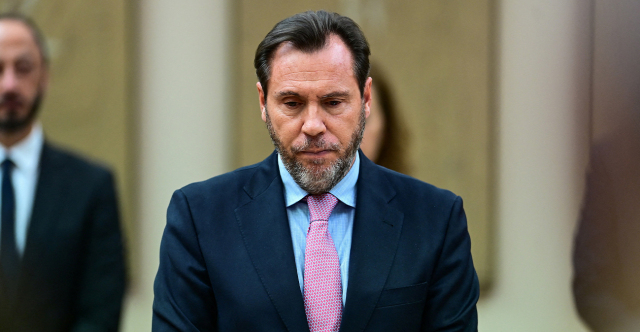
Spain’s transport minister, Óscar Puente, has announced his resignation following the devastating train crash in Urda, in the province of Toledo, which claimed 69 lives and left around 200 people injured.
His decision came at the end of a tense four-hour parliamentary hearing on Tuesday, during which he faced fierce criticism from opposition parties and members of the governing coalition over the safety of Spain’s railway network.
“A transport minister in a country like Spain cannot remain in office after two accidents in less than a year,” Puente declared, accepting political responsibility for the situation.
His resignation follows two deadly railway disasters, in Urda and Adamuz, which have raised serious concerns about the safety of Spain’s railways and intensified scrutiny of Spanish Prime Minister Pedro Sánchez’s government.
Puente also announced that he would not head the Socialist Party’s (PSOE) candidate list in Valladolid at the next general election.
Heated parliamentary confrontation ends in resignation
The parliamentary session descended into a bitter confrontation as Puente was pressed to explain the circumstances surrounding the latest crash, the decisions taken by railway authorities and the measures in place to protect passengers.
Shortly before his resignation announcement, Ester Muñoz, a spokeswoman for the opposition conservative People’s Party (PP), sharply criticised the minister’s handling of the crisis.
“Your responsibility is not to explain fatal accidents, but to prevent them,” she said.
Muñoz also accused Puente of mishandling both the Urda disaster and the earlier railway tragedy in Adamuz.
Puente responded that appearing before parliament and providing explanations was a fundamental obligation to the victims, their families and the wider public.
However, at the conclusion of the hearing, he announced his departure from government, citing political dignity and the need to take responsibility following the two disasters.
Critical questions over failed safety systems
The parliamentary debate focused heavily on the circumstances of the Urda crash, in Toledo province, where two high-speed trains operated by Renfe and Iryo collided.
Puente reiterated his concerns about a decision taken by the control centre of Adif, Spain’s state railway infrastructure manager, to allow an AVE high-speed train to resume travelling at normal speed despite a failure of the LZB safety system.
At the same time, another train operated by Iryo was stationary further along the line.
According to information presented to parliament, the AVE train continued for approximately 25 kilometres at speeds exceeding 160 kilometres per hour before the collision occurred.
The LZB system is a crucial component of high-speed railway safety, providing continuous monitoring of train movements and supervision of permitted speeds.
Its failure, and the subsequent authorisation for the train to continue its journey, are now central questions in the ongoing investigation.
The outgoing minister defended the overall reliability of Spain’s railway system while acknowledging that further safeguards were necessary to prevent similar disasters.
€780 million railway upgrade programme under scrutiny
During his appearance, Puente reminded lawmakers that the government had launched a €780 million programme to modernise and upgrade the country’s railway infrastructure.
He rejected suggestions that the Madrid-Seville high-speed railway was a neglected route, stressing that renewal and modernisation works had been planned and were under way.
His explanations, however, failed to satisfy opposition parties, which questioned whether existing safety systems were adequate and whether infrastructure inspections and maintenance procedures had been effective.
The government has also announced additional safety measures, including a reduction in train frequency on the Madrid-Seville line.
Another measure will require instructions governing train movements to be confirmed by a second Adif controller whenever the LZB safety system fails.
The changes are intended to reduce the possibility of individual errors leading to catastrophic consequences.
Government allies also demanded minister’s departure
Pressure on Puente did not come solely from the conservative People’s Party and the far-right Vox party.
Sumar, the left-wing alliance participating in Sánchez’s governing coalition, had also called for his resignation, while making clear that it did not hold him personally responsible for causing the crash.
Its spokeswoman, Verónica Barbero, highlighted working conditions across the railway sector, arguing that the expansion of train services had not been accompanied by a corresponding increase in staffing levels.
The criticism reflected broader concerns about whether Spain’s rapidly expanding high-speed railway network has sufficient personnel and resources to maintain safe operations.
Gabriel Rufián, parliamentary spokesman for the Republican Left of Catalonia (ERC), questioned the effectiveness of a safety system in which a single human error could result in such devastating consequences.
He argued that when an individual mistake could cause a tragedy of this magnitude, it indicated that the system itself was not functioning as it should.
Other parties raised similar concerns, broadening the political debate beyond the immediate circumstances of the Urda collision to the overall condition and management of Spain’s railway infrastructure.
Death toll reaches 69, with around 200 injured
The disaster occurred on 28 October near Urda, in the province of Toledo, and ranks among the deadliest railway accidents in modern Spanish history.
The confirmed death toll stands at 69, with approximately 200 people injured. Dozens of victims remain in hospital.
Forensic authorities have completed the identification of all 69 people who died.
Of those killed, 54 were Spanish nationals and 15 were citizens of other countries.
Investigators are continuing to establish the precise sequence of events that led to the collision, with particular attention being paid to the technical operation of the railway line and the instructions issued by the control centre before the disaster.
Judicial and police authorities are examining whether the breakdown of the LZB safety system, the subsequent operational decisions or other failures contributed to the collision.
The investigations remain ongoing, and no definitive conclusions have yet been reached about the causes or responsibility for the crash.
Puente’s resignation now leaves Sánchez’s government facing both the immediate challenge of restoring confidence in Spain’s railway network and the wider political consequences of two major transport disasters within a
Ask me anything
Explore related questions




