





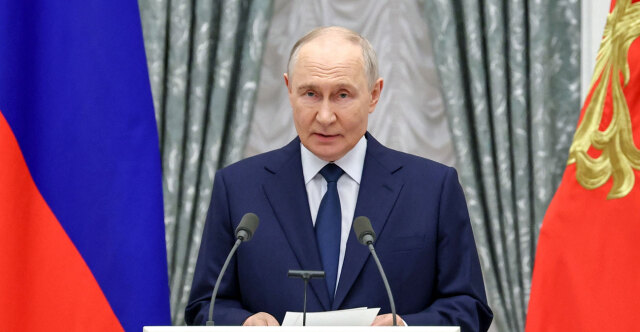
Under a decree issued today by Vladimir Putin, the Russian assets of Japanese tobacco group Japan Tobacco Inc. (JTI) are being placed under the temporary management of Russian company Promyshlennye Aktivy (Industrial Assets). According to the decree, cited by RIA Novosti, 100% of the shares in Petro, a limited liability company owned by JTI Investments Sarl, are being transferred to the temporary management of Promyshlennye Aktivy.
Specifically, the Russian joint-stock company Promyshlennye Aktivy (Industrial Assets) is taking over the management of JTI’s interests in four Russian limited liability companies: JTI Donskoy Tabak, Petro, JTI Yelets and Kres Neva. No reason has been given for the decision, although the Kremlin has linked similar moves in the past to the actions of countries it describes as “unfriendly”.
Coca-Cola HBC shares are currently under heavy pressure on the Athens Stock Exchange, plunging by close to 12.5% amid concerns over the company’s presence in the Russian market. Despite its strong performance, the company must now factor in the impact of geopolitical risk at a time of heightened tensions. Indeed, a number of European groups have recently found themselves in the Kremlin’s sights.
A further source of concern for the market is a report by Russian newspaper Kommersant, according to which Bochkari, an Altai-based producer of beer and soft drinks, has asked Putin to place the Russian operations of the former Coca-Cola business under temporary external management.
According to information published by the Russian newspaper, the proposal concerns the Multon group, which until 2022 bottled Coca-Cola’s international products in Russia and remains today one of the country’s largest non-alcoholic beverage producers, with well-known brands such as Dobry and Rich.
The total value of the business is estimated to reach as much as 245 billion roubles, making the case particularly significant for the Russian soft drinks market.
JTI’s presence in the Russian market
According to Interfax, JTI has operated in Russia since its establishment in 1999, when its parent company, Japan Tobacco Inc., acquired the international operations of R.J. Reynolds. In 2007, JTI became the leading player in the Russian tobacco market, further strengthening its dominance in 2018 through the acquisition of Donskoy Tabak.
The four companies covered by the presidential decree operate at different stages of the production chain. Specifically, the Petro facilities in St Petersburg and those of JTI Donskoy Tabak in Rostov-on-Don manufacture finished tobacco products.
By contrast, JTI Yelets, in the Lipetsk Region, and Kres Neva, in the Leningrad Region, are involved in the processing of raw materials.
However, the decree provides no additional identifying details about the company taking over management, beyond its corporate name. Consequently, it is not possible to establish exactly which of the companies registered in Russia under the name Promyshlennye Aktivy will assume control of JTI’s operations.
Financial performance of the four companies
The latest published financial statements for JTI group companies in Russia relate to the 2023 financial year.
According to the figures:
- JTI Donskoy Tabak: Revenue of 10.3 billion roubles and net profit of 1.3 billion roubles.
- JTI Yelets: Revenue of 1.25 billion roubles and net profit of 139.9 million roubles.
- Kres Neva: Revenue of 8.5 billion roubles and profit of 1.28 billion roubles.
- Petro: Revenue of 73 billion roubles and profit of 13.2 billion roubles.
Based on the published figures, Petro is the largest of the four companies in terms of both turnover and profitability, accounting for the greatest share of their combined financial figures.
What happened to the other major tobacco companies?
The decision concerning JTI marks the first application of the temporary management mechanism to tobacco industry assets in Russia. In previous years, other international groups had opted to leave the Russian market by selling their local operations.
In 2022, British group Imperial Brands, which owns Imperial Tobacco, transferred its Russian operations to Russian investors.
Similarly, in 2023, British American Tobacco sold its Russian assets to its local management team.
Philip Morris International, for its part, had announced several years ago that it was considering restructuring its Russian operations, potentially including the transfer of assets. However, no further information has been made public since then regarding the implementation of such a plan.
Other European groups also in the Kremlin’s sights
The latest decision follows the placement of the Russian assets of Switzerland’s Nestlé, Germany’s Metro and France’s Auchan under temporary management in September.
In October, Moscow also took control of the operations of four other European companies in Russia, citing European countries’ support for Ukraine and what it described as the illegal expropriation of Russian assets.
Tensions between Russia and Japan escalate
The decision concerning Japan Tobacco comes at a time of deteriorating relations between Moscow and Tokyo. In October, Russia’s Foreign Ministry described a Japanese company’s sale of an unmanned aerial vehicle to Ukraine as an “unfriendly act”, warning that a strong response would follow.
Meanwhile, Russian authorities announced last month that they had arrested a Japanese journalist in the Sakhalin region of Russia’s Far East on suspicion of espionage. The incident marked a further deterioration in bilateral relations, which have already come under considerable strain in recent months.
Ask me anything
Explore related questions




