





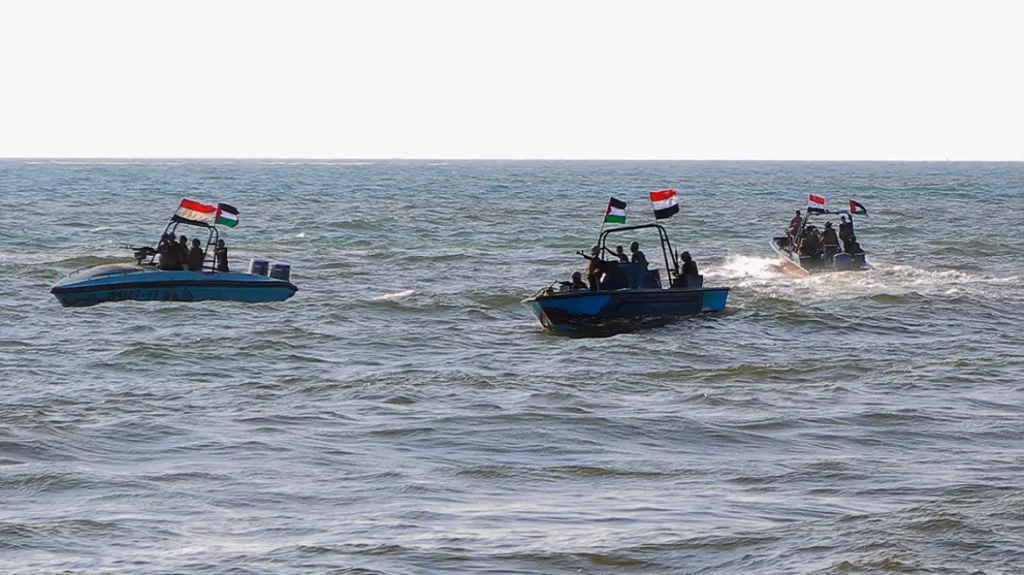
Yemen’s Houthis are reportedly operating a special mechanism for controlling commercial shipping in the Red Sea, using a procedure that resembles an administrative licensing service: ship captains send emails to the rebels requesting confirmation that they can safely pass through the area.
According to information analysed by the Wall Street Journal, the Houthis have managed to exercise effective control over a significant portion of shipping in the Red Sea, making use of a system of applications and responses that operates alongside the threats and restrictions they have imposed on maritime transport.
The procedure is straightforward: Shipping companies or ship captains contact an organisation established by the Houthis via email and request assurances that their vessels can pass safely.
The centre established by the rebels for shipping companies
In early 2024, the Houthis established an administrative body called the “Humanitarian Operations Coordination Center” (HOCC).
This organisation undertakes to manage applications from shipping companies and communicate the restrictions and sanctions imposed by the rebels on maritime transport.
Officially, vessels that have no links to the United States, the United Kingdom or Israel can pass through the area without first contacting the HOCC.
However, when the Houthis announced a naval blockade of Saudi Arabia in July 2026, some shipping companies began seeking assurances from this organisation before resuming their passages through the Red Sea. This emerges from accounts by seafarers, analyses by shipping experts, and email correspondence examined by the Wall Street Journal.
“We have no connection whatsoever with Israel, the US or Britain”
An illustrative example of the procedure is a request sent to the Houthis on 16 August, which the WSJ has published in abbreviated form.
In the message, the captain states that his vessel has no connection whatsoever with Israel, the United States or the United Kingdom and requests approval for safe passage.
“Dear Sirs,
I am the captain of the vessel. We hereby formally declare that the vessel has no connection whatsoever with Israel, the United Kingdom or the United States of America. The vessel’s owner, the management company and the operating company are Chinese enterprises. All crew members are Chinese and have no connection whatsoever with Israel, the United Kingdom or the US.
We hereby submit a request for safe passage through the Bab el-Mandeb Strait. We understand and will comply with the ‘Ban on Maritime Traffic To and From Saudi Arabian Ports’, issued by the Armed Forces of Yemen on 20 July 2026. The vessel will comply with the International Regulations for Preventing Collisions at Sea (COLREGs) and will navigate safely in these waters. Please confirm that we may pass through safely.”
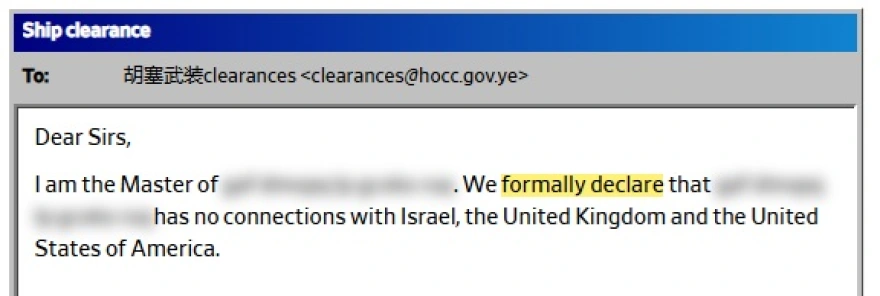
This particular wording indicates that captains do not merely provide information about their vessels, but also undertake to comply with the restrictions imposed by the Houthis.
The Houthis usually respond within 24 hours
According to crew members and email messages examined by the Wall Street Journal, when the Houthis choose to respond to a request, they usually do so within 24 hours.
A characteristic example was recorded in September, when the rebels approved the passage of the Chinese container ship Zhong Cheng Chang Ling.
The ship’s captain stated that its management company had asked him to contact the Houthis as an additional precautionary security measure.
In its response, the HOCC stated:
“We hope you are well. We are pleased that you have understood the criteria concerning which categories of vessels fall under the prohibition. The vessel may safely transit the Red Sea, the Bab el-Mandeb Strait, the Gulf of Aden and the Arabian Sea.”
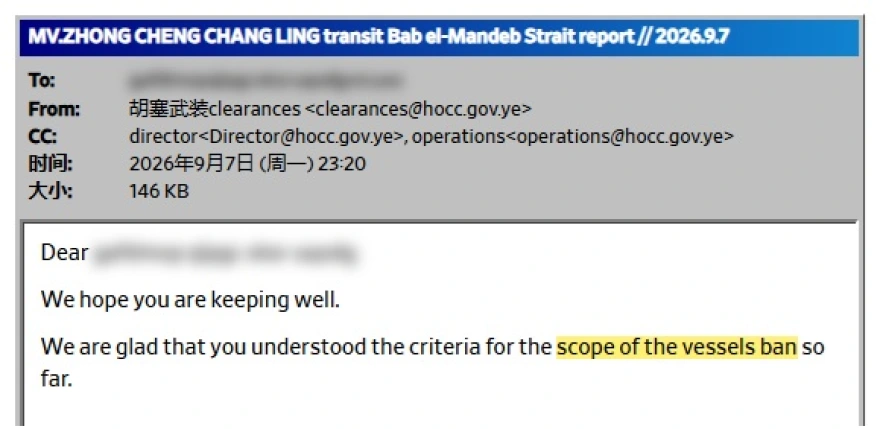

The message then included specific instructions for the crew:
– The Automatic Identification System (AIS) and VHF radio channel 16 must remain continuously operational throughout the passage.
– The vessel must follow the international shipping route.
– Passage near vessels that have switched off their AIS systems, as well as near military vessels, must be avoided.
– Any suspicious activity observed in the vicinity of the vessel must be reported.
The message also contained an additional note: “If there are any changes to the voyage of a vessel that has received transit approval, please inform us.”
The HOCC also provided a telephone contact line and invited recipients to subscribe to an email notification service in order to receive updates on the latest developments.
The Chinese vessel that followed the instructions
The case of the Zhong Cheng Chang Ling demonstrated how the system works in practice.
On the evening of 8 September, one day after the Houthis’ response, the Chinese vessel changed its declared destination in the tracking system.
Instead of Port Klang in Malaysia, one of the most important container shipping hubs in the Strait of Malacca, it displayed the designation “armed guard on board”.
This practice is frequently used by vessels as a means of deterring Houthi attacks, as well as attempts by pirates to board them.
The Zhong Cheng Chang Ling continued its journey through the Red Sea and the Bab el-Mandeb Strait.
On 11 September, it entered the Indian Ocean and restored Port Klang as its declared destination, according to vessel-tracking data. Throughout the entire voyage, the Chinese vessel kept its AIS system active, following the relevant instruction issued by the Houthis.
International maritime authorities warn against making contact
Despite the existence of this mechanism, many vessels choose not to request approval or assurances from the Houthis.
The United States has imposed sanctions on the organisation, which it has designated as a foreign terrorist organisation.
At the same time, official guidance from international maritime authorities states that vessels should neither communicate with the HOCC nor register with its system.
The procedure established by the Houthis does not constitute an internationally recognised maritime navigation licensing system, but rather a mechanism through which the rebels are attempting to enforce their own restrictions on vessel traffic.
Ask me anything
Explore related questions




