





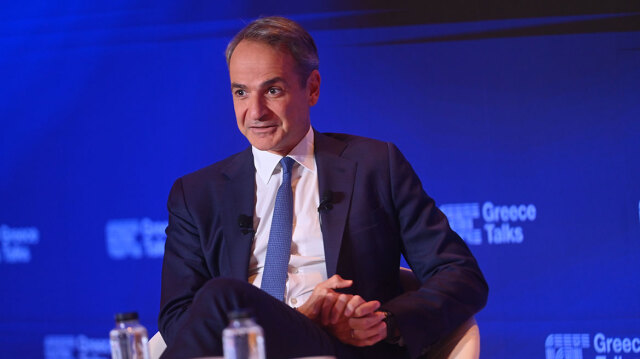
Prime Minister Kyriakos Mitsotakis outlined his vision for Greece’s future, defended his government’s record and addressed major domestic and international challenges during his appearance at the Greece Talks 2026 conference on Tuesday, 10 November, at the Hotel Grande Bretagne in Athens.
Speaking with journalist Antonis Sroiter during a discussion entitled “Greece as It Is”, Mitsotakis addressed issues ranging from the Greece-Cyprus electricity interconnector and relations with Turkey to the next general election, a possible third term in office, the cost of living, corruption, artificial intelligence and Greece’s strategic partnership with the United States.
The annual conference, organised by Proto Thema and Travel.gr under the theme “NOSTALGIA: Memory, Connection & the Traveler”, brings together prominent figures from politics, business, tourism and culture to examine Greece’s identity, its heritage and the forces shaping its future. ProtoThema English+1
Throughout the discussion, the prime minister defended his government’s achievements while acknowledging mistakes, particularly over the agricultural payments agency OPEKEPE. He also ruled out cooperation with former prime minister Alexis Tsipras, reiterated his preference for a single-party government and explained why he believes a third four-year term would be crucial for Greece.
Greece-Cyprus electricity cable: No permission sought from Turkey
One of the most significant parts of the discussion concerned the Greece-Cyprus electricity interconnector, a major European infrastructure project that has generated tensions with Turkey.
Mitsotakis made clear that neither Greece nor Cyprus had requested Turkish permission for the research and installation work associated with the project.
“What Turkey says publicly is not particularly important. What matters is the reality, who granted permission and from whom it was requested. Permission was requested from the Greek and Cypriot authorities, not from Turkey or any other coastal state,” he said.
The prime minister emphasised that the electricity interconnector had been planned for many years and was of exceptional importance in ending Cyprus’s energy isolation.
He described the project as European rather than exclusively Greek, highlighting the involvement of French investment capital and a French company responsible for supplying the infrastructure.
“It is clear that permission for this vessel to sail has been granted only by Greece and Cyprus,” he said.
Mitsotakis also addressed the diplomatic notification sent by the French side to third countries, including Turkey and Egypt, insisting that providing information about the project should not be confused with requesting authorisation. “It would be a mistake for some to confuse a general notification about the project to third countries, such as Turkey and Egypt, with authorisation, which falls exclusively within the competence of the Greek authorities,” he said.
According to the prime minister, the French diplomatic note creates no legal complications, establishes no precedent and cannot be interpreted as a request for permission.
He expressed confidence that the project would be completed without significant disruption.
Turkey, the Blue Homeland doctrine and the possibility of extending territorial waters
Turning to broader Greek-Turkish relations, Mitsotakis said he did not expect tensions to escalate over the electricity interconnector but stressed that Greece remained prepared for every eventuality. “I do not believe there will be an escalation of tensions over this issue, but I want to remind everyone that we have handled difficult situations in the past. Remember the summer of 2020,” he said.
He explained that strengthening Greece’s Armed Forces was essential to safeguarding national sovereignty, adding that the country’s military capabilities were stronger than ever.
The prime minister also criticised opposition parties over their handling of sensitive foreign policy issues, questioning why some appeared more willing to accept Turkey’s arguments than those of the Greek government.
He said the foreign minister regularly briefed political parties during confidential parliamentary sessions, while expressing frustration over what he described as distorted leaks from those meetings.
Mitsotakis pointed to previous government decisions, including the extension of territorial waters in the Ionian Sea, the establishment of marine parks and maritime spatial planning, as examples of policies pursued despite earlier doubts.
Addressing Turkey’s proposed legislation relating to its Blue Homeland doctrine, he warned that such a move would further strain bilateral relations. “It would be a mistake for Turkey to proceed. It would place a major additional burden on Greek-Turkish relations at a time when the entire world is in turmoil. And if it happens, there will be a forceful response from Greece,” he said.
He did not rule out a unilateral Greek decision to extend territorial waters to 12 nautical miles.
Nevertheless, Mitsotakis stressed that Athens remained committed to maintaining open communication channels with Ankara. “We are condemned to be neighbours with Turkey. That will never change,” he said, adding that Greece could maintain dialogue without making concessions on fundamental national interests.
He also highlighted Greece’s ambition to strengthen its position as a regional hub connecting Europe with the Middle East.
Next general election: Not on Easter Sunday
Mitsotakis also addressed the timing of Greece’s next general election, ruling out Easter Sunday, 2 May 2027, as a possible polling date.
Speaking humorously to Sroiter, he suggested that nobody needed to cancel their Easter holiday plans because of the election.
The prime minister otherwise avoided committing to a specific election date, stressing that his government still had several months of work ahead.
He argued that the government’s immediate responsibility was to continue implementing its programme and to explain its plans for the country’s future. “We have several months until the elections. Our job is to talk about the future, our plan for Greece and to continue our government work, because we have projects to deliver over the coming months,” he said.
Referring to opinion polls, Mitsotakis maintained that the combined support of the second- and third-largest parties remained below New Democracy’s share.
He also recalled that polling ahead of the 2019 and 2023 elections had failed to anticipate New Democracy’s eventual results.
Why Mitsotakis wants a third four-year term
Asked why he wanted to remain prime minister for another four years, Mitsotakis initially responded with humour. “Have you been talking to my wife?” he asked Sroiter, prompting laughter from the audience.
He then explained that his desire for a third term was directly linked to the challenges Greece would face over the coming years. “The main reason I would like, provided the citizens place their trust in me, to serve a third four-year term is that we are living in extraordinary times,” he said.
The prime minister argued that his experience in office would be particularly valuable during a period of technological disruption and geopolitical instability. “I firmly believe that a great deal will be decided over the next four years. Artificial intelligence, geopolitical realignments, migration, the climate crisis, all these things are creating a world in constant turmoil,” he said.
He presented 2030 as a defining milestone for the country’s future. “By 2030, it will be decided whether Greece will be, to put it very simply, among the winners or the losers,” he said.
Coalition governments: PASOK the only possible partner, Tsipras categorically excluded
Mitsotakis reiterated his support for single-party governments, arguing that they can govern more effectively without becoming entangled in negotiations between coalition partners.
He suggested that coalition governments elsewhere in Europe appeared to have become bogged down in political deadlock, whereas his administration continued to pursue its agenda. “The only party seeking an outright majority today is New Democracy,” he said.
Nevertheless, he acknowledged that the election result would determine whether coalition negotiations became necessary. “If there is no outright majority, the first party has an obligation to explore whether there is any scope for cooperation,” he explained.
He ruled out cooperation with smaller parties to New Democracy’s right, identifying PASOK as the only party with which a coalition could potentially be considered. “The only party we could cooperate with is PASOK,” he said.
However, he acknowledged substantial political differences between the two parties and questioned PASOK’s willingness to enter government with New Democracy.
He pointed out that PASOK had held a party conference at which it rejected cooperation with New Democracy, while making no equivalent declaration concerning Tsipras or SYRIZA.
Mitsotakis suggested that these circumstances reinforced his argument that a New Democracy parliamentary majority offered a realistic route to forming the next government.
He was considerably more categorical when asked about cooperation with Tsipras. “How could we cooperate with Mr Tsipras? I categorically rule it out,” he said.
“As far as I understand, he wants to put all of us in prison. I would remind you that he was saying the same thing in 2023.”
The prime minister accused Tsipras of returning to confrontational politics after what he described as an unsuccessful attempt to rebrand his political image. “Since the rebranding failed spectacularly, he is doing what he knows best: polarising and inflaming tensions,” Mitsotakis said.
He suggested that political tactics employed 15 years earlier now appeared outdated.
Mitsotakis says he will not engage in another confrontation with Tsipras
Despite his criticism of the former prime minister, Mitsotakis insisted that he did not intend to engage in a prolonged personal confrontation with him.
Asked about Alexis Tsipras, the criminal codes and comments made by Health Minister Adonis Georgiadis, he said political disagreements should be resolved through elections and competing policy proposals rather than personal attacks.
“I will try to ensure that our party does not concern itself with Mr Tsipras and that we instead have a debate about positions and solutions for the country’s future,” he said. “Personally, I will not enter into a confrontation. I did not do so in 2019, I did not do so in 2023, and I will not do so now.”
He acknowledged that New Democracy included numerous senior figures who expressed their own views, adding that the party sought consistency in its political messaging.
However, he argued that voters had little interest in another personal dispute between the two politicians. “The last thing citizens are interested in is a cockfight between Mitsotakis and Tsipras,” he said. “If he wants to do that, it is his choice. He has tried it twice, he has been tested twice, and it did not work. When you make the same mistake, why do you expect a different result?”
Economy: 600,000 jobs created and investment records
On the economy, Mitsotakis highlighted employment growth and investment as two major achievements of his government. “Greece has created 600,000 jobs and is going from record to record in investment,” he said.
He also acknowledged the pressure households faced from rising living costs, particularly energy prices.
The prime minister stressed that the government could not meet every demand but was seeking to distribute available resources fairly. “We are not magicians. We cannot cover every need, and we are trying to save every euro so that we can distribute it fairly across society,” he said.
He added that such decisions required difficult political choices.
Mitsotakis announced that applications for the heating allowance would open on Tuesday, presenting the measure as part of the government’s response to household energy costs.
He also said that legislation implementing measures announced at the Thessaloniki International Fair would be introduced during the week, with the measures scheduled to take effect at the beginning of 2027.
Asked about the possibility of reducing VAT, the prime minister avoided making a specific commitment, instead urging greater attention to the tax and support measures already announced. “Let us highlight the important interventions we are legislating this week, which will come into effect at the beginning of the year,” he said.
VAT on menstrual products and measures announced in Thessaloniki
Mitsotakis separately addressed the taxation of menstrual products, describing the existing situation as an injustice that needed to be corrected.
He confirmed that the relevant measures announced at the Thessaloniki International Fair would be voted on during the week.
The prime minister also said that the government’s proposals would provide an opportunity to assess the opposition’s position on measures designed to support households.
He argued that monitoring the market following the implementation of the relevant tax changes would be relatively straightforward because only a limited number of companies operated in the sector.
Corruption, organised crime and the rule of law
The prime minister defended his government’s record in tackling corruption and criminal activity, arguing that important reforms introduced after the 2023 election were beginning to produce measurable results. “The government decided to deal seriously with this issue,” Mitsotakis said when asked about corruption cases.
He argued that enforcing the law equally for everyone should be taken for granted, although he acknowledged that this had not always been the case in Greece.
Mitsotakis said he had placed particular emphasis on the principle of equal application of the law after the 2023 election.
He cited measures against university violence, football-related disorder and organised crime as examples of the government’s approach. “We created the FBI two years ago. The government decided to restore order,” he said, referring to Greece’s specialised organised crime enforcement structure.
The prime minister also highlighted the campaign against tax evasion, which he said had intensified since 2023.
According to Mitsotakis, those efforts had generated an additional €9 billion in revenue over the four-year period.
He argued that the increased revenue demonstrated that the crackdown had practical financial benefits, enabling the government to fund measures supporting vulnerable households.
Artificial intelligence to dominate the next election agenda
Mitsotakis identified artificial intelligence as one of the most important issues that would shape the next election campaign and Greece’s future development. “For us, the agenda of the next elections will be the artificial intelligence revolution,” he said.
The prime minister described the digitalisation of government services as an important tool for reducing corruption and improving efficiency.
He argued that artificial intelligence could dramatically improve public administration, particularly in areas where lengthy procedures created opportunities for inefficiency and a lack of transparency. “Artificial intelligence and public procurement can change a great deal in terms of the transparency of a process that currently still takes quite a long time,” he explained.
Mitsotakis said his government had already achieved several objectives by exploiting new technologies but stressed that the transformation of the public sector was still at an early stage.
He linked the expansion of artificial intelligence to the broader technological changes that Greece would need to navigate over the next four years.
Relations with the United States and Kimberly Guilfoyle’s resignation
On foreign policy, Mitsotakis emphasised the durability of Greece’s strategic relationship with the United States, arguing that bilateral cooperation rested on strong foundations across both major American political parties. “Greece has strategic relations with the United States, which have strong bases and strong foundations in both parties,” he said.
The prime minister recalled working with Donald Trump during his first presidency, with Joe Biden during his administration and subsequently with Trump again.
He also referred to his address to the US Congress, noting that he had been invited with support from both political sides.
Mitsotakis welcomed the election of six Greek Americans to Congress, making particular reference to Chris Pappas.
Asked about the resignation of US Ambassador Kimberly Guilfoyle, he said that although the development was not positive, Greece would work with whoever the American president selected as her replacement. “We do not choose who comes to Greece. We will cooperate with whoever the American president chooses,” he said.
He sought to distinguish the strength of the bilateral relationship from changes in diplomatic appointments, stressing that the Greek-American partnership extended beyond individual personalities.
Government achievements: Stronger Armed Forces and restored international standing
Asked to identify the most significant achievements of his administration, Mitsotakis placed particular emphasis on national security and the strengthening of the Armed Forces.
“We have moved to another level. It is an investment that will remain as a legacy for many years,” he said.
He argued that defence spending and military modernisation had significantly improved Greece’s ability to protect its sovereignty and national interests.
The prime minister also highlighted what he described as the restoration of Greece’s international standing.
“I made the country one that is respected abroad again. They no longer look at us with suspicion,” he said.
Mitsotakis presented these developments as important elements of his government’s wider effort to strengthen the country’s economic, diplomatic and strategic position.
OPEKEPE scandal: Mitsotakis acknowledges personal responsibility
When asked about the biggest mistake of his second term, Mitsotakis singled out the controversy surrounding OPEKEPE, Greece’s agricultural payments agency.
He acknowledged that his government had failed to intervene early enough in a system whose structural weaknesses had become apparent.
The prime minister also accepted a share of personal responsibility. “I, too, failed to intervene in a system that was clearly incapable of functioning properly from within,” he admitted.
His comments marked an acknowledgement of the government’s shortcomings in addressing the agency’s problems, despite the broader anti-corruption initiatives he had defended earlier in the discussion.
Greece’s changing tourism landscape and the pull of Zagori
Reflecting the conference’s focus on nostalgia, travel and the country’s identity, Mitsotakis also spoke about his personal connection to Greece’s landscapes and the importance of discovering lesser-known destinations. “I constantly discover new destinations, some of which were completely unknown to me,” he said.
The prime minister suggested that Greeks themselves had not yet fully explored their own country.
He recalled visiting the Zagori villages in Epirus when he was 14 years old during an excursion organised by the YMCA of Thessaloniki.
That childhood experience, he explained, left a lasting impression. “That was when I discovered this beautiful part of Greece. Those experiences remained very deep inside me,” he said. “And sometimes, when I am not thinking about Crete, I find myself wanting to return to Zagori, precisely because I have that memory from such a young age.”
Asked whether he had ever gone camping, Mitsotakis confirmed that he had, although not recently.
Political legacy: ‘I took Greece at one level and raised it to another’
Towards the end of the discussion, Mitsotakis was invited to assess his time in government and reflect on what he believed he had achieved. “I believe I took Greece at one level and raised it to another,” he said.
The prime minister also addressed the question of his political future, making clear that the end of his premiership would also mark the conclusion of his political career.
He reiterated that political leaders remained accountable to their parties and their voters.
Referring to a hypothetical electoral result below 25% for New Democracy, Mitsotakis acknowledged that such an outcome would be poor and said he would accept responsibility.
His remarks reflected his view that the future of his leadership would ultimately be determined by electoral performance and the confidence of the electorate.
What Mitsotakis misses about ordinary life: ‘A normal morning’
The conversation concluded on a more personal note, with Mitsotakis asked what he missed most about life before becoming prime minister. “A normal morning,” he replied.
He then recalled a remark attributed to former US President Barack Obama, who had joked that after leaving office he wanted to move to Hawaii and open a shop selling only plain white T-shirts in size large.
The idea, Mitsotakis explained, was that Obama would no longer have to make any decisions, even about something as simple as choosing what products to sell.
For Mitsotakis, the anecdote illustrated one of the less visible demands of political leadership: the constant responsibility of making decisions, even as he expressed his wish to remain in office for another four years.
Ask me anything
Explore related questions




